More permits, changes for the self-employed and a tax on banks: everything that the council of ministers has approved that affects your pocket
The Spanish government approves a new package of economic measures in the final stretch of the electoral campaign
-
CAT -
CAST
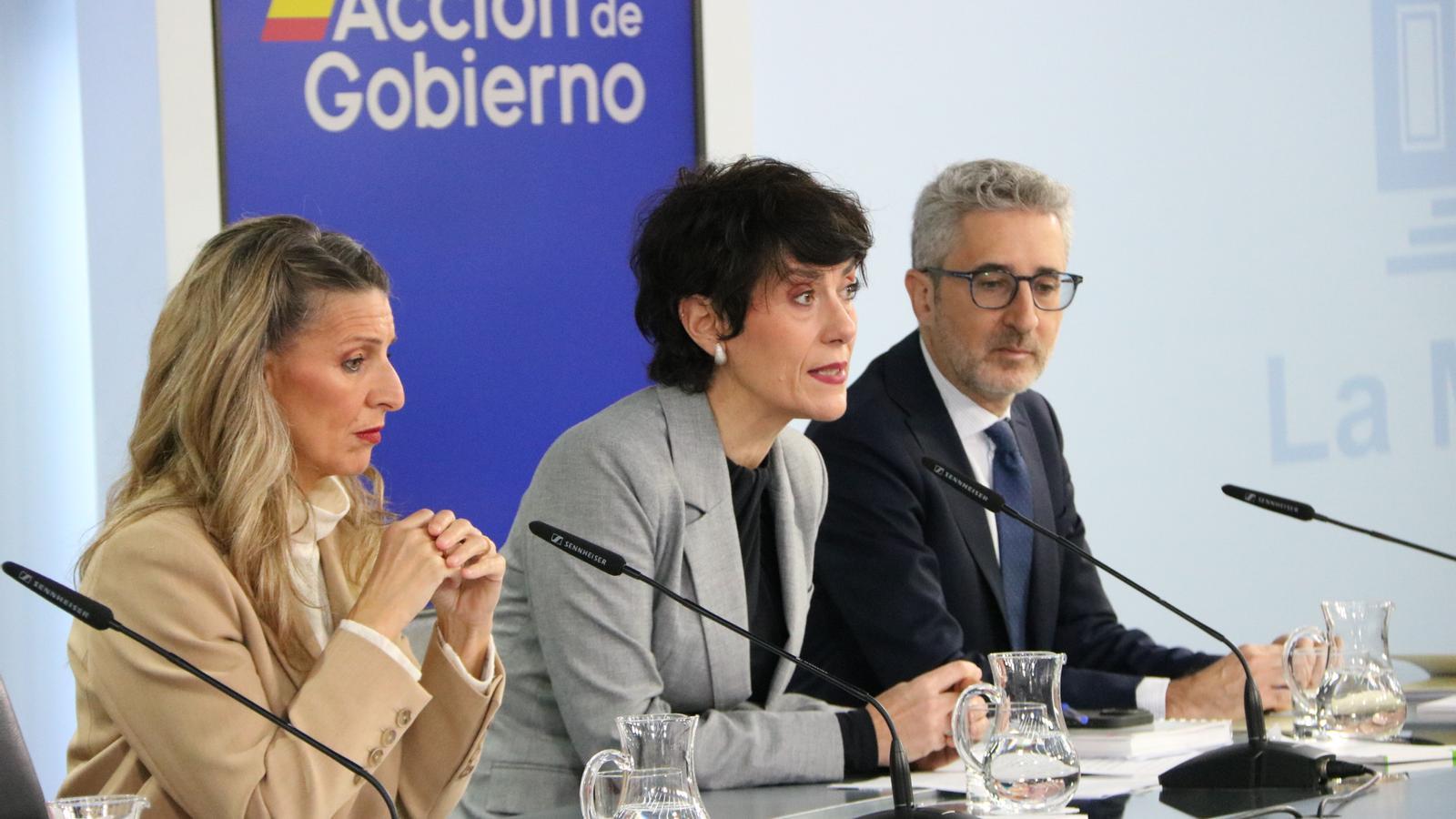
Barcelona / MadridOn the eve of the November 29 elections, the Spanish government has approved a new package of economic and labor measures, after the Ministry of Labor pushed forward last week the minimum wage increase and the major royal decree-law to strengthen wage transparency in companies, among others. The new initiatives will come into force once they are published in the Official State Gazette (BOE), and afterwards, once the elections have passed, they will need to be ratified by the permanent deputation.
Extension of birth leave
One of the main measures approved by the Council of Ministers is the extension of birth and childcare leave to 20 weeks for each parent. In this way, the leave, which is non-transferable and “100% paid”, will be extended by one more week; until now it was 19 weeks. These extra days of leave, as explained by the Ministry of Labor and Social Economy, can be enjoyed in an accumulated or uninterrupted manner until the child turns eight years old. In the case of single-parent families, birth and childcare leave is extended to 34 weeks, two weeks more than at present.
Birth leave has been updated repeatedly over the last decade: until 2016, Social Security only covered 13 working days for fathers, extendable to 15, although mothers were entitled to 16 weeks. Since then, however, the leave time for fathers has been continuously increasing: it first went to four weeks in 2017 and, one year later, to five. In addition, in 2019 it was approved to progressively equalize the leave of both parents in three phases: the leave for fathers went up that same year to 8 weeks, in 2020 it was extended to 12 and, finally, in 2021 it became comparable to that of mothers, which at that time was 16 weeks. “Raising a child is a two-person job,” asserted the second vice president and Minister of Labor, Yolanda Díaz, in a press conference, and added that “equality is also built with weeks”.
Ten days for bereavement
Another of the permits that is being extended is the bereavement leave. The Spanish government has updated to ten days the leave that a worker will be able to have in the event of the death of a close relative. This ten-day period will apply to spouses, domestic partners, or first-degree relatives by blood. Furthermore, the executive also extends from two to three working days the bereavement leave in the event of the death of a first-degree relative by marriage and second-degree relative by blood or marriage. In cases involving travel, the possibility of adding two additional days is included, up to a total of five days.
As the Ministry of Labour explains, the extension of this permit "will allow accompanying workers during a complex emotional process that requires recovery time." "It will also benefit companies, which will see their activity protected by avoiding an almost immediate return of staff affected by a loss," it adds. Additionally, Yolanda Díaz has remarked that the regulation will incorporate the specification that these are working days, as it was not specified until now.
New rights and permits
The news regarding leave does not end here: the Spanish government also incorporates the possibility of taking a day off to accompany a person to receive euthanasia. This will not take into account whether or not there is a degree of kinship, since it can only be taken by workers who have been designated by the person who is to undergo the process. Furthermore, from now on, the right of workers to request adaptations to the duration and distribution of their working hours will also be recognized when a spouse, domestic partner, or blood relatives up to the second degree require palliative care.
It is worth remembering that Yolanda Díaz's ministry negotiated the changes to bereavement leave and the new ones for palliative care and euthanasia with social agents a year ago, but the employers' association rejected them, considering that it shifted the cost of care onto companies, and they were never finalized.
Measures for the self-employed
The Council of Ministers has also approved an important package of measures for self-employed workers. It consists of two packages of measures: a tax cut, which according to the Minister of Finance, Arcadi España, will mean savings of 465 million euros for these workers; while the other package has to do with the elimination of bureaucratic tasks.
- The personal income tax (IRPF) deduction for provisions and expenses that are difficult to justify is increased from 5% to 10%, and the current limit for the bonus is extended from 2,000 to 3,000 euros.
- In the case of self-employed individuals who are taxed under the module system, the reduction of the net yield for the current year is increased from 5% to 10%. For agricultural activities, this reduction reaches 15%.
- In the area of VAT, a special annual declaration regime is created for professionals and small entrepreneurs who have a turnover of less than 85,000 euros per year. This means that, instead of filing quarterly VAT self-assessments, it will be done only once a year. At the same time, the Tax Agency will inform the self-employed person that they must make three installment payments in April, July, and October, so it will calculate how much each worker must pay based on the income from the previous year. At the end of the year, if the self-employed person has overpaid, the difference will be refunded, and if they have underpaid, the opposite will occur. In any case, it is a new voluntary regime.
- The Council of Ministers has also reformed the personal income tax (IRPF) advance payments made by self-employed workers each quarter. Until now, 20% was applied to the profit, which is now reduced to 19% for those who invoice less than 250,000 euros. In the annual income tax return, a global calculation is made and the difference is paid. In the case of self-employed workers who invoice less than 85,000 euros, if the last income tax return resulted in a payment, they will not have to make the quarterly advance payments. Alternatively, they can also choose for the Tax Agency to calculate a fixed amount based on the 2025 profits and have it automatically debited from their bank account.
- The latest measure is a new postponement of the digital billing system. The so-called Verifactu will not come into force until October 2028 to make it coincide with the mandatory electronic invoice.
Limits on the cost of consumer credit
Pedro Sánchez's executive has also been activated to protect household debt. The Council of Ministers has approved a royal decree-law that establishes a general limit on the cost of consumer credit of 22% APR. In addition, different conditions are established for those high-value loans. At the press conference following the executive's meeting, the Spanish government spokesperson, Elma Saiz, said that this regulation acts on the contracting of loans and introduces limits on the cost of consumer credit. It also regulates the sale of debt to third parties so that this practice does not reduce the rights of those who have to repay the loan.
Thus, the royal decree-law approved this Tuesday incorporates several European directives into the Spanish legal system: the consumer credit directive, the distance marketing of financial services directive, and the credit buyers and servicers directive. In addition, measures to combat money laundering are also introduced.
Extension of the bank tax
During this Tuesday's council of ministers, the extension of the tax on banks until the 2027 fiscal year was also approved. The levy originated in 2022, when the interest rate hikes to curb prices due to the war in Ukraine resulted in historic profits for the banking sector. Two years later, at the end of 2024, it was reformed and extended until 2026. Now, the Spanish government has decided to extend it for one more year, with the intention of raising 1.4 billion that are intended to be dedicated to housing policies.
The Minister of Finance, Arcadi España, has highlighted that this is not a tax “against” the banks, but rather a tax figure to advance fiscal justice. However, España recalled that the tax has not prevented bank profits from setting new records in recent years: “The main Spanish financial institutions earned almost 30 billion euros up to September of this year,” the head of the Treasury recalled.
