European leaders blame Sánchez for the regularization of immigrants: "It has a pull effect in Europe"
The socialist leader defends Spain's immigration policies and attacks Meloni's deportation centers
-
CAT -
CAST
BrusselsPedro Sánchez is increasingly alone in the European Union with the migratory challenge. A few days after the entry into force of the migration reform and the agreement to create centers outside the Community territory for deporting immigrants, several European leaders have reproached the Spanish Prime Minister for his stance on migration and the massive regularization of newcomers at the European Council meeting this Friday in Brussels, according to various diplomatic sources.
In a context where the EU is toughening policies against the entry of immigrants, the socialist leader has spoken behind closed doors against the creation of migrant centers like those Italy wants to establish in Albania. He has also opposed the request of several leaders to maintain a strategic dialogue on migration at other EU heads of state and government meetings, which has angered at least five leaders: Italy's Giorgia Meloni, Germany's Friedrich Merz, Belgium's Bart De Wever, Denmark's Mette Frederiksen, and Hungary's Péter Magyar.
Diplomatic sources describe the discussion as "tense," but within the usual parameters of exchanges between "real leaders" with "character" who defend "their position and their country," especially on such a delicate dossier as migration. They also explain that, as he has already expressed in public, Sánchez has said that he does not consider the outsourcing and creation of deportation centers outside the European Union to be an "effective" measure.
An intervention that has not pleased at least five of his counterparts who were in the room. They have not only reproached him for opposing a strategic dialogue on migration at other meetings of heads of state and government, but have also taken the opportunity to criticize Sánchez's general stance on migration and have accused him of causing "a pull effect in Europe." "Your decisions also affect our countries," say diplomatic sources who reminded Sánchez. Furthermore, these five leaders have criticized that, the moment an immigrant manages to enter or regularize their situation in a member state, they can then move throughout the European Union, including to the countries they lead, which they want to avoid.

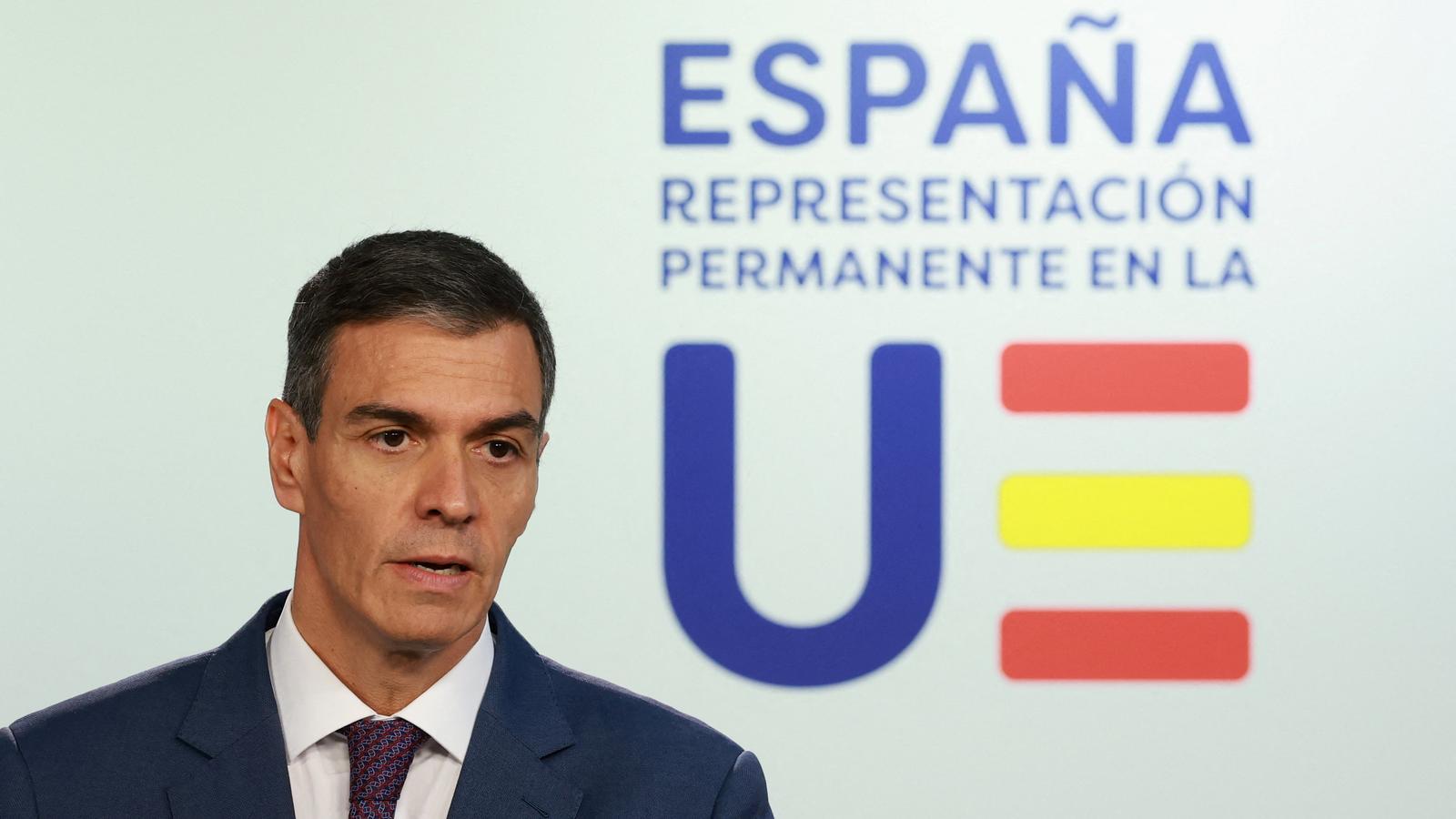
Before the media, Sánchez has defended the same thing that diplomatic sources report he has stated behind closed doors. He has sent a "message of collaboration and empathy" to people arriving irregularly in the EU and has assured that "they are not a problem." Furthermore, he has explained that, for example, there are economic sectors that need the entry of newcomers, such as construction.
The socialist leader has also called for massive regularization and has defended that "people who live" in the State and "contribute to economic development deserve to have the same rights." Along the same lines, he has defended his government's immigration policies and told his counterparts that he is "delighted to talk and share Spain's experience." "And, if you have any doubts, talk to the Vatican," he added.
However, the Spanish Prime Minister has denied that it is an "episode" of tension between leaders, and has simply described it as a "necessary debate" that takes place in all European countries. "It is a debate that exists, and Spain has a clear and resounding discourse from the outset: this solution will not bring solutions. It is a deception, it is absolutely ineffective and it wastes economic resources," Sánchez pointed out at a press conference.
More pressure to speed up Meloni's deportation centers
Far from slowing down the hardening of migration policies, as Sánchez has tried, the vast majority of European leaders have increased pressure to accelerate the regulations that will speed up deportations and the creation of migrant centers outside the European Union. Up to nineteen member states, governed by different political colors, have issued a joint letter addressed to the President of the European Council, António Costa, and the President of the European Commission, Ursula von der Leyen, in which they ask to "advance as quickly as possible" the regulations inspired by the policies promoted by Meloni in Italy.
This statement – signed by Italy, Denmark, Greece, Austria, the Netherlands and, among others, Poland – also indirectly criticizes some measures that they consider favorable to the entry of immigrants, such as Sánchez's mass regularization, and advocates for "eliminating incentives for illegal migration" and for "repatriating those who do not have the legal right to stay in Europe". "Together we have redefined the European debate on migration and achieved broad consensus around the need for a European migration policy that is both firm and just," the letter says. However, against this majority consensus is not Sánchez, who has become the leader who most forcefully opposes the hardening of the EU's migration policies.
The EU raises its tone against China
Sánchez is also swimming against the tide regarding the EU's relationship with China and has been the leader who has most clearly opposed the change in direction between Brussels and Beijing. In fact, the trade deficit with China has concerned the leaders of the European bloc for some time, and for this reason, the consensus to combat it has never been so broad. The leaders have agreed to explore new trade strategies with the Asian giant, and have asked the European Commission to put on the table a legal tool to defend itself against Beijing, according to diplomatic sources.
However, European leaders do not want to start a trade war with China, nor, in any case, break off trade relations with it. They know it is a key partner. No member state is interested in Beijing turning off the tap of critical exports for European industry or applying tariffs to sectors that export to the Asian giant.
Be that as it may, the majority opinion among member states – led by France – has prevailed, which calls for new legal tools to protect themselves agilely and quickly against practices by China that the EU may consider "unfair," such as large public subsidies to certain sectors or massive price reductions. At the last minute, the industrial locomotive of the bloc, Germany, has also joined, which until before this week's summit was always in the group of countries that wanted to strengthen ties with China.
The growing trade deficit, however, has led more and more countries to want to toughen their rhetoric against Beijing. The clearest exception is Spain. "We need friends, balanced relations, we need to be pragmatic and build bridges with large economies and with potential allies like China," Sánchez assured at the doorstep of the leaders' meeting. Thus, sources from Moncloa defend that the tools that the European club currently has are already good enough and say that "there is no magic instrument" that allows solving a problem that affects so many sectors of the economy.
