Russia excludes once again the liberals

-
CAT -
CAST
In this Sunday's parliamentary elections in Russia, there will be no candidacies from the liberal Yabloko party, excluded by an unexpected Supreme Court ruling in the middle of August. History repeats itself: Yabloko has been erased from the Russian political scene just as the Kadet party, the historical liberals, was erased, who in 1917 tried to block the path to the Bolshevik coup d'état.
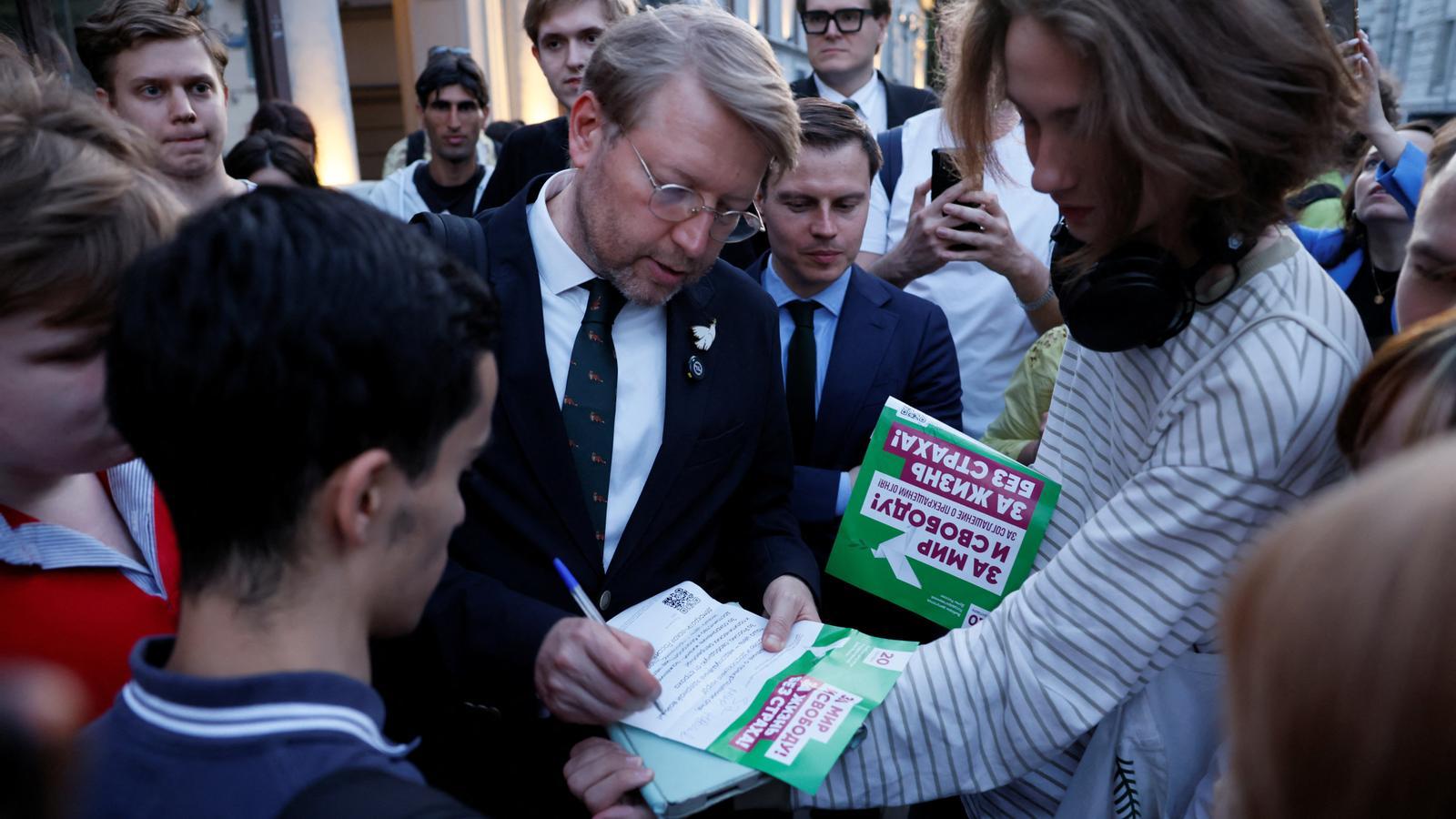
It seems that what has most unsettled the Kremlin are the estimates that attributed around 10% of the vote to Yabloko. A qualitative leap considering that in the last elections they barely exceeded 1%. The majority of potential new voters would be young people who are against the war, the most popular slogan of the liberals. The exclusion has provoked protests throughout the summer in front of the Supreme Court with shouts of “For peace and freedom! For a life without fear!”, as narrated by the ARA correspondent, Albert Sort. These young people protesting at the doors of the Supreme Court will be more willing than ever to join the anti-Putin calls endorsed by all dissent. Especially if Putin, once the expected electoral results are achieved next week, decrees general mandatory conscription. The exclusion of Yabloko has been accompanied by the harassment of its militants, and by the eleven-year prison sentence for Lev Shlosberg, one of its prominent leaders.
For now, Putin's agents have not bothered Grigory Yavlinsky, the founder and soul of Yabloko, although they keep him in their sights. At 74 years old, Yavlinsky and his liberal and pro-European ideas represent a threat. Especially because, looking back, while the Soviet Union was falling to pieces between 1990 and 1991, Grigory Yavlinsky was stubbornly fighting to convince both Mikhail Gorbachev and Boris Yeltsin that first of all, it was necessary to clean up the economy by reducing the deficit, designing the privatization of companies, and liberalizing prices—yes, but with strict controls. All this had to be done in “500 days,” the title of the program. Either that or the total bankruptcy of the state. Which is what happened: the USSR dissolved and Grigory Yavlinsky found himself acting as Deputy Prime Minister of a non-existent state. His replacement, Yegor Gaidar, already as Prime Minister of Russia, agreed with the IMF and the World Bank on the dismantling of the Soviet economy through a process of criminal auctions, at the end of which the Soviet administrative class had mutated into a property-owning capitalist class.
Russia has always shown a great fondness for defenestrating its liberals. In fact, Yavlinsky began to be considered a dangerous element – he explained it to me personally – when at 26 years old he presented his doctoral thesis and the Marxist-Leninist university tribunal was frightened by that boy who dared to defend free-market ideas. Liberal leader Boris Nemtsov – a former minister under Yeltsin – would have less luck, gunned down in front of the Kremlin in February 2015. Nemtsov was precisely preparing his participation in the Liberal International.
The Kadets, powerful during the constitutionalist revolution of 1905, were eliminated when the Constituent Assembly of 1917 was forcibly dissolved, which lasted only one day of sessions: Lenin had not been able to bear that his Bolshevik Communist Party had barely reached 25% of the votes. Liberalism would dilute in Russia for almost seven decades until Grigori Yavlinsky showed up with his 500 days, which would barely amount to 400. Figures filled with emptiness and bitterness.
