Russia punishes pacifists: 11 years in prison for one of the opposition leaders
Lev Xlosberg is vice-president of the Yabloko party, to which justice has ratified the veto in elections

-
CAT -
CAST
MoscowThe Kremlin intensifies its crusade against the pacifist opposition one month before the legislative elections. Specifically, it seeks to punish the only party opposed to the war in Ukraine that had initially been authorized to participate in the elections, Yabloko. The justice system has sentenced one of its vice-presidents, Lev Shlosberg, to 11 years and one month in prison for having defended the need for a ceasefire and criticized Vladimir Putin. Furthermore, the Supreme Court has rejected the party's appeal against the decision to ban them from the electoral process, after Yabloko's popularity soared in polls in recent weeks and an unprecedented wave of support among young people was generated.
Shlosberg, 63, has been found guilty of repeatedly "discrediting" the Russian army and spreading "falsifications" about it. In practice, he is held responsible for having participated in a public debate with historian Yuri Pivovarov in which he positioned himself in favor of stopping the conflict as soon as possible and negotiating a peace agreement. The paradox is that the phrases that the Prosecutor's Office deemed criminal were uttered by his interlocutor. He is also imposed this sentence for having shared a cover of the British newspaper Daily Mirror, in February 2022, which stated that Vladimir Putin had blood on his hands. A publication made before the law prohibiting this type of content rejecting the invasion was approved.
After receiving the sentence, Shlosberg addressed the judge and said: "I am sorry for you, your honor; you will have to live with this decision. May God forgive you." In his closing statement last Friday, the politician lamented the violation of his right to defense because the court refused to postpone the last session of the trial, even though his lawyers had been unable to attend. The opposition member complained that in Russia, someone who "demands the preservation of human life" is accused of discrediting the armed forces, and added: "For three decades, the Russian state and society have gone from the hope of freedom to the practically complete destruction of civil rights. Our country has once again embarked on the steep path of the 20th century, a tragic journey that led to the martyrdom of millions of people."
The Supreme Court closes the door on Yabloko
Meanwhile, the Supreme Court has given Yabloko no option to reverse its exclusion from the elections. One of the judges, known for having excluded Aleksei Navalny from the 2018 presidential race, has rejected all motions from the defense lawyers in the appeal hearing. The Central Election Commission, which had previously allowed the party's registration, and the Prosecutor's Office have also urged the court to confirm Yabloko's disqualification.
The pacifist party has announced that it will file a new appeal, in this case a complaint to the Presidium of the Supreme Court, a body responsible for reviewing sentences. The organization's defense denies that it has been financed from abroad, as claimed in the lawsuit by the far-right group Rodina and accepted by the court. Furthermore, Yabloko has sought to demonstrate that, following the criteria by which they have been deprived of the right to run in the elections, the five parties with representation in the Duma should also be excluded. The president of the liberal party, Nikolai Rybakov, has criticized the ruling. "Today there has not been a real judicial process, but a simulation of a judicial process. They have excluded us from the elections because we defend peace and freedom, but we have achieved the most important thing: that the whole world knows how many people in Russia want peace," he expressed upon leaving.
The police sought to prevent the repetition of the gathering of hundreds of young Yabloko supporters outside the courthouse. For this reason, since early morning, they have been dispersing sympathizers and have arrested at least 85 people, including several minors, lawyers, and journalists. Rybakov has called for an end to the intimidation of his followers, as judicial summonses have also been sent to the protesters who demonstrated on the day of the first hearing. Earlier, the liberal leader had been forced to ask that no one organize support events for Yabloko, fearing they would serve as a pretext for their imprisonment.
The organization reports that recently twelve of its members have been accused of criminal offenses, and of these, eight are behind bars. Less than two months ago, the justice system sentenced another of Yabloko's vice-presidents, Maksim Kruglov, for allegedly disseminating on Telegram a news report about the Russian massacre in the Ukrainian city of Bucha and another about the destruction of Mariupol during Moscow's offensive.
Kyiv and Moscow intensify attacks
Meanwhile, Russia and Ukraine continue the escalation of cross-attacks with drones, a cheap and lethal weapon that can overcome anti-aircraft defense systems and overwhelm them. Moscow claims to have neutralized 822 Ukrainian drones during the early hours of Sunday in various regions of the country, Crimea, and the waters of the Black Sea and Sea of Azov. The mayor of the Russian capital, Sergei Sobyanin, stated that about 600 drones were heading towards the capital. The offensive has caused at least six deaths, according to the Kremlin.
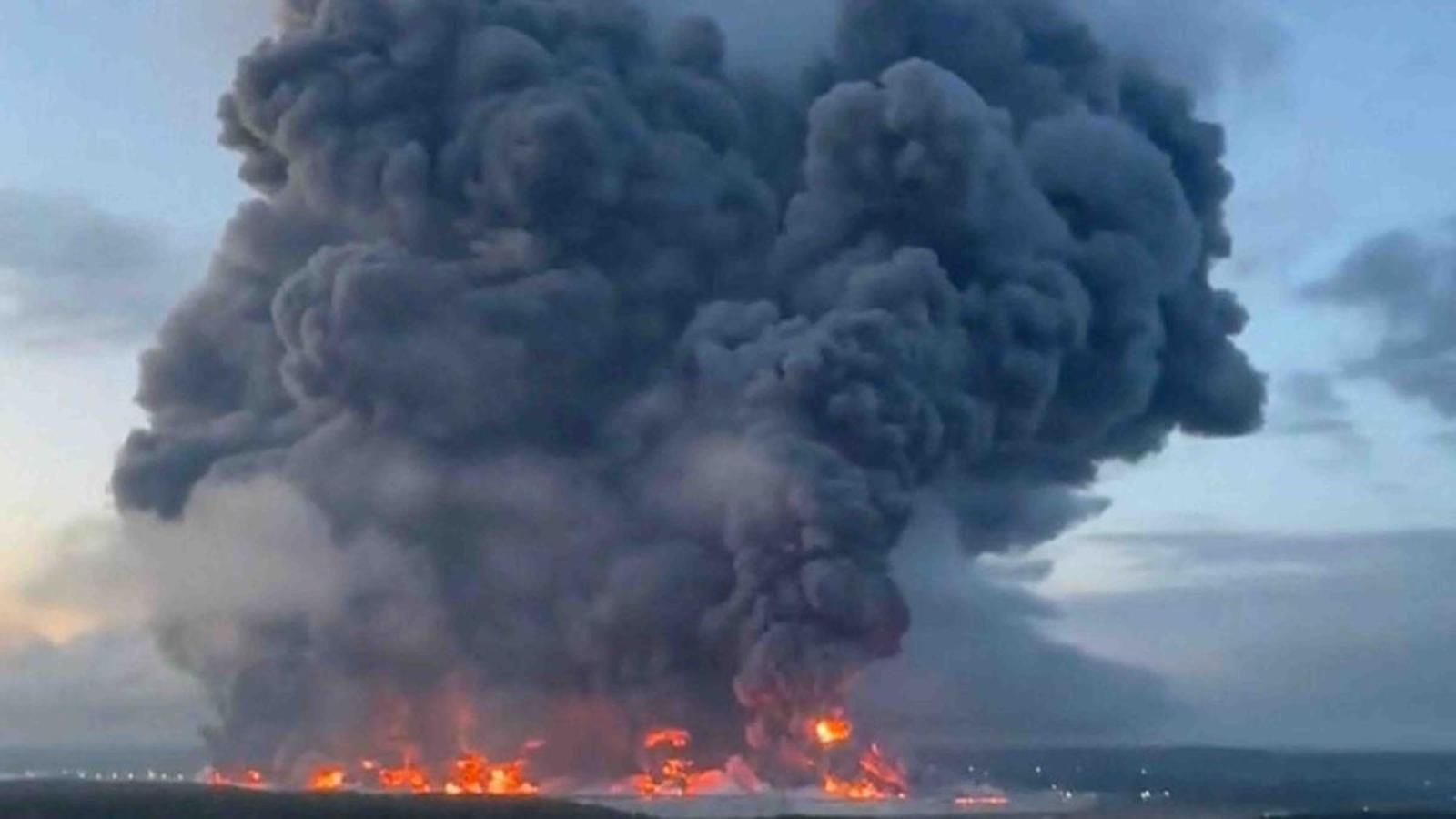
Five of the fatalities have been recorded in the Rostov region, bordering Ukraine. In Podolsk, south of the capital, an 83-year-old man died during the attack, according to the regional governor. The offensive also caused a fire in a large warehouse of Wildberries, Russia's leading e-commerce company, in Koledino, about 45 kilometers south of Moscow.
Russian authorities have also reported drone attacks against other infrastructure in the Moscow region. Several international media outlets have described the offensive as one of the largest drone attacks on Russian territory since the start of the war.
The attacks also come at a time of a stalemate in talks between Washington and Moscow. One year after the Alaska summit between Donald Trump and Vladimir Putin, the relationship between both presidents is once again at a dead end, while Trump's efforts to reach an agreement to end the war have not managed to curb the military escalation.

