Russia bans the only anti-war party and outrages young people and the opposition
The unprecedented support for the Yabloko party's polls forces the Kremlin to eliminate it from the September legislative elections

-
CAT -
CAST
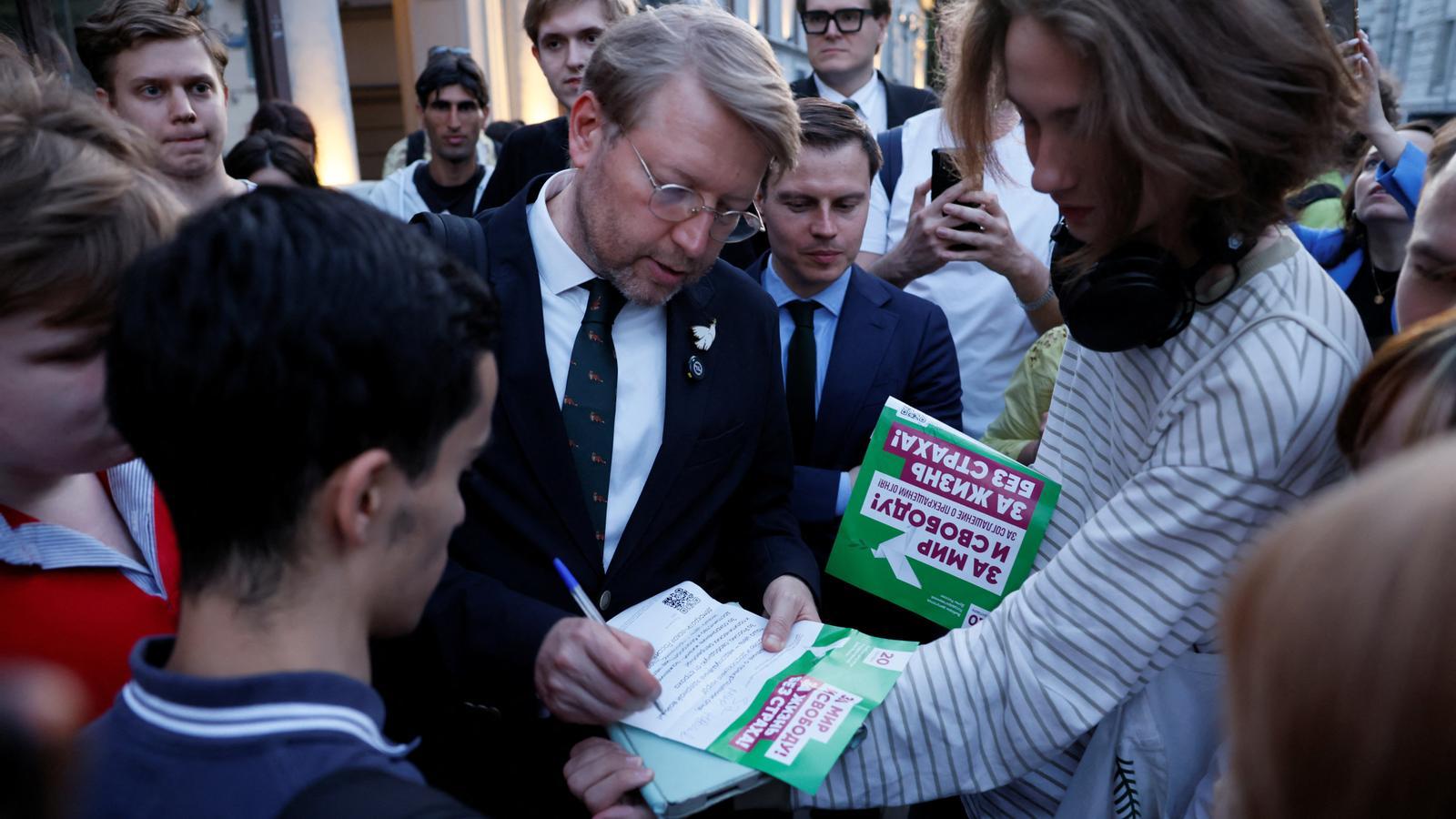
MoscowIn Russia, a country where elections are conceived as a bureaucratic formality intended to legitimize the regime, the exclusion of the only party opposed to the "Ukraine war of the upcoming legislative elections has shaken up the campaign. After the Electoral Commission unexpectedly registered Yabloko, a party with historically very low support, the opposition almost unanimously called for votes for them and their popularity soared on the internet, especially among young people.
Faced with this fact, the authorities have backtracked and, through a lawsuit filed by a far-right party, the justice system has left them out of the election date of September 20. The decision has outraged the hundreds of boys and girls who gathered at the doors of the Supreme Court on Monday, while a good part of the opposition claims that this reaction shows that Vladimir Putin has been scared.
The slogan "For peace and freedom! For a life without fear!" has seduced many of these young people who have come of age in the midst of war, fearing being recruited and ending up at the front, while also seeing their rights limited and the internet blocked day after day. Memes of all kinds with the not-so-subtle prominence of an apple (yabloko means apple in Russian) have gone viral in recent days, while commercial brands, some based in Russia, have also resorted to the symbol of the fruit in their advertisements.
Although Yabloko is a minor party (in the last legislative elections it barely surpassed 1% of the votes) and had often been accused of being purist and of excessive institutionalism by the rest of the opposition, the window opened this summer has catapulted them in the polls. This has been the last straw in the eyes of the authorities. According to various media outlets, the party had reached nearly 10% in voting intention and had options to enter the Duma.
This has put the Kremlin and the systemic opposition on guard, the parties that are part of the parliament, but that do not question either Putin's leadership or his war. The one tasked with doing the dirty work for them has been Aleksei Juravliov, the only deputy from the ultra-nationalist Rodina, who has denounced Yabloko to the justice system. The lawsuit, described by experts as "unsolid" and "poorly prepared," has been enough to achieve its purpose.
The Supreme Court has considered that the liberal party had received financing from abroad, although the defense lawyers maintain that it is only the equivalent of about 170 euros sent from Georgia and Armenia, which were returned to the senders. It has also ruled that support materials for Yabloko were disseminated through foreign platforms such as YouTube or Instagram.

One of the most implausible accusations that the judge has considered relates to intellectual property. Far-right lawyers argue, for example, that the party used a photo of Hiroshima from 1945, taken by a US Army photographer, without permission, or that it should have requested authorization from OpenAI to use an image created with ChatGPT.
A miscalculation
Since Monday, many citizens have been wondering why Yabloko's candidacy was initially authorized. One of the answers is that the regime wanted to use them to channel a part of the dissatisfied vote with no options to enter the Duma and thus strengthen United Russia. At the same time, the illusion of plurality at the polls was created and, most importantly, it was shown that the liberal and pacifist agenda is residual.
The opposition outlet Viorstka points to another complementary hypothesis: that the security services, which are in conflict with the Kremlin's technocrats, wanted to weaken the only systemic liberal party, New People. This formation, promoted in 2020 by the strongman of the presidential administration's political bloc, Sergei Kiriyenko, has gained weight in recent months with a moderately belligerent stance on internet shutdowns, and the secret services are now trying to involve it in this crisis and gain even more power.
Journalist Farida Rustamova believes that with this judicial decision, "the authorities are demonstrating their strength to demoralize critical-minded people once again and dispel even the slightest idea that they can unite and change anything." From exile, Navalny's widow, Yulia Navalnaya, believes that the Kremlin has realized that "millions of Russians are beginning to have the opportunity to say what they really think about Putin and the war."
Meanwhile, politician Vladimir Kara-Murza opines that the young people who "sang, chanted, and laughed in the faces of the police" at the Supreme Court's doors are "the tomorrow of Russia, while the cowardly old dictator in the bunker is now eternally yesterday." Some young people whom the officers threatened to send to a recruitment office if they did not disperse. "They support us simply because they want to live in Russia and do not want to be killed," Yabloko leader Nikolai Rybakov had declared to the judge a while earlier.
