Interior reveals to the judge that Morocco arrested two instigators of the entry into Ceuta
They would be two boys who created a WhatsApp group in which they gave instructions on how to cross the border
-
CAT -
CAST
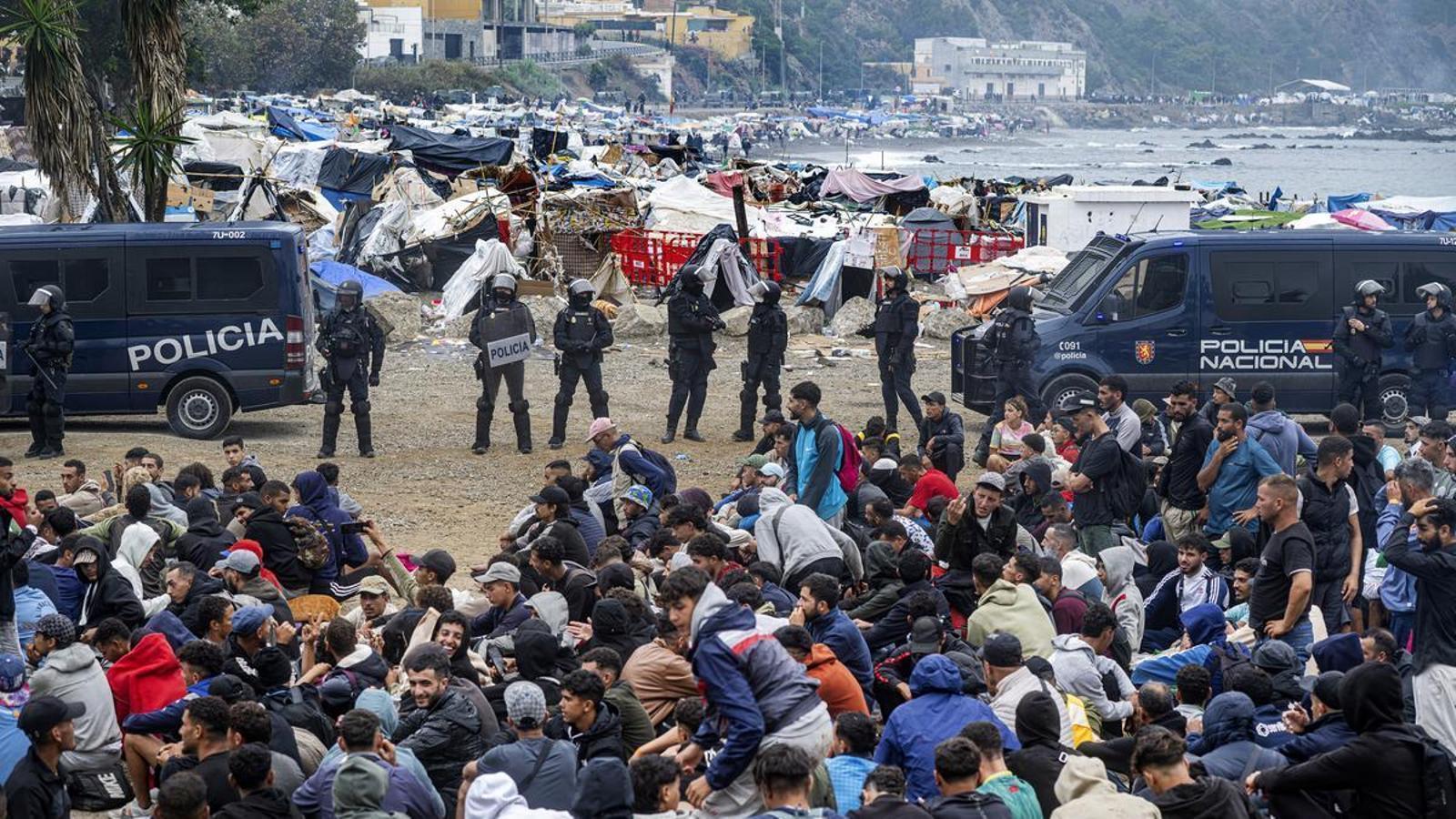
BarcelonaThe Ministry of the Interior has revealed to the National Court judge María Tardón, who is investigating the massive entry of migrants into Ceuta, that Morocco arrested two people who administered a WhatsApp group that was used to spread calls to enter the autonomous city on July 30 and 31. The information that the Spanish government has shared with the magistrate comes from an informative note prepared by the Spanish embassy in Morocco, to which Efe has had access. The arrests of these two suspects took place on August 6.
This note is part of the set of documents that the Interior has sent to Tardón and, in the specific case of the arrests, the embassy cites a Moroccan media outlet as the source of the information. The first detainee, identified by the initials Y.Ch., is attributed with the "creation or main administration" of the WhatsApp group. He was arrested, according to the same document, "for publishing and distributing messages aimed mainly at young people in which they were encouraged to move towards the Fnideq area and attempt to reach Ceuta irregularly, including express references to attempts to enter by swimming".
The second individual, who would respond to the initials M.M., is also suspected of "participating in the administration of the same WhatsApp group". In the Interior's informative note, it is also highlighted that the Moroccan courts "are processing procedures related to the events", and that even a court in Tetouan "has already handed down sentences against several people investigated for their participation in the organization or incitement of collective border crossing operations". Despite these two arrests, the Interior warns that "the information currently published does not allow us to establish that the investigated group constituted an organized structure of a stable nature".
More documents at the Court
This document is one of those on the table of the judge of the National Court, but there are others. For example, Tardón already has several of the reports she requested a few weeks ago from different bodies, such as the Civil Guard, the National Police or the National Intelligence Center (CNI), to try to clarify what happened. One of these reports transpired this Thursday and was from the National Police. Specifically, they claimed that they had identified two high-ranking Moroccan officers who appear in videos of the entries giving instructions around the border crossing.
Another of these reports, according to Efe, is from the Civil Guard and it estimates that "approximately 88,146" migrant people "could have returned" to Morocco after the entry into Ceuta. It is a higher figure than that given by the Spanish government until now. The Civil Guard report, which dates from October 27 and focuses on the deployment of personnel and mobilized material resources, estimates at 862 the rescues made in national waters and at 90 the number of deaths.
Previous reports
In another report sent to the judge, in this case from the beginning of July, prior to the mass entry, the Civil Guard warned that the recent doctrine of the Supreme Court would increase irregular entry by sea to the autonomous cities of Ceuta and Melilla, and alerted to a possible "pull effect". The Spanish police proposed reinforcing the forces in the area.
Among the documentation sent to the judge there is also a report from the CNI from July 30th in which it analyzes "the situation and the outlook" of what the intelligence services qualify as the "largest mass displacement of migrants in the history of Spain to the autonomous city of Ceuta". The CNI highlights that, at an operational level, "no proactive reaction has been detected on the part of the Moroccan authorities regarding the loss of control of the situation", beyond the deployment of some anti-riot units.
The judge also has the report in which the Ministry of the Interior explains that in the days prior to the mass entry it did not receive any "alert, report, communication, email or operational documentation" that "anticipated a risk of mass entry of the magnitude" of what happened.
