Global politics is surrendered to the algorithm in search of the youth vote… and tries to master it
Networks and content creators transform electoral strategies and alter the rules of political communication around the world
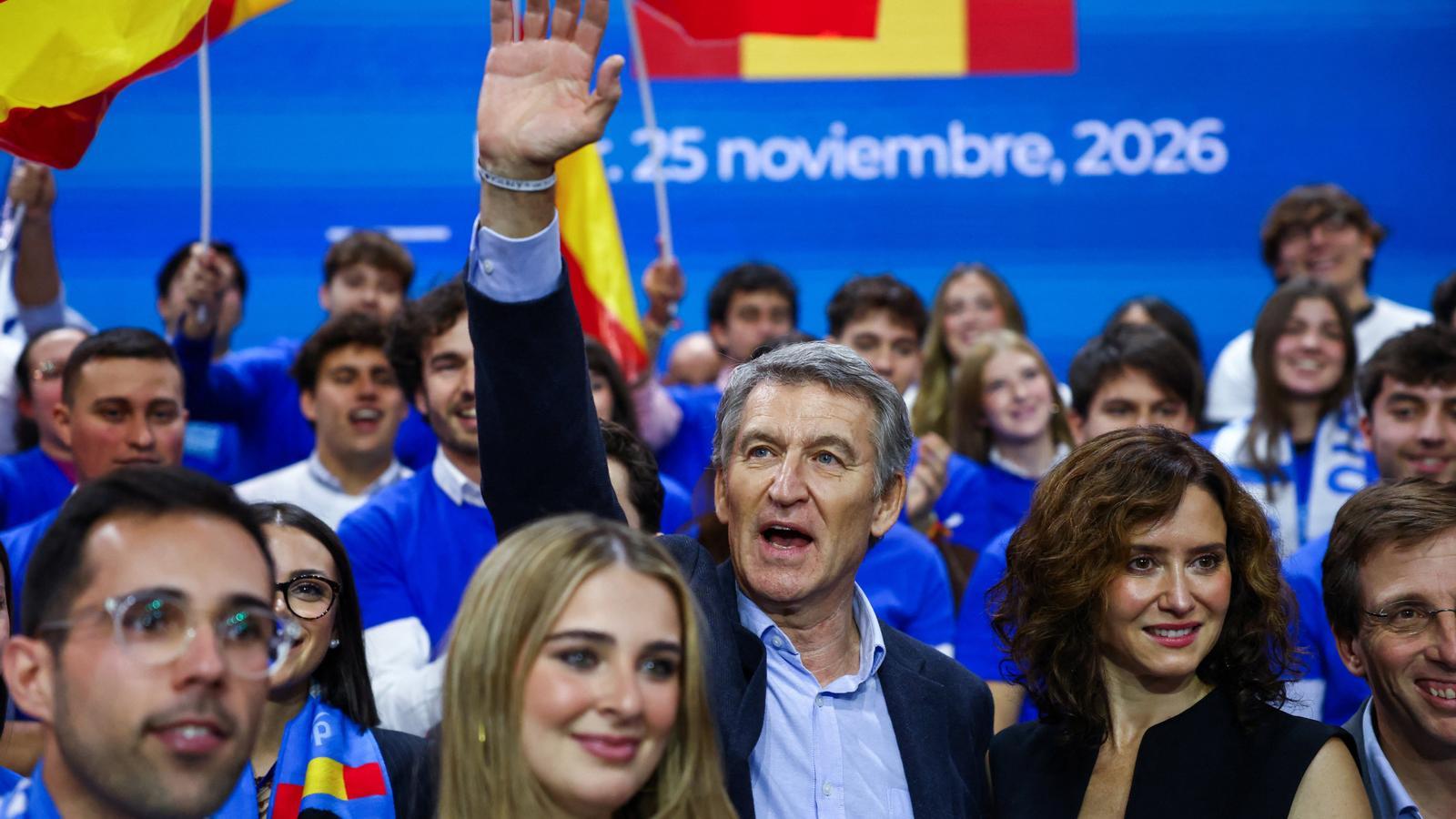

LondonReaching a different audience. This is the gamble of the political class in the age of the algorithm. Pedro Sánchez, Alberto Núñez Feijóo and Ada Colau admitted this using different formulas in their respective meetings with the youtuber Jordi Wild. Sánchez had 8.5 million views; Feijóo, 7.2; Colau, 4.5. It was the candidate of the Broad Front who expressed most openly that perhaps it was not a terrain she was used to: “The first thing my son, who is 15 years old, said to me when I told him I was going to run, was: ‘You have to go on Jordi Wild’.” Wild, therefore, as the axis of an alternative and highly fragmented communicative planet.
The leaders of the PSOE and the PP also accepted the invitation of the youtuber Daniel Alonso Agúndez, YoSoyPlex, who has 14.8 million subscribers. In the forty-eight hours after he posted the meetings with both, 2.1 million people had viewed the interview with the Prime Minister and 1.6 million with the leader of the opposition. The average for the head-to-head was 10.5 million people; that of the four-way debate, 10.2 million viewers.
But do views, subscribers –or viewers– mean voters? One must keep a first precaution in mind: there is no single ranking of who is winning the digital battle. One party may have more followers, another may generate more comments, and a candidate may manage to get their videos to circulate far beyond their own community. But none of these data, on their own, allow one to know how many votes are behind them.

“We don't have data. What we do know thanks to academic research is that it is very difficult for people to change their minds. If you have one formed, and a defined voting intention, it is very difficult for you to change it because you have seen something on Instagram, on television, or in a newspaper,” notes Eduardo Suárez, director of editorial at the Reuters Institute for the Study of Journalism at the University of Oxford.
Researcher Guillermo López García, professor of journalism at the University of Valencia, agrees: it is not enough to count views – which can be for a few seconds or a whole interview – nor to know who follows a creator, and this same uncertainty preserves an “irreducible space” of personal decision in the face of algorithmic manipulation attempts.
Expand, increase, diversify
Feijóo at the Jarama circuit and Sánchez admiring himself in front of a Lamborghini; both with YoSoyPlex. The candidates, night and day non stop surfing the algorithm. Parties and politicians have had to “expand, increase and diversify campaign messages over the last 25 years,” says López García. Before, they channeled all action through the media and campaign events, such as rallies, also designed for the media. Now they have to diversify and “generate their own information and content,” emphasizes López García.
What is behind this global political phenomenon? “Above all, parties are looking for the youngest ones there,” comments Suárez. And also, in his view, it is a way to “activate a vote that perhaps wouldn't bother to go to the polls”.
Regarding journalism and democratic quality, both experts point to fundamental changes. Suárez stresses that, although the debate may lose depth when a demanding journalistic interview is replaced by friendlier formats or partisan creators, these channels allow informing young people under 25 or 30 years old who no longer enter the websites of traditional media.
At the same time, he warns of the blow to the press business model when consumption remains within the platforms without generating clicks, despite the appearance of native projects or spaces like Substack. López García, however, adds that, in this “post-media sphere,” traditional media continue to influence the thematic agenda indirectly, and that “the quality of the debate depends as much on the training and transparency of the intermediary as on the interest of the public”.
Trump, a pioneer
The phenomenon, on the other hand, is neither new nor exclusive to a single ideological space. In 2016, it was already foreshadowed by the Republican candidate Donald Trump with the use of Twitter (now X) and Facebook, anticipating communicative atomization. A strategy based on avoiding legacy media –which he labeled as biased and “enemies of the people”– and which he would take to the extreme before returning to the White House with the October 2024 interview with Joe Rogan on YouTube and Spotify. The format, three hours without journalistic filters or interruptions, allowed the tycoon to project authenticity and connect with a young and male electorate distanced from conventional news.
In New York, Zohran Mamdani’s campaign for mayor demonstrated how this same logic of direct interlocution could be successfully adapted from the left and at a municipal scale. Mamdani –with whom content creator Hasan Piker collaborated by explaining his program on his Twitch channel– turned a relatively unknown candidate into a figure of national projection. He made short videos, with humor and references to popular culture, in which he explained proposals about the cost of living, rents, or public transport.
The now mayor of New York spoke directly to the camera in everyday settings, presenting politics as a conversation. Despite far exceeding the digital interest of his rival Andrew Cuomo, his success was not limited to screens: the content served to generate identification, but was accompanied by an agenda focused on economic accessibility and intense mobilization of volunteers on the ground.

This model, moreover, has transcended the electoral contest to settle into institutional management: as revealed by The New York Times in September, Mamdani's mayoral team articulated a network of creators and commentators to amplify government decisions – such as the cancellation of a nine-million-dollar contract with the consulting firm McKinsey – further blurring the boundary between institutional communication, activism, and political promotion.
Faced with the effectiveness of these new channels, the Democrats decided to replicate the formula for last November's midterm elections. After the difficulties of 2024 in reaching certain segments of the electorate, the Democratic National Committee reinforced its creator program with hundreds of collaborators. The goal was no longer just to distribute party slogans, but to integrate candidates like Abdul El-Sayed, Annie Andrews, or Scott Colom into the channels of these communicators and have them produce short videos, parodies, and everyday scenes to build a relationship of familiarity with the voter. The regular presence of influencers at events and conventions on both sides of the political spectrum confirms that this ecosystem is no longer a marginal supplement, but the new central axis of contemporary political communication.
Lula's army
In fact, in Brazil –where Lula won the election in the second round against all odds–, digital mobilization also played a prominent role in the president's comeback. The WhatsApp channel Exército do Lula, promoted by deputy André Janones, the so-called “WhatsApp general,” went from about 50,000 subscribers to over 10 million in three weeks. Lula gained more than 10.4 million votes between the first and second rounds, while more than three million people who had abstained went to vote. Although it is impossible to quantify how many voters decided their vote exclusively because of this campaign, analysts point out that it was key to spreading messages and mobilizing the electorate, along with other factors, such as the government's economic measures and street protests.
This whole shift responds to a structural change in information consumption habits. According to the 2026 Digital News Report from the Reuters Institute, in Brazil, social media and video platforms already surpass television as a weekly source of news, with a nine percentage point difference and a growing influence of content creators. Even so, free-to-air television and digital portals maintain notable influence and higher-than-average credibility, while the written press has lost weight, settling at around 10% of weekly consumption, according to the 2025 edition of the same report.
In the case of the United States, the report indicates that 54% of the population accesses news through social media and video platforms, ahead of television (50%) and media websites and apps (48%). And according to the Pew Research Center, Facebook and YouTube are the most used platforms for getting informed, followed by Instagram and TikTok.
Digital consumption also extends to podcasts, which 32% of the population listens to, and artificial intelligence chatbots, used for information purposes by 15%. Although 63% of Americans watch news on television “at least occasionally,” the preference for this format has dropped and is concentrated primarily among older generations.
Controversy at Downing Street
However, it can all get out of hand, as happened to British premier Andy Burnham this very week. Since coming to power four months ago, he has wanted to appear very close to the public and capture the youth vote through intense activity on social media, especially on TikTok. He admitted it in Parliament last Wednesday, while trying to undo the mess this strategy has gotten him into.
At the beginning of November, the British Prime Minister hosted a reception for a group of influencers at Downing Street. One of the sixty guests, Max Balegde, recorded a video at the door of Number 10 with derogatory comments about women and a Nazi salute. Another, Luke Hamnett, recreated inside the official residence the famous dance by Hugh Grant in the role of premier in the movie Love Actually.
The controversy, in any case, has revived doubts about the current leaders' willingness to submit to public scrutiny through traditional media and parliamentary bodies. The budget that Burnham's government allocates to feeding the algorithm machine for Downing Street propaganda demonstrates the importance it gives it: 25 million pounds annually compared to the 12 and change of Keir Starmer.
But beyond the protocol gaffes, the new influence market poses an even less visible question: who pays the creators and with what transparency? An investigation by The New York Times documented that some influencers who promoted Democratic candidates in the primaries and mid-term elections received financial compensation that they did not always make explicit to their audiences.
The problem is not just covert political advertising, but the confusion between a personal opinion, a spontaneous recommendation, and a message contracted by a campaign. When trust is precisely a creator's main asset, knowing who is behind a publication becomes a democratic issue.
The avalanche of participation on social media and presence among influencers responds, ultimately, to what the political analyst and former chief of staff to Pedro Sánchez, Iván Redondo, has summarized this very week via X: “No one holds the scepter of the audience anymore and you have to be in many places, in many formats, and in many conversations” at the same time.
