Israel continues without any clear formula of government one day from the deadline to designate a candidate
A part of the opposition shows itself willing to negotiate with the ultra-Orthodox in order not to depend on the Arab parties

-
CAT -
CAST
Jerusalem“A Jewish and Arab government, together” was the demand repeated last Saturday at one of the demonstrations in Jerusalem after the elections. On the street, some Israelis were asking that Arab parties be able to participate in the future government. In Parliament, this possibility remains the main obstacle to ousting Benjamin Netanyahu from power.
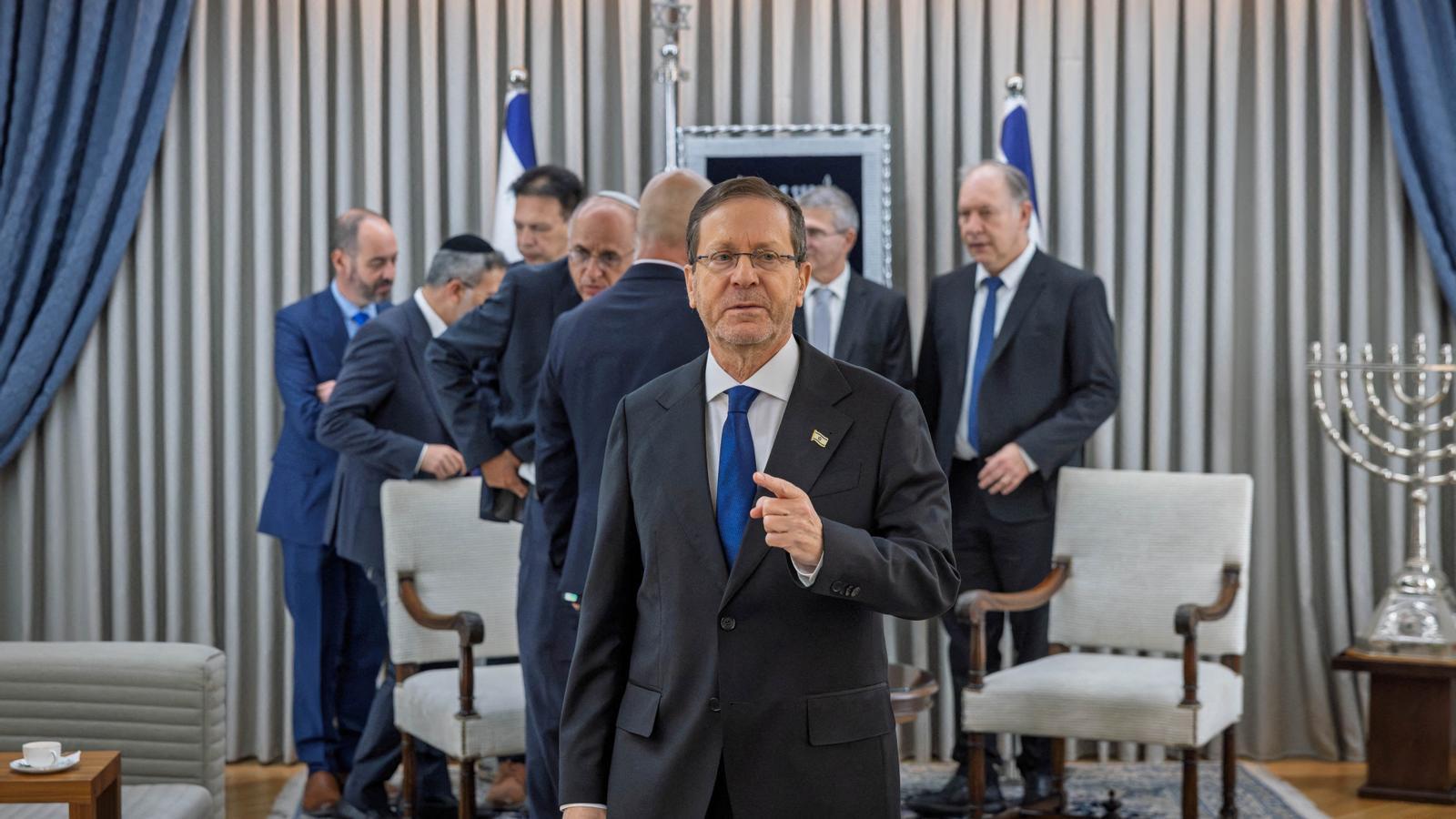
The president of Israel, Isaac Herzog, will have to designate a candidate this Sunday, who will have 28 days to try to form the executive branch. But Israel is still immersed in political uncertainty. Netanyahu has lost his parliamentary majority, but his opponents have not yet managed to transform the sum of seats into a government alternative. On paper, however, they start with an advantage: 67 deputies have recommended Gadi Eisenkot as the next prime minister, compared to the 46 who have expressed their support for Netanyahu. This support, however, is still far from translating into a coalition.
The Arab parties, with a historic result of 19 seats, are essential to build an alternative, but a part of the opposition continues to refuse to govern with them or depend on their votes. Meanwhile, they have begun to explore another path: approaching the ultra-Orthodox parties, traditionally at odds with some of their electoral commitments.
Herzog made the difficulty clear on Thursday, after completing consultations with the political formations. Although Eisenkot has received the highest number of recommendations since 2015 and well above Netanyahu, he warned that it was not evident who had more capacity to form a government, due to the “mutual vetoes between the blocs and within the blocs themselves”.
The first sign of opposition unity arrived on Tuesday, in a meeting between Eisenkot, Naftali Bennett, Yair Golan, Avigdor Lieberman, and Yair Lapid. The five leaders agreed to support Eisenkot as a candidate, but the joint statement spoke of a Zionist national emergency government, without clarifying what role the Arab parties would have in it. Two days later, the Arab factions Joint List and United Arab List recommended his name to the president, in a significant institutional step, but one that does not imply they have agreed to join the government. In fact, the Joint List has ruled out being part of an executive that maintains the current military policies in Gaza and southern Lebanon, despite being willing to provide external support to an Eisenkot government.
Differences over how to form an executive persist. Golan has shown himself more open to exploring cooperation with Arab parties, while Bennett and Lieberman reject that a future government should depend on their votes. Eisenkot had also ruled out forming a coalition with them during the campaign. Israel's shift to the right and the deterioration of relations between the Jewish majority and the Arab minority, aggravated since the Hamas attacks of October 7, 2023, complicate any understanding. Furthermore, the precedent of the United Arab List, the first Arab party to enter the Bennett and Lapid government between 2021 and 2022, does not make repeating the experience any easier: that coalition fell apart after just over a year.
Approach to the ultra-Orthodox
Statements by Lieberman this Friday have added a new element to the negotiations. The leader of Yisrael Beytenu, who has made the demand for military service for the ultra-Orthodox one of the pillars of his campaign, has confirmed that he would be willing to back down on this issue to avoid new elections and put an end to the Netanyahu era, without accepting a government that depends on Arab parties.
The party opens the door to negotiate with United Torah Judaism, which has not recommended either Netanyahu or Eisenkot to the president. The approach is delicate: the recruitment of ultra-Orthodox Jews is one of Israel's major political and social conflicts and could divide Netanyahu's opponents even before attempting to form a government.
Following Lieberman's statements, Eisenkot has reiterated his conditions for accepting any partner: recognizing Israel as a Jewish and democratic state, establishing compulsory military service, and considering Hamas a terrorist organization, with a commitment to dismantle it. These demands may complicate both the rapprochement with ultra-Orthodox parties and an agreement with Arab factions. On this latter front, however, the opposition leader has introduced a nuance: he has shifted from demanding the destruction of Hamas to speaking of dismantling its power, a change in wording that could facilitate, according to some analysts, an understanding with the United Arab List.
In this scenario, Netanyahu is trying to remain at the center of negotiations and has advocated for a national unity government under his leadership, although he has not yet reached any agreement. At the same time, he has described any government alternative that depends on Arab parties, whom he accuses of supporting terrorism, as dangerous.
The opposition faces an uncomfortable choice: to assume the political cost of depending on the Arab parties or to lower its demands to include the ultra-Orthodox. Meanwhile, Likud remains the most voted-for force and Netanyahu remains at the head of a caretaker government. If the President of Israel tasks Eisenkot with forming a government and he fails, Netanyahu could run as a candidate again to try to gather a majority and remain in power.
