Eisenkot gains options to receive the mandate to form a government and oust Netanyahu
The ultra-orthodox withdraw support for the prime minister and the Arab parties commit to recommending the former chief of the General Staff at the head of the presidential consultations

-
CAT -
CAST
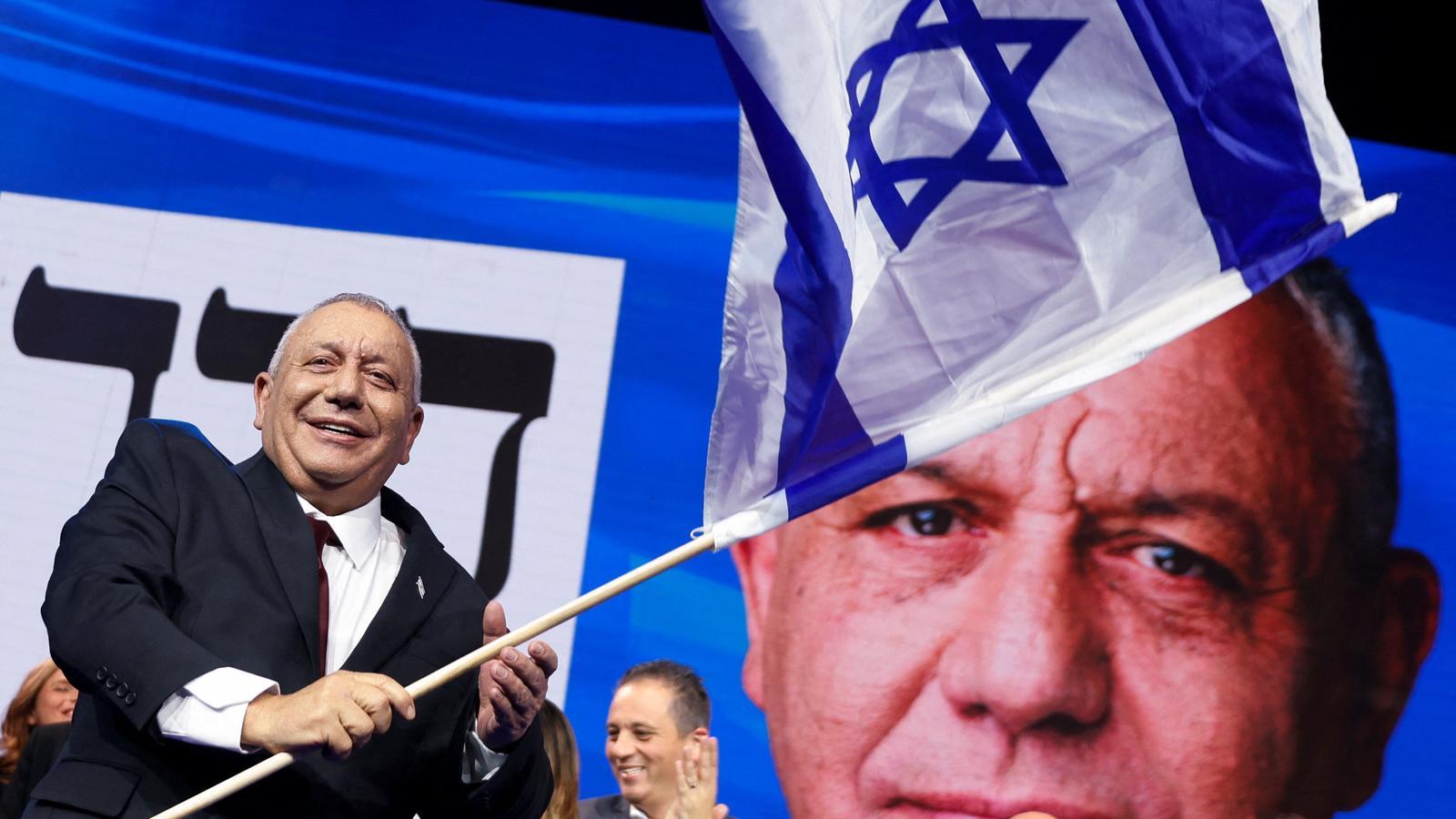
JerusalemGadi Eisenkot is gaining ground in the race to be tasked with forming Israel's next government. The former Chief of Staff of the Israeli army has garnered 67 recommendations, compared to Benjamin Netanyahu's 46, placing him in the lead during presidential consultations. The options for Eisenkot have increased after the ultra-Orthodox party United Torah Judaism announced that it will not recommend any candidate to President Isaac Herzog, and the two Arab factions expressed their support for the former general. The endorsements, however, do not yet guarantee his investiture.
The October 27th elections left a fragmented Israeli Parliament. The Prime Minister's Likud was the most voted force, with 27 seats, but its bloc only managed to secure 53 deputies, far from the 61 needed to obtain an absolute majority. The opposition bloc, led by Eisenkot, obtained 48 seats.
Now, the decision of United Torah Judaism, with seven deputies, has changed the scenario. The party has distanced itself from Netanyahu due to the disagreement over the exemption from compulsory military service for students of Talmudic schools and its spiritual leaders have ordered that the party not recommend any candidate to Herzog. However, they have left open the possibility of supporting an opposition government from outside the coalition, provided that the privileges of the ultra-Orthodox community are preserved.
In parallel, the two Arab formations, Ra’am and the Joint List, with eight and eleven seats respectively, have expressed their willingness to facilitate Eisenkot's arrival in government, although this does not necessarily imply that they will join the executive. The Joint List has shown itself willing to provide external parliamentary support to an Eisenkot government, while Ra’am's support, for the moment, has been limited to recommending him to the president. On paper, this combination would allow the former military officer to attempt to form a minority government with the endorsement of the Arab parties. The formula, however, clashes with the reluctance of his partners Naftali Bennett, Yair Lapid and Avigdor Lieberman. Only Yair Golan, leader of the Democrats, has openly defended negotiating with the Arab parties.
The difficulties also became evident on Tuesday, in the first meeting of the opposition bloc, when in addition to agreeing to start negotiations to form a national emergency government, the leaders set some conditions for making agreements with potential partners: recognizing Israel as a Jewish and democratic state and considering Hamas a terrorist organization. These are conditions that may further complicate the understanding with Arab political parties.
Four decades in the army
Born in Tiberias, in northern Israel, into a Jewish family of Moroccan descent, Eisenkot joined the Israeli army in 1978 and, after more than three decades of military career, in 2015 he assumed the leadership of the General Staff, the highest military position in the country, which he held until 2019.
During this stage, he advocated for a security policy based on deterrence and the use of force against Israel's adversaries, especially Hezbollah in Lebanon and Hamas in Gaza. In this context, he is considered one of the main drivers of the so-called Dahiya doctrine, which provided for forceful military responses against areas used by Hezbollah and which received strong criticism because it could lead to the destruction of buildings, basic services, and other civilian infrastructure.
His entry into politics came in 2022, when he joined National Unity, the center-right alliance led by Benny Gantz, also a former Chief of Staff. After the Hamas attacks of October 7, 2023, Eisenkot joined Netanyahu's emergency government as an observer to participate in directing the military response. In 2024, after the death of his son, who was serving in the army in the Strip, he left the government, demanding a plan from Netanyahu for the future of Gaza after the war and accusing him of subordinating strategic decisions to his political interests.
In 2025 he founded Yashar, the party with which he has run in the elections with a discourse focused on the renewal of the country's political leadership, the defense of a firm security policy, the revision of military exemptions for the ultra-Orthodox, and the creation of an investigative commission on the errors that allowed the October 7th attacks.
With this program on the table, if President Herzog entrusts him with the task of forming a government, the former military officer will have 28 days, extendable by two weeks, to negotiate a coalition. The challenge will be to reconcile the demands of the Arab parties, the reluctance of some partners, and the disagreements over the conscription of the ultra-Orthodox. Receiving the mandate may be the first step to ousting Netanyahu; gathering the support to govern will be much more complicated.
