Is Russia behind the protests of the young people in European cities?
The Kremlin denies any link to the riots, but amplifies them and dips bread into the social unrest

-
CAT -
CAST
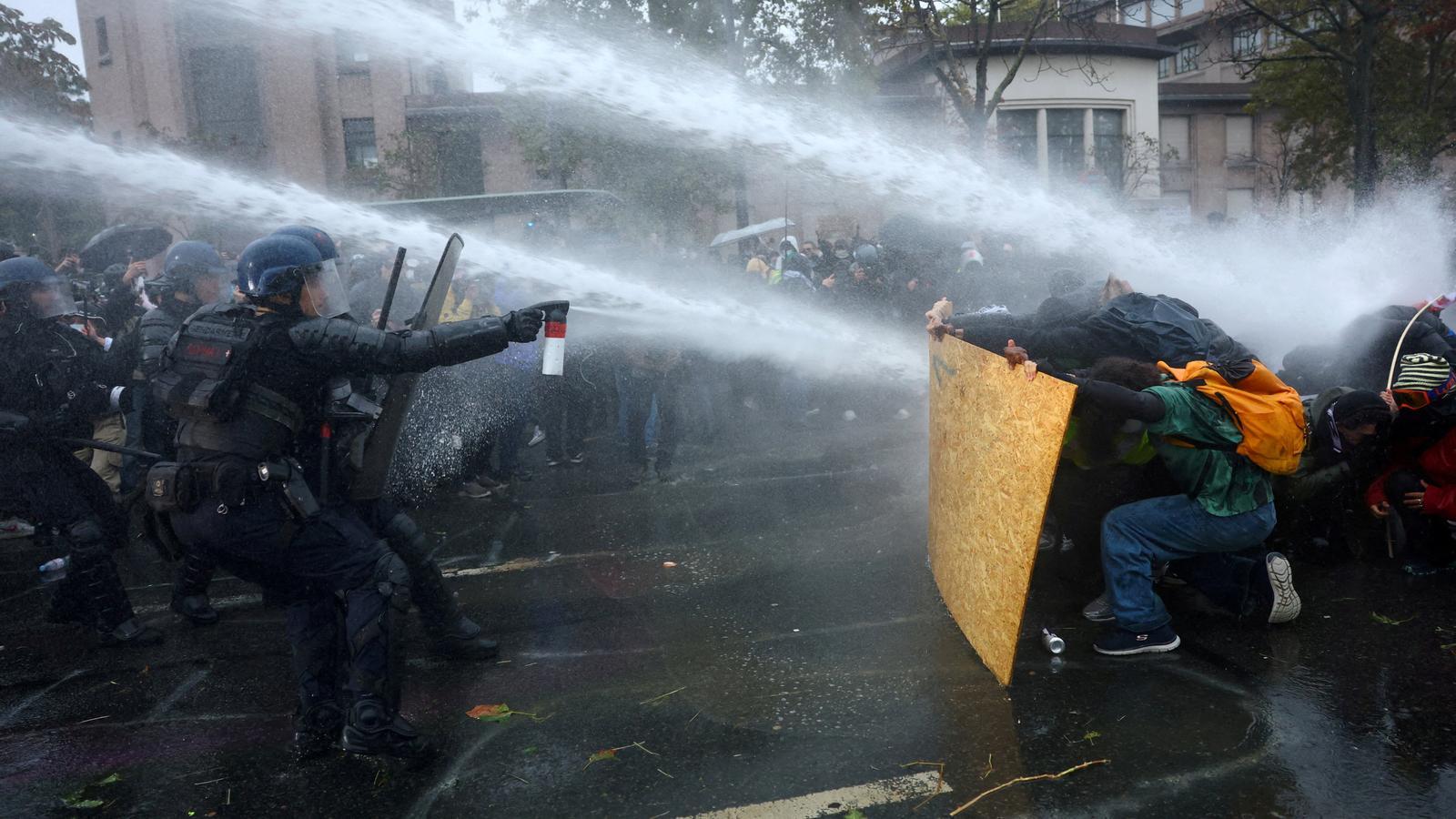
MoscowSince the wave of youth unrest in Western Europe began, the suspicion of a Russian hybrid attack has loomed over public opinion. The confusion over coordinated actions through channels specifically created for the occasion and the absence of visible leaders have spurred the shadow of an influence operation by Vladimir Putin's government. The reality, however, is that it is impossible to attribute the origin of the protests to Russia. What has been proven is that Moscow has amplified the disturbances and has tried to present them as the social reaction to the militarism of community elites devoted to Ukraine. A very convenient approach on the eve of an electoral cycle that could catapult the European parties most opposed to support for Kyiv.
Although no messages related to defense spending or aid to Volodymyr Zelensky circulated around the Barcelona call, in the case of France, they did. The Alliance 4 Europe laboratory has discovered that the Russian disinformation network Döppelganger spread, before and during the most violent protests, hundreds of news stories that exploited real grievances and redirected them towards Ukraine. Even the spokesperson for the Russian Foreign Ministry, Maria Zakharova, interpreted them from this perspective. “Guns and shells instead of desks and textbooks: these are the current priorities of the French political establishment,” she said.
However, experts believe that it would be going “too far” to claim that Russia orchestrated those demonstrations. As Ilya Klixin, a journalist specializing in Russian digital propaganda, explains to ARA, dismantling a single influence operation and determining who is behind it “may require several years.” What Spanish intelligence services have detected, as published by ABC, is that the Kremlin boosted calls for mobilization in the Catalan capital on TikTok. In other words, these accounts fattened an existing phenomenon, but did not create it.
“The goal is not so much to promote a specific narrative for its own value as to take advantage of any narrative that can contribute to destabilizing other societies, whether it comes from the extreme left or the extreme right,” notes Klixin. This method, furthermore, is cheap and reproducible; it does not require building any infrastructure from scratch and does not need major results, but is satisfied with achieving visibility and sowing discord.
Furthermore, magnifying these interferences gives ammunition to Russia, which fuels its discourse by denouncing unfounded accusations from Europe. Vladimir Putin was quick to warn that pointing to them as being behind the riots was "an absolutely obvious exaggeration" and that European leaders "must not blame someone from abroad," but rather "deal with their own problems." At the same time, he added: "We should not rejoice or take advantage of it to poke at the wound, but when they accuse us, we must react in some way."
And, in fact, in recent days the Russian president has taken the opportunity to poke at it and has directly pointed to migrants as those responsible for the acts of vandalism. From his point of view, European governments are proving unable to manage uncontrolled immigration, a position he shares with far-right parties. "How can they introduce European traditions and customs into these communities when they themselves are destroying their own?" Putin asks. The Kremlin leader understands that the lack of resources to address the migration crisis is the result of Brussels' decision to stop buying Russian gas and opt for the green economy, which has made their economies unviable. He has also used the protests to claim the importance of state control over social media.
Election interference
Russian bots are already instrumentalizing youth protests for electoral purposes. Accounts on the Matryoshka network predict riots in the United States if Democratic candidates win the midterm elections. In France, these fake profiles and media outlets hold representatives of Emmanuel Macron's party responsible, aware that a victory for Marine Le Pen in the spring presidential election could mean the medium-term end of military aid to Ukraine, as she has recently asserted, and that on the left, Jean-Luc Mélenchon warns against the risk of entering a war with Russia.
In Italy, the Kremlin has one of the main detractors of sending arms to Kyiv in Giorgia Meloni's vice president, Matteo Salvini, and the electoral successes of Alternative for Germany have been received with hope in Moscow, where they consider CDU leader Friedrich Merz the greatest exponent of anti-Russian policies on the continent. Regarding the Spanish state, although Podemos opposes continuing to arm Zelensky, not even Vox questions the alignment of the PP and the PSOE in supporting Ukraine and, despite this, Spain is not usually the target of criticism from the Russian government.

