Salvador Illa: "If Catalonia mobilizes Pedro Sánchez will govern"
President of the Generalitat and first secretary of the PSC
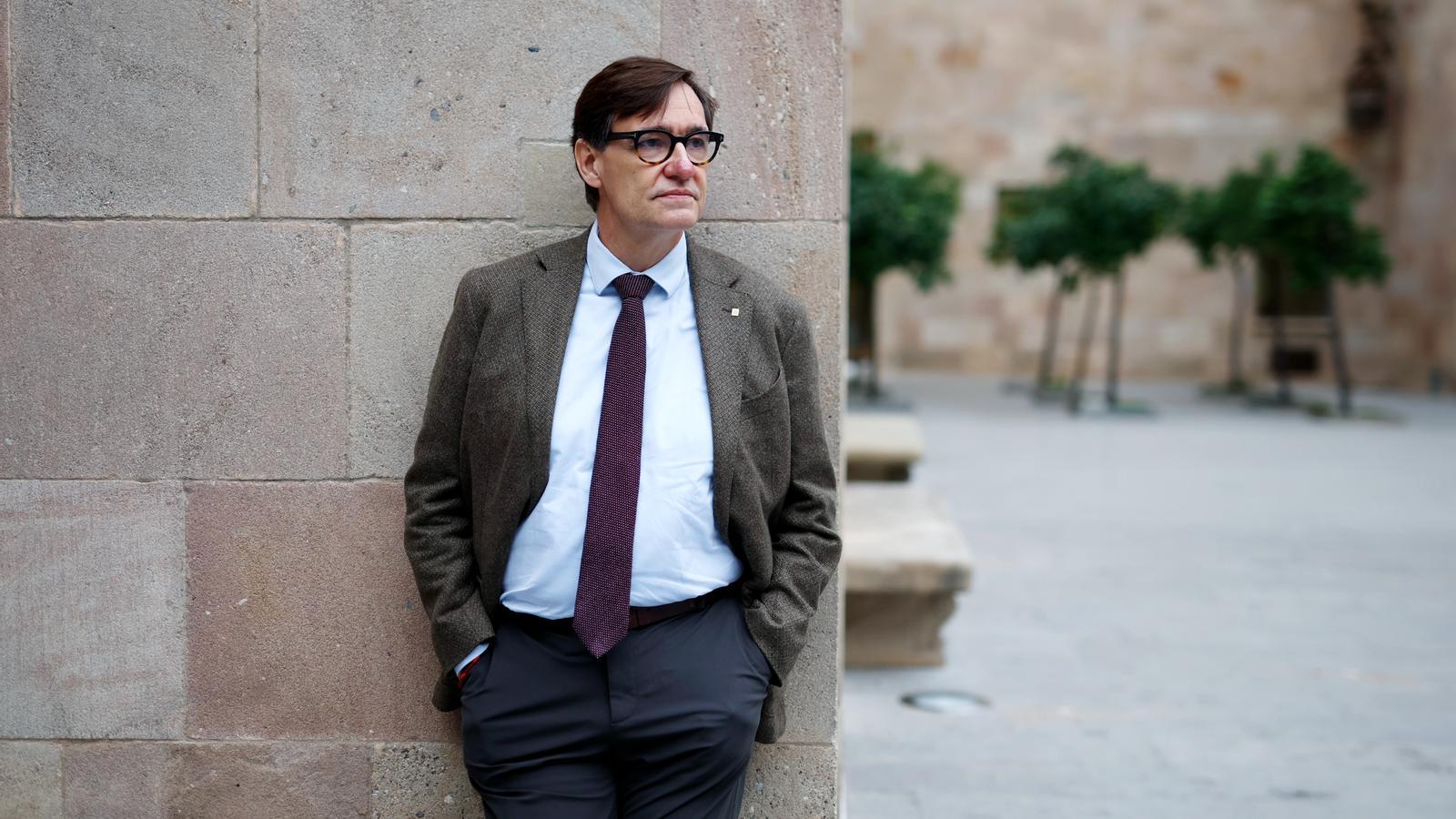

BarcelonaSalvador Illa (la Roca del Vallès, 1966) receives the ARA at the Palau de la Generalitat in the middle of the general election campaign of November 29th. Despite it being the day after the head-to-head between Sánchez and Feijóo, he radiates optimism.
Did you watch the head-to-head between Pedro Sánchez and Alberto Núñez Feijóo?
— We saw two very different ways of understanding Spain. A Pedro Sánchez who addressed the citizens, who explained the management he has carried out and who made proposals. And a Feijóo obsessed with Sánchez. They are two different styles, one is that of serenity and explanation and proposals, and the other is that of interrupting a lot and not letting the other's proposals be explained. I, between these two models of Spain, am clear about which one is best for Catalonia. In Catalanism there are different sensibilities, but I believe that we all agree that with a PP and Vox government in Catalonia we lose. And that is why I address all the people who love Catalonia to tell them that to defend self-government and the Catalan language on July 23rd trust us and vote for Pedro Sánchez's candidacies. Self-government and the Catalan language are at risk with a Feijóo and Abascal government.
Did you miss a little more strength in the defense of the management by Sánchez?
— The management is clear and the citizens know it. The president had a style of serenity, of wanting to contrast projects. And I saw a Feijóo very obsessed with Pedro Sánchez, who interrupted a lot. It is a way of doing things that I don't quite like.
The socialists promoted the amnesty, and Puigdemont made some statements affirming that he took advantage of Sánchez's “excessive ambition” to “defeat” Spain. What is your opinion on this?
— Catalonia has left the past, nostalgia, and Puigdemont behind. We have done what was best for Catalonia, thinking about the future and coexistence. I am glad to have done so.
Is President Sánchez "amoral", as Puigdemont says in the interview with El Mundo?
— No. President Sánchez is a person who has principles, values, and I believe the eight years of trajectory he has had at the head of the government of Spain and the previous ones as Secretary-General of the Socialist Party attest to that. I believe the interview to which you are referring portrays the person conducting the interview very well.
How do you portray her?
— I believe that the citizens see it. Look, I insist, Catalonia has left the nostalgic past behind and also Mr. Puigdemont.
To which strategy do you think this interview responds?
— I don't know. On 29-N, for those of us who love Catalonia, there is no room for neutrality. Either you stand with a model of a plurinational Spain, which defends the Catalan language, wants better financing, and recognizes that more investments need to be made in Catalonia, or you stand with the PP and Vox, who have been against the amnesty law. There is no ground for neutrality. There are those who say: “We are in the middle.” In the middle of what? In the middle of the PP and Vox?
What assessment do you make of what your government has achieved with the PSOE?
— I make a positive assessment of it and I believe that Catalonia has already advanced and moved forward in many areas during these years. We have re-established bilateral relations and it has allowed us to move forward on different issues. From the investments we are making in infrastructure to the proposals we have made for debt forgiveness and improvement of financing, which I hope to recover on November 30th with a government led by Pedro Sánchez in Madrid. I would also highlight the execution of important investments, such as the gigafactory and the support for Catalonia's science and research ecosystem.
Could things have been done faster with the financing and debt forgiveness could things have been done faster?
— A more active collaboration from Junts would have helped. We should have had this issue resolved this year 2026, but the announcement was provoked by a vote from Junts aligned with the PP and Vox, turning its back on a very cross-cutting proposal regarding housing. These are measures that even the PNV, which is not known for having progressive or left-wing tendencies, supports. I believe they are yielding to the interests of what I call big money, and an electoral call is being rushed. I hope to resume these measures with a Pedro Sánchez government.
Will Catalonia continue to be the Gaulish village of socialism in Spain?
— Catalonia will follow its path, and I hope it will be with the accompaniment of the government of Spain. The model that I defend and the one we have, and which I believe is shared by Catalan society, is that of generating prosperity. However, it needs to be a shared prosperity. It cannot be that it accumulates in a few people and remains concentrated in certain territories. Today, this means, above all, housing policies and a strengthening of public services. Catalonia will follow this path, I believe it is the right one and what the majority of citizens are asking for. And when alternative paths have been applied, they have not worked.

But that is not the path that the rest of Spain seems to be following, starting with the autonomous communities. What do you fear most about a right-wing government?
— There are autonomous communities that, effectively, have not followed it, but the whole of Spain has so far given it majority support, and I trust that this will happen again on November 29th. And I insist: Catalonia has a very decisive role. I am in this scenario. The other option is that of standardization, of an ultra-liberal economy, that of the chainsaw that is shamelessly exhibited as a symbol of cuts, of positions in the international arena almost of vassalage and of following to the letter what is marked for you by people like Donald Trump or Benjamin Netanyahu. They do not finish saying what they will do with pensions, but the announcement of audits and review of the state of finances we already know is always the prelude to saying that the numbers do not add up. Look, the numbers do add up and it is a distribution system that works and is solvent, and alternative capitalization or mixed systems have not worked. The latest example we have of this is in Paraguay, where one of the main banks that provided coverage to this system has gone bankrupt.
As president of the Generalitat, would you foresee direct threats against self-government?
— I am clear about what I have to do as president of the Generalitat. However, I am not in a scenario where on November 29th everything is already decided and determined as to what will happen. That is what they were saying in Brazil, and look what happened. I call upon all Catalans: if Catalonia mobilizes and if they go out to vote decisively, Pedro Sánchez will govern, and self-government and the Catalan language will be respected. And, furthermore, I ask that the vote be concentrated on those candidates who go for what is certain, who will not perform twists and turns or strange things. It is not the moment to be in the middle. Does the far-right in the government of Spain harm Catalonia? Yes, a lot. Can it be stopped? Yes. How? By voting. For whom? For Pedro Sánchez.
It is obvious that the ballot boxes must be filled, but the average of the polls indicates that the extreme right is rising, both in Catalonia and in Spain. To what do you attribute this and what has been done wrong?
— To the wave that exists throughout the West, organized and financed by these warmongers, and to this current of authoritarianism that aims to weaken democracies. But where their recipes have been applied, they have failed. The Brexiters said they would leave Europe and everything would be resolved. Look at the United States, Argentina... Who is better off? The rich. Or rather, the ultra-rich. The middle and working classes have seen their rights cut and the cost of living has risen.
Has the left spoken little about immigration?
— I have never refused to talk about immigration and I believe we have talked about it. But demagoguery is used and it is used as a scapegoat. Your cost of living has gone up because there are two gentlemen who have decreed two wars in Ukraine and the Middle East, which are unnecessary and contrary to international law. And there is another one who has committed genocide in Palestine. Therefore, the problem is not the most vulnerable layers of society, but rather that prosperity is generated and it is not shared because some want to keep it all for themselves. We must not be confused and must not maliciously attack the most vulnerable.

Is the population increase well-dimensioned with our welfare state services?
— We are faced with the challenge of adapting and increasing our public services. This is what we are doing, and we have already done so other times in the past. It is also true that we are reversing a decade of disinvestment or lack of investment caused by austerity policies in response to the 2008 recession, which was caused by the application of ultraliberal approaches. This is the complete opposite of what we did with the pandemic, when there was a decisive investment by the European Union, Spain, and Catalonia.
Gabriel Rufián has proposed a concentration government in Catalonia as a response to a possible government of the Popular Party and Vox. What is your response?
— I am working so that Spain has a government led by Pedro Sánchez. This is the priority, now, and I do not understand if Mr. Rufián and his party consider it lost. I say no, that this is possible, that Catalonia is decisive and that the backbone of this government is Pedro Sánchez and the socialists. If Mr. Rufián is not clear about it, citizens have an option of people who are.
You have spoken about the equidistant ones or those who place themselves in the middle. I assume you are referring to Junts per Catalunya. Do you believe that after the interview and Carles Puigdemont's positioning, they continue to position themselves in the middle?
— I believe that citizens have the right to know what the potential deputies of Junts will do. That is to say, who they will support. We have seen that recently they have been supporting the proposals of the PP and Vox quite consistently, for example in the matter of housing. It seems that, based on these latest statements, they are clearly positioning themselves in the bloc of the PP and Vox.
Has the PSOE and the PSC, and you personally, who also changed your position, suffered significant wear and tear due to the amnesty?
— We have done what we had to do. The result is positive for Catalonia and for Spain. And I would do it again.
Do you feel disappointed?
— No. If you are referring to the interview in question [of Puigdemont in El Mundo], no. Also because I possibly did not expect too much from it.
