Costa proposes a new tax on technology companies and tobacco to finance the European budget
The European Council proposes cuts of 10% on the EU budget

-
CAT -
CAST
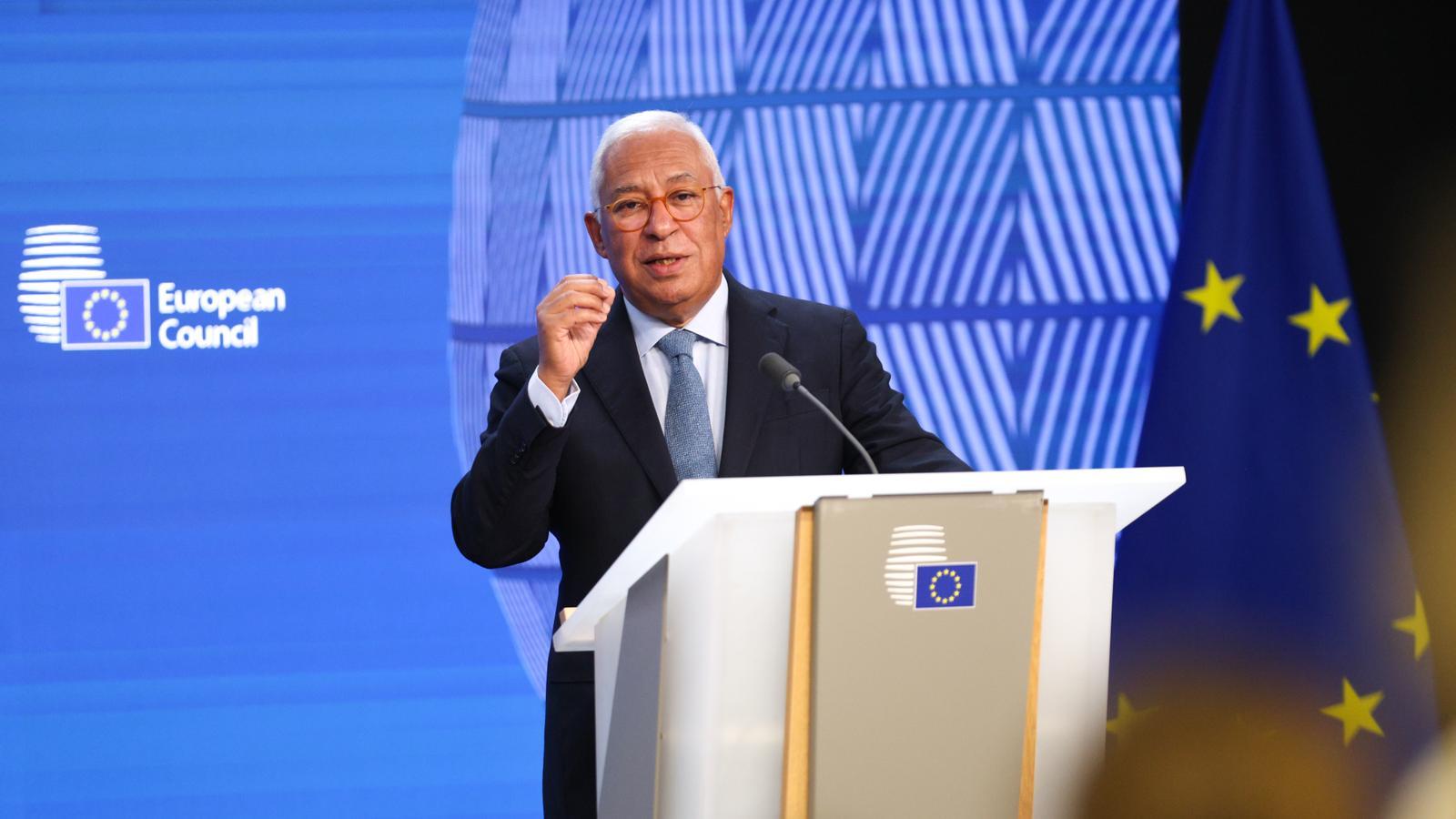
BrusselsThe European Union continues its crusade to agree on a new budget for the next seven years. In yet another attempt to try to unblock negotiations and find consensus within the bloc, the President of the European Council, Antonio Costa, presented his proposal this Saturday, which will be the basis for member states to discuss at next week's summit.
The new working document sets the 2028-2034 accounts at 1,582,516 million euros, which represents a global cut of 10.2% compared to the European Commission's initial proposal, and opens the door to providing the bloc with two new financing routes through new taxes. In this way, Costa seeks the complicity of the frugal countries (such as Germany, the Netherlands, or the Nordic countries) that were demanding to contain national contributions to the community budget, and to reduce the dissatisfaction of the states known as the “friends of cohesion” (which include Spain, France, and Italy) that are calling for more ambitious accounts. “We have listened to the concerns of the member states. It is not easy to find this balance, but with this proposal, we have managed to get very close to the current level of national contributions,” defended the Portuguese leader.
At the same time, Costa maintains the ambition to raise about 60,000 million euros annually with new own resources. For this reason, he proposes two new community taxes that must be added to the three already in existence. Costa is committed to taxing 3% of the gross income of big tech companies (which they obtain through online advertising and data sales) and imposing a progressive tax on tobacco that could reach 15% by 2034. These levies are in addition to those already imposed on companies for the emissions and non-recyclable waste they generate. This will allow, according to Costa, to maintain national contributions at a “reasonable level,” that is, 0.82% of GDP compared to the current 0.80% of GDP, in addition to repaying the Next Generation funds debt more quickly.
The tax on technology companies primarily targets American giants, such as Google, Meta, Amazon, or Microsoft, which have an annual turnover of more than 750 million euros, and would exclude SMEs and the majority of European operators. The Donald Trump administration has repeatedly threatened trade tariffs against countries that impose such levies, and within the bloc, countries like Ireland (which attracts this type of company) raise objections. But Costa has argued that “this tax is not directed against any specific company, and even less against any country,” but rather aims to ensure “fair taxation” in the internal market.
The geopolitical shift of the EU
The accounts reflect the EU's geopolitical shift. Costa has defended that his proposal is “a good basis” for the agreement, as it spikes spending in strategic areas compared to the current budgetary cycle. The defense line item grows by 232%; competitiveness by 120%; and funds for security and migration double. However, if compared with the European executive's latest proposal, the big loser of the cuts is precisely the competitiveness line item, which was supposed to be one of Brussels' spearheads this term, and it also proposes cuts to the defense and external action portfolios. Within this scope, Costa also proposes a downward adjustment of support for Ukraine of 11% with respect to the Commission's document.
On the other hand, Costa has softened the blow for the items where resources have traditionally been allocated most: the common agricultural policy and cohesion policy, which are integrated into a new joint fund. Both items remain practically intact with respect to the European executive's proposal. But, if we compare it with the current budget, they fall between 15% and 22%.
As a social novelty, the European budget provides for the first time since the beginning specific funds for social housing, “especially in areas under stress,” Costa remarked. The fixed proposal is that states will have to allocate at least 14% of national and regional funds to social objectives, an umbrella that will now allow for the financing of housing access policies.
All in all, the European Union budget will stand at around 200 billion euros. The figure, equivalent to the GDP of the Barcelona Metropolitan Area, is still very far from the 750 to 800 billion additional euros each year that the Draghi report called for to prevent Europe from permanently missing the economic train compared to the United States and China.
