Who is the daughter of Turkish immigrants who has swept through Berlin?
The post-communist Elif Eralp has hoisted Die Linke in the German capital focusing a good part of the campaign on affordable housing while avoiding the Palestinian question
-
CAT -
CAST
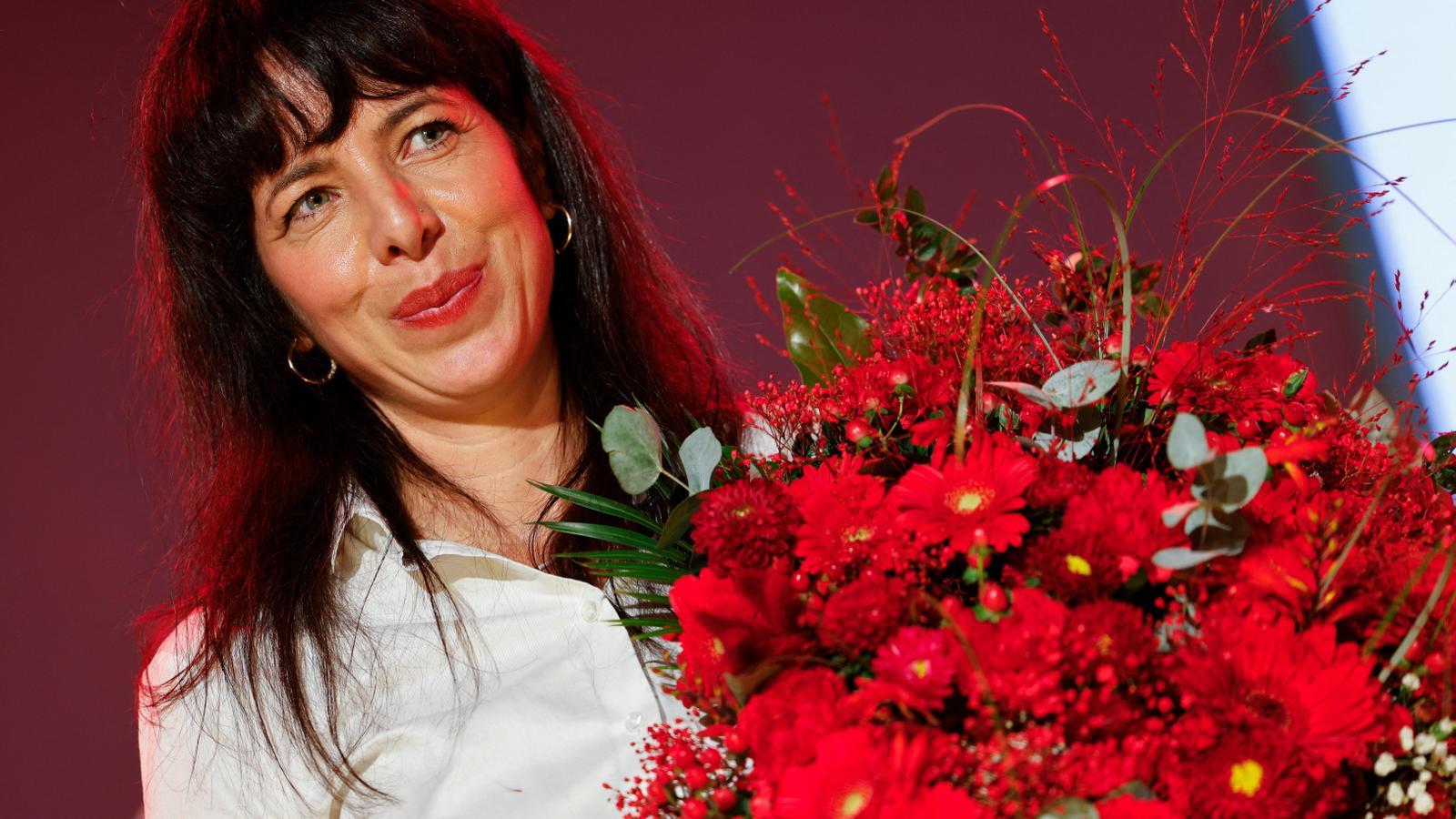
BarcelonaThe triumph, for the first time, of the post-communists on this Sunday's election night in the city-state of Berlin, has a name: Elif Eralp, the candidate for Die Linke, who has come to lead the institutional progressive political space in the German capital. For the first time since reunification, this party has obtained more support than the Social Democrats, who remain last in the distribution of seats. Die Linke has also surpassed the Greens. This triumph contrasts with the global rise of the far right.
With a discourse based on social justice in which she often speaks of prioritizing "the interests of the people of Berlin, without dividing them according to their origin", Eralp, 45, has emerged as the battering ram against the city's elites and the reactionary wave. The campaign and the tone of several interventions recall the mayor of New York, Zohran Mamdani. In fact, she herself has cited him several times as a personal political reference.
Elif Eralp is married and is a mother of two children. She was born in 1981 in Munich, shortly after her parents, Turkish socialists and trade unionists, fled the country following the 1980 military coup. She grew up in Dortmund and Hamburg, where as a child she was influenced by the family atmosphere of commitment and political activism. In Hamburg, she studied law and specialized in criminology. During her internship period, she gravitated towards immigration law. During the same period, she also got involved in the anti-nuclear movement. In 2010, she began working as a legal policy advisor for the Die Linke parliamentary group in the Bundestag, the federal parliament.
After finishing her studies, she moved to Berlin and settled in Kreuzberg –one of the most multicultural, alternative, and politically demanding neighborhoods in the city, historically with a large Turkish community–, where she has developed a good part of her public and associative activity. Specifically, she acted in the anti-racist field, the rights of migrants, and the demand for affordable housing. In 2018, she joined the Berlin leadership of Die Linke, and in November 2021, she obtained a seat in the Berlin Parliament, which she retained after the 2023 elections. In May 2025, she was elected vice-president of the party in Berlin. Now, in a general context of hostility towards migrants and their descendants, she is expected to become the first German-Turkish mayor of the city. She speaks German, Turkish, English, and Spanish.

During the campaign, Eralp has focused a good part of her rallies and public interventions on proposals to address the housing crisis that, like many European cities, Berlin is also going through, despite the fact that rental prices are capped throughout Germany. One of her star proposals that she has repeated during the electoral campaign includes a measure that is not unknown to Berliners, even though it has never been implemented.
In 2021, residents of the German capital voted in a non-binding referendum in favor of expropriating properties from companies and investment funds that own more than 3,000 homes. 56.4% of Berliners supported buying 240,000 homes with public money and creating a company to manage their rents. But even though a commission of experts from the city-state concluded that it is legally viable, this measure has never been implemented, and Eralp has committed to pushing it forward.
Among some sectors, however, she is criticized—both her and Die Linke as a whole—for having a position that is sometimes too unclear on a particularly sensitive issue in the country: the conflict between Israel and Palestine. Eralp openly defends Israel's "right to exist," and has often distanced herself from the more pro-Palestinian sectors of the party. In fact, during the campaign, she has avoided this topic whenever she could. One of the reasons, according to various analysts, is that a defense of Palestine that might be read in Germany as excessively fierce could hinder future pacts with the SPD and the Greens, with whom she aspires to govern and who have often leveled accusations of antisemitism at Eralp's party when it has defended pro-Palestinian positions.
One in two young people voted for her
The Palestinian question is one of the points where some tensions that she has maintained with the most radical sectors of the party become most visible, both with young militants and with some members of the leadership. These are frictions that Eralp has known how to overcome and that evidence the centrist role she occupies within the formation, far from the most radical sectors.
Despite the divergences with some youth sectors of the formation, Eralp has been able to connect with and convince the youngest Berliners: 42% of voters between 16 and 24 years old have opted for the post-communist rooted formation, and among citizens aged 25 to 34, the percentage rises almost to 50%.

