"We hope that tourists begin to come": relief and caution among the Kurds for the peace process with Ankara
The armed conflict has claimed nearly 50,000 lives since the creation of the PKK five decades ago

-
CAT -
CAST
Diyarbakir (Turkish Kurdistan)The millennial historic center of Diyarbakir, the unofficial capital of Turkish Kurdistan, no longer looks like it. Several of its neighborhoods are now vacant lots or sad new houses, all identical, of a grayish color. It is the consequence of the urban war that took place here in 2015 between Turkish security forces and militants or sympathizers of the PKK, the guerrilla group led by Abdullah Öcalan that aspired to achieve the sovereignty of Kurdistan. However, for more than a year, when the PKK announced its dissolution to open a peace process, a much calmer atmosphere is felt throughout the Kurdish region.
“The siege of the old town lasted two years. It was very violent,” comments Akiut, while showing videos of the battles of that period on his mobile. “Now that is over. We hope that tourists will start coming,” adds this young man who is planning to open an Italian restaurant soon in an old renovated mansion that belonged to an Armenian family. The majority of Kurds face the possible end of an armed conflict that has claimed nearly 50,000 lives since the creation of the PKK in 1978 with a sense of relief and an attitude of caution.
This prudence derives above all from the memory of the failure of another negotiation in 2015 that led to an intensification of violence. “Many believe that [Turkish President] Erdogan is only interested in promoting the peace process to win the Kurdish vote in order to be able to win the next presidential elections,” maintains Turkish analyst Umut Ozkirimli.
Furthermore, Kurdish nationalism faces the start of the process from a position of weakness that has led it to renounce not only independence, but even the demand for an autonomous regime within Turkey. “I believe there is no turning back to armed struggle. The PKK has reached the conclusion that violence was a dead end and can achieve its rights through the political path,” maintains Reha Ruhavioglu, director of the Kurdish Studies Center.
The largest stateless nation in the world
The Kurdish people are often defined as the world's largest stateless nation. Inhabited by some 30 million people, Kurdistan is divided among four states: Iran, Syria, Iraq, and Turkey. About half of the Kurds live in the latter, but it is in Iraq where they enjoy the most rights within the framework of a federal system. Very attached to their language and culture, the international community did not keep its promise made at the end of the First World War, and embodied in the Treaty of Sèvres, to grant them a state. Since then, there have been countless Kurdish revolts in the heart of the Middle East.
For the moment, the peace process has already brought a return: the approval last August 10th of a partial amnesty in the Turkish Parliament. In theory, the law will allow both the release of imprisoned Kurdish activists—many of them members or leaders of the pro-Kurdish DEM party—and the return of PKK militants accused of minor crimes and based in other countries (the militia's headquarters is on the border with Iraq). At the moment, there is no official figure for how many people could benefit from the measure, but it is estimated that it would be several thousand. A matter that has been postponed for the time being is the approval of some kind of pardon for Öcalan, the founding leader of the movement, sentenced to life imprisonment after his capture in 1998.
Faced with Ankara's categorical rejection of discussing the creation of an autonomous system, the leaders are committed to integrating into Turkish political life and negotiating recognition of Kurdish cultural rights in future government agreements. The undertaking does not seem easy given Turkey's marked authoritarian drift, a country with dozens of political prisoners, including the unofficial leader of the opposition, the former mayor of Istanbul, Ekrem Imamoglu.
Reconciliation process in Syria
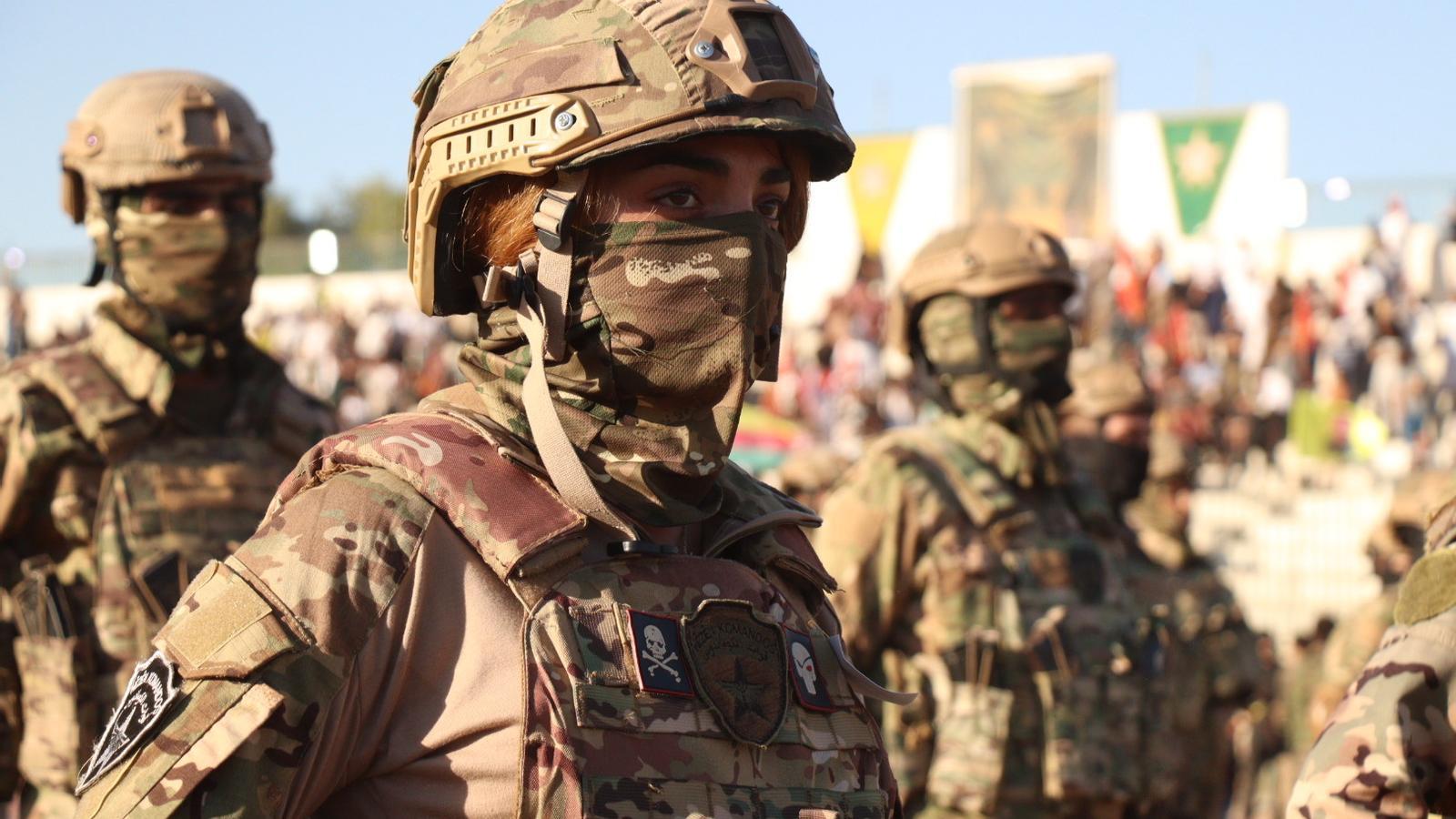
On the other side of the border, in Syria, a similar reconciliation process is underway, but at a more advanced stage. However, among many Syrian Kurds there is a clear sense of loss, as they enjoyed a semi-independent entity for about fifteen years known as Rojava. Their experiment collapsed at the beginning of the year, once Washington withdrew its support and Damascus troops launched a rapid and successful military offensive. The pro-Kurdish militia of the Syrian Democratic Forces, linked to the PKK, and the region's political institutions were forced to dissolve and integrate into the Syrian state in exchange for recognition of their cultural rights, including the consideration of Kurdish as an official language. For now, however, this status is more symbolic than real.
Nor does it seem that the ambition for Kurdish sovereignty can materialize in Iran. At the beginning of the current war in the Persian country, Donald Trump flirted with the idea of arming the Kurdish-Iranian militias based in Iraq and using them as infantry. However, the idea did not prosper. In fact, the ayatollahs' regime has proven to be stronger than expected and its collapse does not seem imminent. Finally, in Iraq, the trend is a progressive lamination of Kurdish autonomy by a strengthened Baghdad government. The hope that the wave of changes in the Middle East triggered in 2011 is long gone. Kurdish dreams of sovereignty, once again, will have to wait.
