Euthanasia, the first right that could be repealed with a PP-Vox government
Catalonia, promoter of the regulation, is the territory with the most applications and services provided in the State

-
CAT -
CAST
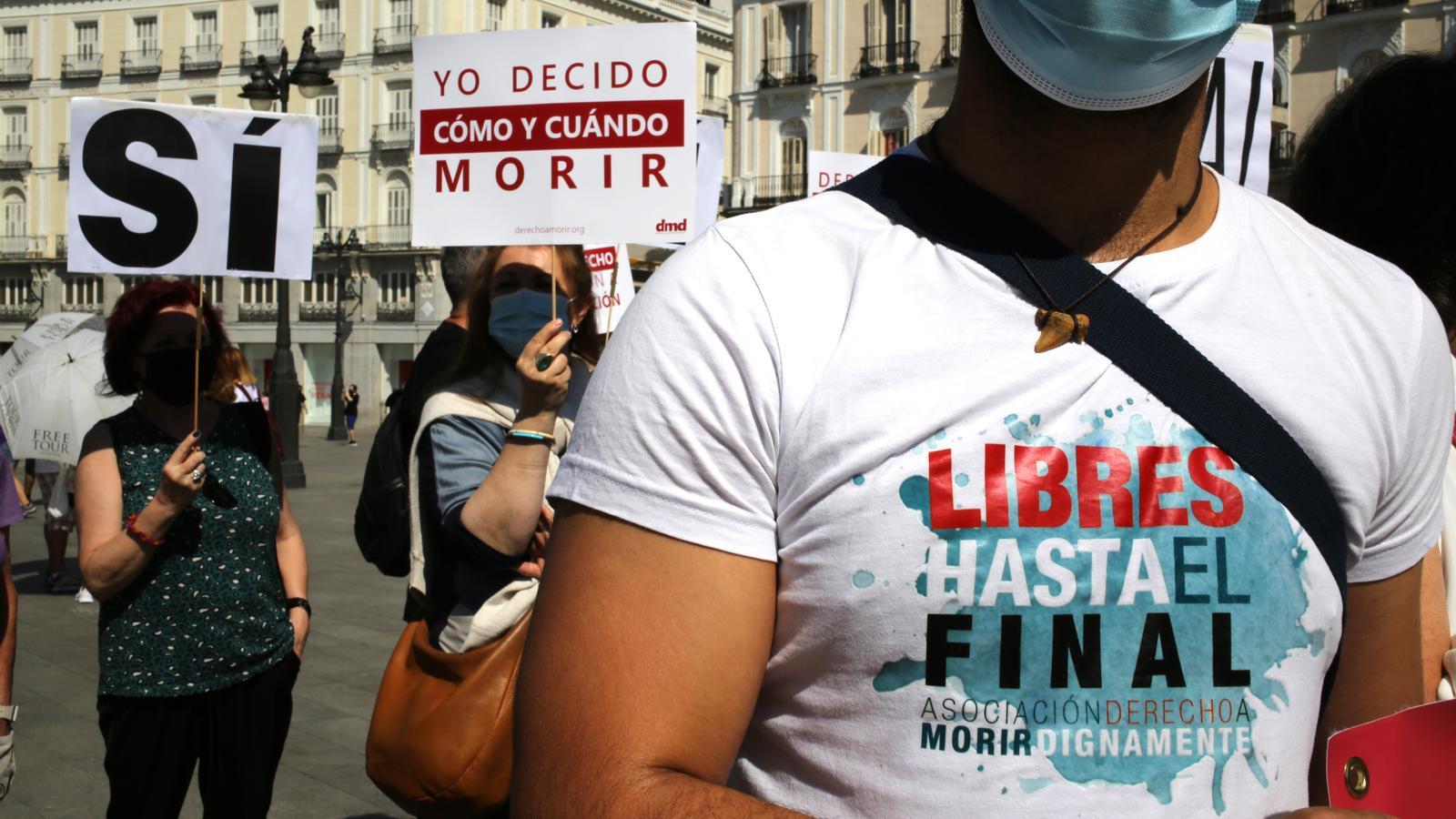
BarcelonaIt took 27 years of demands, suicides and assisted deaths in clandestinity, and parliamentary initiatives and debates –mostly driven from Catalonia– before Spain became, in March 2021, the sixth country in the world to legalize euthanasia. Five years after the approval of this right –at that time with the support of four out of every five residents in the State and, in the case of Catalonia, also 92% of healthcare professionals–, the possibility of the PP and Vox reaching the Moncloa puts it at risk. While Alberto Núñez Feijóo has been hardening his tone regarding the “need to reform” the regulation in favor of palliative care, Santiago Abascal's party has described it as “legal homicide” and has assured that, with them in the Spanish government, they will do everything possible to repeal it.
Euthanasia allows Spanish adults with a serious, chronic, and intractable illness to request to die in a healthcare facility or at home to leave behind their incurable suffering. For the most part, applicants have an oncological or neurodegenerative disease without treatment. The process, however, can only proceed with the express will of the person who wants the benefit, in consensus with their doctor and with the endorsement of a committee of experts that analyzes each case.
Having a disability or a mental health disorder, being elderly, or needing help for daily activities does not grant the right per se. In fact, no situation automatically grants euthanasia. The regulation delegates the management and application of access to this benefit to the regional governments, but the process has a common and fixed regulation: it begins with the mandatory submission of two voluntary requests separated by at least 15 calendar days; then, the doctor must provide information about the diagnosis and palliative care to the patient, who, if they wish to proceed with the process, must be evaluated by their responsible physician and another independent one.
Finally, the case must receive authorization from the guarantee and evaluation commission, specific to each community and formed by professionals in medicine, law, nursing, psychology, and social work, as well as patient associations. The applicant may revoke their decision at any moment during the procedure, and there is also a register of objectors, which excludes professionals who do not agree with it from performing it.
The latest complete euthanasia data in Spain is from 2024: 929 residents in the State had formalized a request for a dignified death (they had an open file) and 426 received it effectively. Of this nearly a thousand requests, 141 were denied, 54 applicants withdrew during the process, and 308 died before receiving the aid to die. Catalonia is the one that concentrates the highest number of requests and euthanasia procedures performed (303 and 142, respectively), although the Basque Country (50 euthanasia cases out of 75 requests), Navarre (14 out of 31), and La Rioja (6 out of 9) have a higher proportion of services provided with respect to the demand.
The Right to Die with Dignity association has repeatedly denounced that there is great inequality in the State in the application of the law depending on the autonomous community; that is, the place of residence significantly conditions the possibilities of accessing the service, both in terms of the frequency with which it is requested and the probability that the request will be resolved favorably. In fact, the rate of euthanasia per 100,000 inhabitants in Catalonia (1.77) doubles the national average (0.88), and that of the Basque Country, for example, is 2.55 times higher. Conversely, in Murcia, the Valencian Community, Extremadura, and Andalusia, the rates of resolved requests per 100,000 inhabitants are well below the national average.
Various factors can influence this situation, such as government interest in the organization and resources of health systems, the agility of administrative procedures linked to the service once approved, and, above all, the social normalization and demand for euthanasia by the population, with aspects linked to culture or religion, for example.
Five years of persecution
The law has been subjected to intense political, judicial, and religious persecution since it came into effect on June 25, 2021. Before its final approval in 2020, the Spanish Episcopal Conference (CEE) promoted a campaign in favor of drafting a living will so that people would refuse euthanasia and specify that they wanted palliative care; an initiative that misinterpreted the concept of rights, as it assumed that the existence of this benefit made it applicable in all cases and not only upon the express request of the patient, as established by the law.

The PP filed unconstitutionality appeals, which ended up being dismissed in 2023, and later triggered several controversial cases due to conflicts between euthanasia applicants and their family members. Some ended up in court: the case of Noelia, in Catalonia, became one of the most publicized –and used by the far-right– and forced the Supreme Court to make a decision on what role family members have when trying to challenge a euthanasia: only those who have “a close bond” with the applicant.
However, among those who defend it, there are also complaints. With partial data from 2025 – up to June and provided only by some communities – the euthanasia process took an average of two months to be authorized (58 days) in Catalonia, and 144 applicants died while awaiting the resolution. Nationally, the waiting time climbs to 70 days, and 374 people died without receiving the service. Organizations and patients consider that the law still does not sufficiently protect vulnerable people – minors cannot access it, and not all mental health disorders are covered under the provisions, for example – or that there are still too many bureaucratic obstacles that prolong the suffering of the applicants.
Now, however, the right to euthanasia faces a double threat: to the existing difficulties in exercising it on equal terms throughout the country, there is added the possibility that a change of government could eliminate its legal recognition.
Program analysis: PP and Vox, alone against euthanasia

The great defender of the euthanasia law
The socialists needed two attempts to manage to approve, in 2020, the decriminalization of euthanasia in Congress. Since then, the Sánchez governments have firmly defended this right “out of respect for human dignity”.
The first promoters of the euthanasia law
Before the socialists claimed credit for its approval in Congress, in 2017 the parliamentary group of Unidas Podemos - ECP - En Marea had already presented an initial bill to decriminalize euthanasia.
In favor, also for minors
The Republicans participated very actively in the processing of the state law that regulates euthanasia. One of their main amendments, which was discarded from the final draft, proposed extending this right to minors.
In favor, but with nuances
Although they voted in favor of the law regulating euthanasia in 2020, four years later they voted against a support law that allowed for the advance declaration of one's own will.
Promises a reform of the law
The November 29th election manifesto makes no reference to it, but Feijóo has already made it clear in recent days that he would reform the law. Previously, the PP proposed a palliative care law so that “no one is pushed to the acceleration of death”.
Unconditional repeal
The extreme right-wing party advocated for repealing the euthanasia law in 2023. Following the case of Noelia Castillo, it has championed "life laws," with policies for suicide prevention, mental health, palliative care, and support.
