Why is the AfD the most feared far-right in Europe?
Other extremist formations have distanced themselves from the German party due to its especially radical positions and its link with Moscow
-
CAT -
CAST
Brussels / BarcelonaIn 2012, when Europe was fully immersed in the debt crisis, a group of economists, academics, and lawyers opposed to bank bailouts launched the platform Wahlalternative 2013, which the following year led to the founding of Alternative for Germany (AfD). What had begun as a movement critical of the monetary union quickly changed course. The 2015 refugee crisis accelerated its drift toward the radical right and shifted its discourse toward immigration, nationalism, and the rejection of the European liberal order.
Paradoxically, one of the first platforms that gave the AfD visibility was the European Parliament. Its euroscepticism allowed it to occupy a political space that was still little exploited in Germany at the time, and in 2014 the party managed to enter the European Chamber. Since then, the group has moved from primarily questioning the single currency to casting doubt on the entire European political architecture.
More than a decade later, the AfD has become one of the forces that most questions the European project from within. The list of the party's proposals against the EU is endless. They advocate leaving the euro and having Germany recover its own currency, the mark; for Germany to leave NATO; they support the Kremlin, and not only do they demand limiting the power of community institutions, but their most radical sector has the "controlled disappearance" of the EU as its goal.
Isolation in the European Chamber
Due to its more radical positions, European far-right forces have been distancing themselves from the AfD. This is the case with Marine Le Pen's National Rally, a party that for years shared political space with the German party. While the French party has abandoned the idea of leaving the euro and has softened its more Eurosceptic positions to present itself as a governing force, the AfD has shifted towards increasingly radical positions, especially on immigration matters. The rupture was consummated in 2024 following controversial statements by the party's then-candidate Maximilian Krah, who whitewashed Nazism.
The isolation of the German far-right is also visible in the European Parliament. On a European scale, the far-right finds shelter under three major umbrellas. On one hand, there is Patriots for Europe, where the French RN, the party of former Hungarian Prime Minister Viktor Orbán, the Italian League, and Vox coexist. On the other, the European Conservatives and Reformists (ECR), where Giorgia Meloni's Brothers of Italy and the Polish Law and Justice party are situated. And, finally, the Europe of Sovereign Nations (ESN), the smallest and most radical group, led by the AfD. This summer, the European Parliament opened an investigation to determine whether the ESN respects the fundamental values of the EU. The initiative warned of possible incompatibilities between the behavior of some of its members and the democratic principles of the Union.
An eventual government of Alternative for Germany in Saxony could block the application of European regulations in its territory, but it would not have a major legislative impact on European institutions. However, it would weaken Friedrich Merz's government and, possibly, invite him to adopt tougher stances in Europe on key issues such as immigration—as he has already done until now—or the war in Ukraine. In the words of German analyst Tabea Schaumann, from the European Policy Center, the AfD's triumph in Saxony "shapes the political environment in which Berlin negotiates EU files".
The relationship with the Kremlin
One of the key points that help to understand the distancing of a large part of the European far-right from the AfD is its pro-Russian stance, even after the invasion of Ukraine. Alternative for Germany is located much closer to Russia and its interests, to the point that rumors about direct links between party members and the Kremlin have been common in recent years. So far, a direct connection has not been proven, but it is known that there have been occasional contacts between the German far-right and the ideological space favorable to Vladimir Putin.
The Czech intelligence services pointed in May 2024 to bribes from a pro-Kremlin Ukrainian businessman to Petr Bystron, a prominent member of the AfD. Years earlier, in 2019, an investigation by Der Spiegel and the television station ZDF stated that the Russian government provided material and media support to Markus Frohnmaier, at that time a member of the Bundestag. These are just two examples, spread over time, of cases that have raised alarms, among which there are also meetings and trips of German militants to Russia, also after the invasion of Ukraine.
The Eurosceptic proposals of the AfD and the party's battle against the pillars of current Germany are especially useful for the Kremlin. "For Putinism, the AfD is a breath of oxygen because it destabilizes Germany and, therefore, destabilizes the military support that Ukraine receives," portrays Josep Puigsech, associate professor in the department of modern and contemporary history at the UAB. The party is opposed to continuing to contribute to the defense of Kyiv and, contrary to what the government of Friedrich Merz and the European Union advocate, proposes lifting sanctions on Moscow.
The faces of the AfD
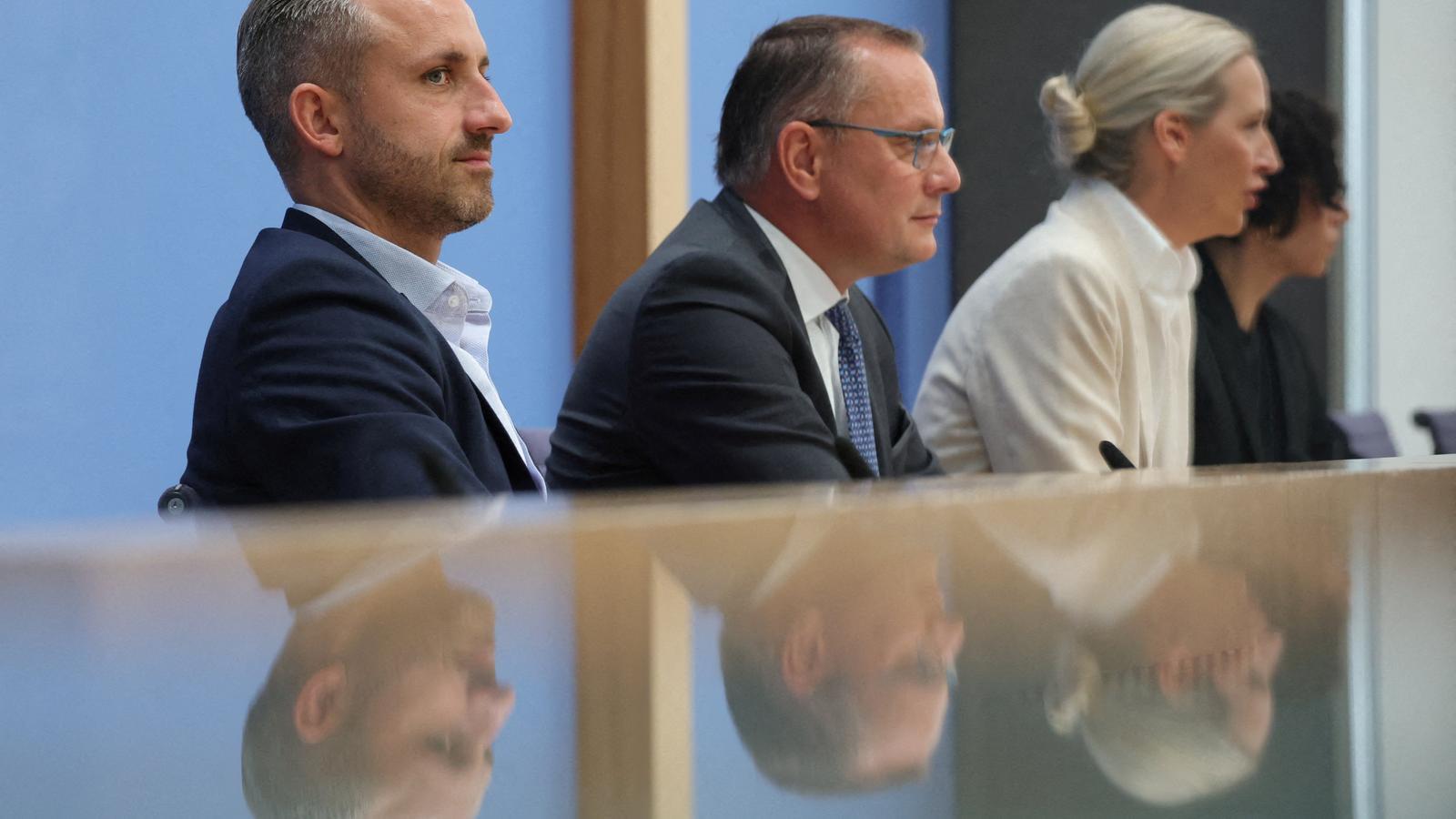
Leading the defense of these proposals are Tino Chrupalla and Alice Weidel, co-chairs of the AfD. Chrupalla, who was born and raised in the GDR, represents the sector of the party most rooted in eastern Germany and is one of the main proponents of the concept of remigration. Weidel, who belongs to the more radical wing of the party, is a controversial figure. While her party rejects same-sex marriage and advocates a hard line against immigrants—including those who have arrived in the country legally or who are descendants of immigrants—the AfD leader is married to a woman who was born in Sri Lanka and was adopted by a Swiss couple. In fact, Weidel spends much of her time outside the country, in Switzerland, together with her wife and the three adopted children they have in common.

Within the party, another of the personalities with the most internal influence and public impact is Ulrich Siegmund, the candidate who this weekend swept the state of Saxony-Anhalt. The newspaper Der Spiegel defined him as "the most dangerous man in Germany", a label that Siegmund has made his own. Beyond the possibility of him coming to govern, what is especially worrying about Siegmund is his trusted team, which includes several people with a common past as former members of the Heimattreue Deutsche Jugend (HDJ), a neo-Nazi organization banned in 2009.

