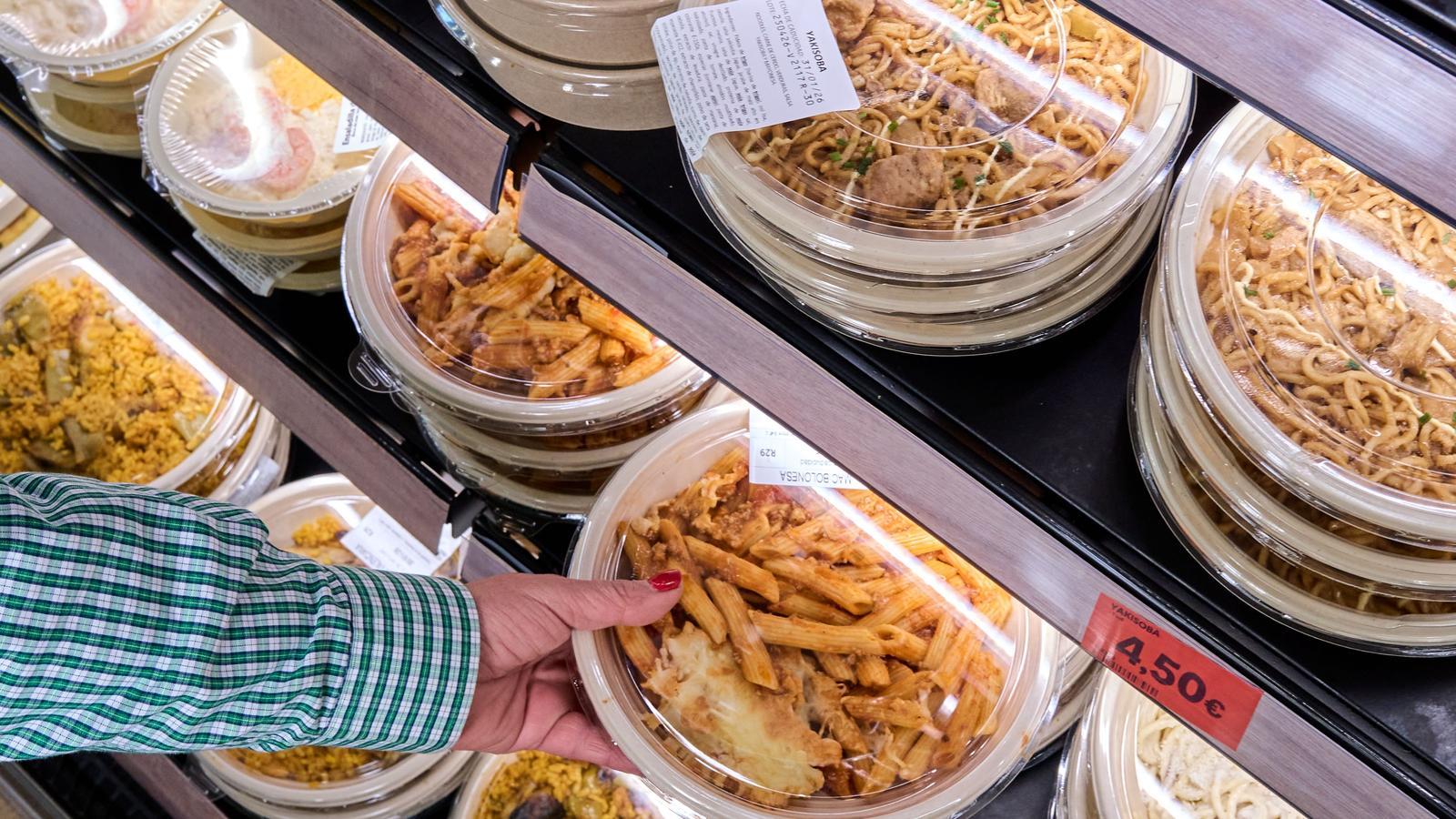
Sunday afternoon is for many the moment to prepare for the week and cook their daily lunch boxes. This is an image that is increasingly combined with that of those who no longer make tupperware on Sundays: they have decided to leave it to chance and buy takeaway food at a supermarket near work and consume it right there, without having had to spend previous time, dirty the kitchen, or spend time thinking about what they will eat or what ingredients are needed to buy for that dish.
It is a whole sector trend that social inventiveness has dubbed with the concept mercaurant (fusing the words market and restaurant), and not because it is a new type of restaurant (in fact, they do not have table service staff) but because they allow you to buy a prepared dish and taste it immediately after on the same premises, heated in a microwave, at shared tables, and with availability of cutlery, glasses, and napkins, a kind of eatery that, it must be said, the Restaurant Guild has denounced.
Takeaway food has existed for years, and also self-service consumption, with the classic Ikea meatballs. But now this way of consuming is shaping up to be a booming trend. The head of Mercadona, Juan Roig, predicted, in fact, that by 2050 the kitchen as we know it today will not exist. "There will be things that we cool, heat up, and it will be a hobby," he said a few months ago. The company's latest annual report indicates that its takeaway service does not stop growing and is already present in nearly 1,470 stores, with an assortment of 40 different dishes.
This is, clearly, a winning service. This is how the general secretary of the Council of Food Distribution Companies of Catalonia (CEDAC), Roger Gaspa, explains it: "Prepared dishes are a very clear megatrend. The whole sector is working to provide an answer to what the customer needs, we follow what the consumer demands," he explains. As he indicates, there are more and more segments of the population that spend less time in the kitchen, from Generation Z to Generation X. In addition, Gaspa points out that we must also look at buying food in delivery format when we are at home, coming from supermarkets and restaurants, beyond the classic pizza. "People prioritize their time and there is an evident reduction in cooking hours," he highlights.
The data highlights this, “with a double-digit trend” that reports like the one from Alimarket three years ago confirm: nearly half of consumers buy ready-made meals once a week, and 39% do so at least every 15 days. “The sector is highly motivated to innovate. We are all heading towards convenience and practicality,” he stresses. In fact, this is illustrated by the sector's dynamism: a few days ago, Ametller Origen incorporated the new Fresc & Go concept, a space with a greater assortment for immediate consumption. “It has come to stay and is a clear and growing trend” with dishes of all kinds: healthy, international, with superfoods, and for those with allergies. In this change, the lunchbox has also lost out. Gaspa believes that “the phenomenon of the increase in the office lunchbox has shifted to the increase in ready-made dishes with very competitive quality.”
Not just time-saving
In this sense, from the Alicia Foundation, food project managers Laia Badal and Fabiola Juárez argue that “what the consumer is buying is time and flexibility.” “We believe that the change is deeper: we live in a society with less time to cook, with smaller households, more fragmented schedules, and a growing demand for flexible solutions,” they say. According to them, in this context, the supermarket is evolving from being just a place to buy into “a space that solves immediate food needs.”
However, the researchers argue that the consumer is now looking for solutions adapted to their daily life. Among their motivations is clearly “convenience,” but according to data from the Association of Manufacturers and Distributors (AECOC), it is also about saving time: “70% try to save time while maintaining the decision about what to eat.” Likewise, 71% consider balanced and healthy products important, while there is a search for relief from mental load: “63% say it reduces the stress of deciding what to cook every day.” Other reasons are economic efficiency, with 53% considering that they allow eating well without increasing spending, and the construction of experience: “61% choose to taste different flavors and introduce variety.”
Single-person households and new consumers
For Ana Jiménez-Zarco, a professor of Economics and Business studies at the UOC, among the users of these grocerants there are people who do not feel like cooking, who are looking for something fast, accessible, and without planning, "like a self-service": "Workers, companies, students, people who live alone and want to get out of the house and do not feel like cooking". In fact, she insists that there is no specific case, but rather that the profile is determined more by the speed of the service and that it does not involve time or prior planning.
For her, this situation responds to different factors, related to the change in the sociocultural model, current family models, economic issues, and business opportunities that are changing supermarket policies, which are diversifying their offer. "The number of people living alone has increased. For people who eat alone, it is a way of not eating in your workspace and it is a leisure space", she explains about consumption in these recreation areas. "It can even be a meeting point", she explains, as already happens among young people who meet at these tables.
On the other hand, Jiménez-Zarco highlights that one eats there "relatively quickly, at an affordable price, and as if you were at home". She also points out that there is no additional fee from the supermarket for using these spaces and it can give the feeling that the consumer is buying "even a fresher product than if they had bought it last week and had it at home, in the fridge". "It gives you variety, speed, and convenience", she considers, which increases the added value and captures certain types of customers who will not go every day.
Some dishes that may (or may not) be healthy
Ready-to-eat meals often have a bad reputation for not being healthy. “Nutritionally, this shift is dangerous. Although we can make better or worse health choices within the range of ready-made meals available, eating them regularly is linked to the development of various diseases such as obesity and overweight, diabetes, cardiovascular diseases, and high blood pressure,” warn researchers at the Alícia Foundation. This is because “many of these ready-made meals include reasonable amounts of salt to make them tastier, added sugars, and oils that are more saturated or have nutritional profiles far from that of extra virgin olive oil.”
The researchers clarify that among the ready-made options, we also find ultra-processed ones, which usually have a long list of ingredients including, in addition to those mentioned, a significant amount of additives, high energy values, and low nutritional quality. “It must be added, however, that a ready-made meal is not always synonymous with ultra-processed, and therefore, we can find ready-made meals with adequate nutritional profiles, prepared with quality, healthy ingredients,” they add.
Thus, it is essential to know how to make good choices, but according to the experts at Alícia, society's change in eating habits, also conditioned by the high volume of existing information regarding nutrition, which ends up becoming information overload, “does not exactly help in this task.” Furthermore, they warn that this change implies a loss of culinary knowledge and, consequently, of gastronomic and cultural identity, in addition to a move away from the Mediterranean diet pattern, which affects not only what we eat, “but also how to prepare it, how we relate to each other while we eat, and how we relate to the environment from which it comes.”