Händelian calculation error
Thibault Noally gives a flat reading of Handel in the concert version of the opera 'Agrippina' at the Palau de la Música
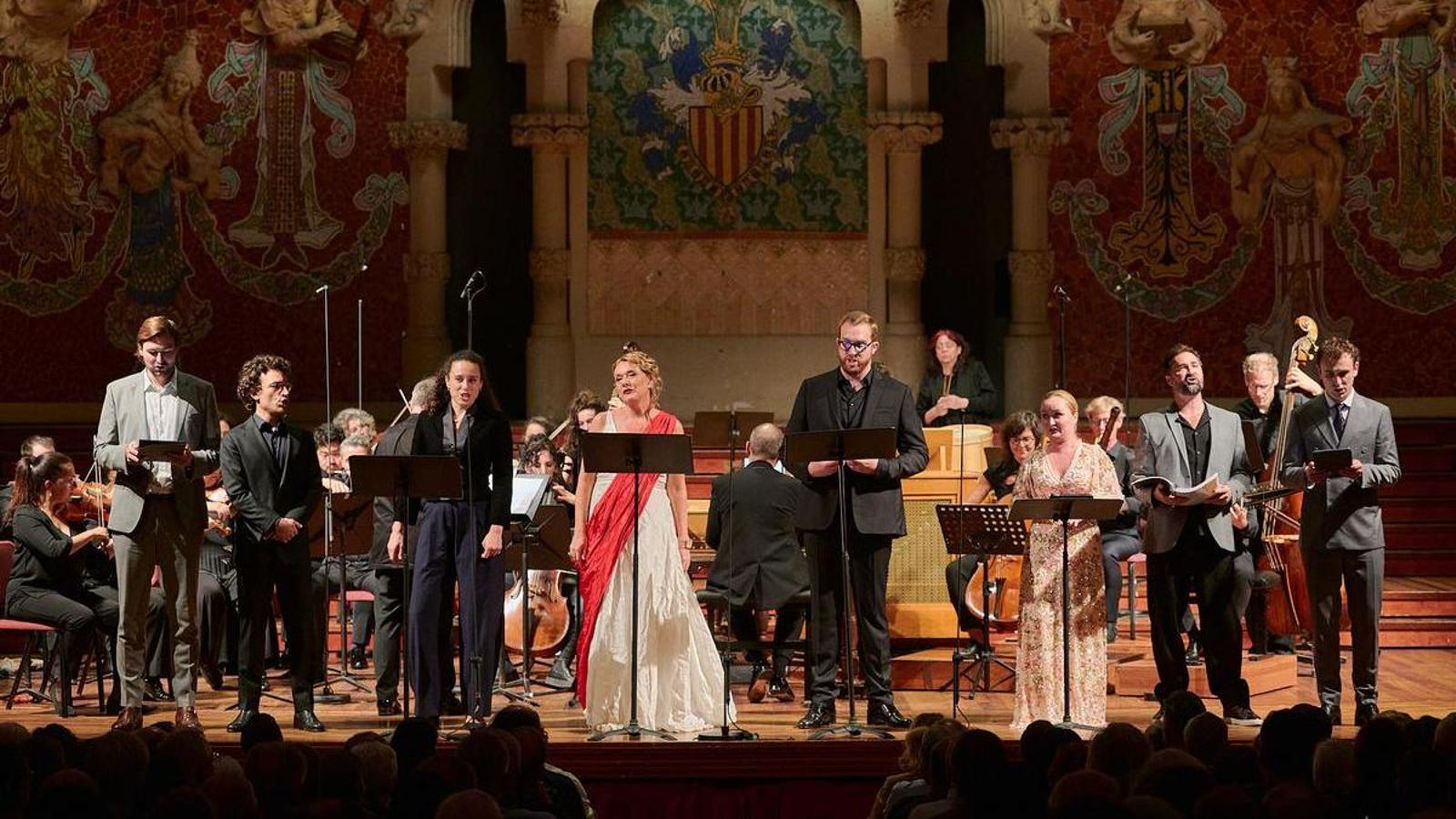
-
CAT -
CAST
- Palau de la Música. November 18, 2026
For years, the Palau de la Música Catalana has been programming operas in concert version. And it has been dedicating special attention to Georg Friedrich Händel, an essential element of Baroque theater with titles that, thanks to the initiative of those responsible for the modernist auditorium, allow for revisiting. However, one must be very selective and carefully calculate which work best suits the stage of the Palau. And above all, one must be sure of another thing: in whose hands the responsibility of conducting one title or the other will fall.
This week's case of Agrippina constitutes an error on several levels: firstly, the work itself. Handel wrote it to bid farewell to Italy and with a prototypically Venetian style, seeking theatricality not only in the recitatives, but also in arias that are shorter and generally less pyrotechnic than those he would write for the London cycle. For this reason, it is a work that can become indigestible in concert version, as much for its own constitution as for its internal dynamics.
However, in second place, it must be said that the reading by Thibault Noally leading the instrumental ensemble Les Accents turned out to be flat, without theatrical form, unimaginative and routine. Especially throughout an exasperatingly endless first part. Perhaps things improved a little in the second part, although without too much joy.
On the other hand, the soloist lineup did not allow the vocal feast to be homogeneous and of a high level either. Only the soprano Julia Lezhneva lived up to what was expected of her in the service of Poppea: audacious agility, musicality, dramatic intention, and good taste in emission and projection managed to convince the most skeptical and caused the room temperature to rise a little. At a greater distance, the mezzo Magdalena Kožená has lost some of the qualities of a voice that a decade ago was one of the best in her range and which now preserves quite a few qualities, even though the sound sometimes turns out to be opaque and poor. Insecurity took hold of her Agrippina, to the point of getting lost in the first part (and that was with the score in front of her!).
Correct the Ottone by Christophe Dumaux, although the vocal color of the French countertenor did not seem to have the appeal he has exhibited in other performances. But overall, he was the singer most involved in the theatrical aspect and for that he must be thanked. Disappointing the Claudio by Nicolas Brooymans, a bass with secure low notes but of dubious intonation in the high register and with some vulgar solutions in the vocal line. And correct the rest.
