Diego Alías: "We serve the first glass of wine, but then we leave the wine on the table; we are hospitable but not servants"
Cook

-
CAT -
CAST
Josa del CadíI am interviewing Diego Alías (Sant Joan de Vilatorrada, 1977) on a summer day when I need to put on a jacket. It is early in the morning, which in Josa de Cadí is experienced with mild temperatures and leaves a green landscape, clear of clouds. In the kitchen of Ca l'Amador, as Diego's restaurant is called, the fires have been lit for a while now. They have all the tables full, as is usual in high season. Ca l'Amador has become a desired restaurant, and that is why they are full every day. Everyone knows that in Josa del Cadí there is a very good cheese shop, Serrat Gros, and Diego, who is cheerful, welcoming, and energetic. The day we speak with Diego, he is very busy between the daily menus and the 'pianatada' he is preparing, a piano concert on the restaurant's threshing floor. He lacks hours. We begin our conversation about the school where he trained, the Joviat of Manresa.

From the Joviat cooking school, you are a batch of chefs who are at the forefront of Catalan cuisine.
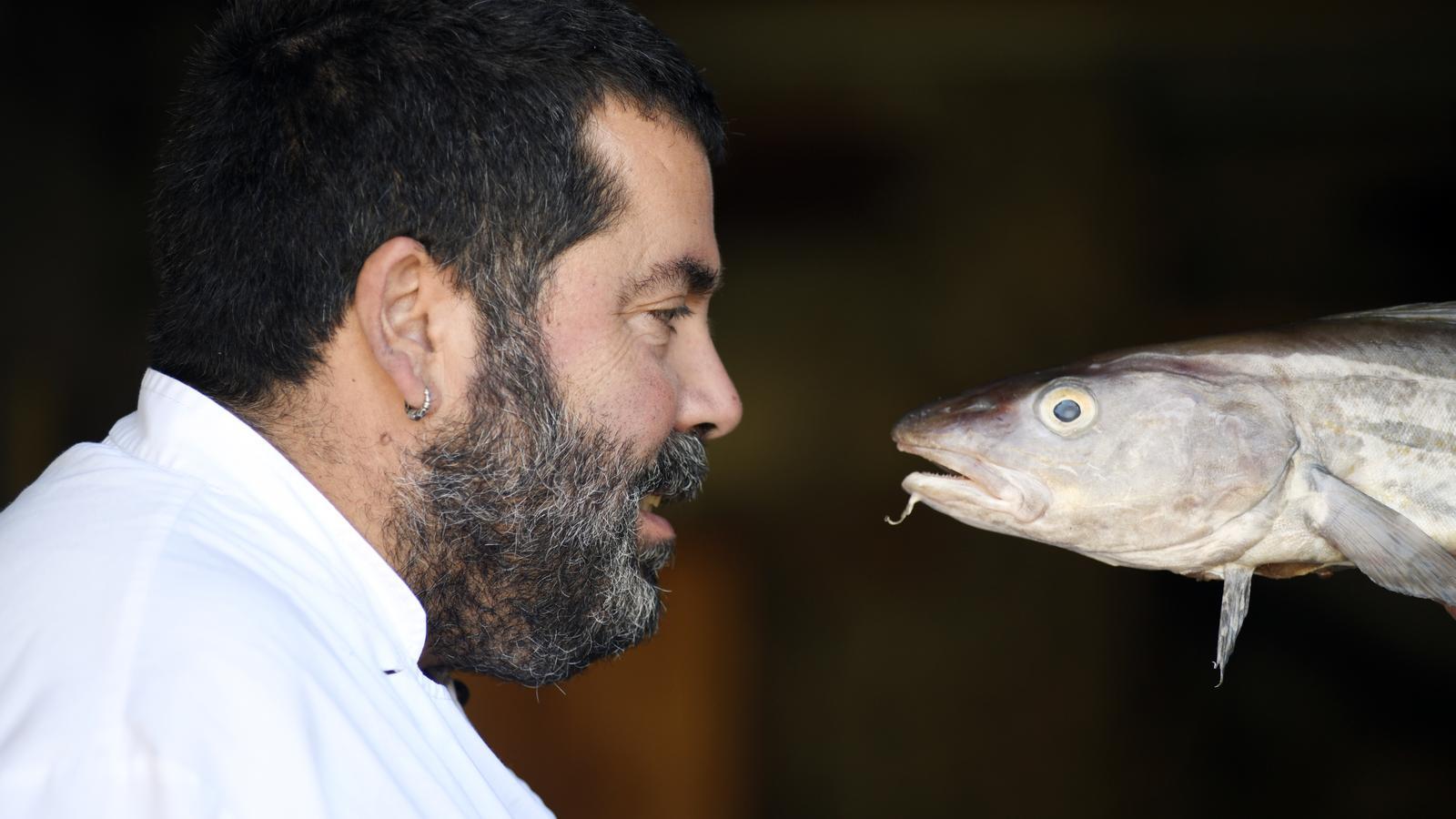
— Oriol Castro, Oriol Rovira, Jordi Cruz, Jordi Vilà; they were a year or two ahead of me. Joviat, which has its own publishing imprint together with Parcir, has published a book about our restaurant called Cod, health and luck! In fact, "Health and luck" is our motto.
In Josa de Cadí, there are many of us who come specifically to buy cheese at Serrat Gros and for your restaurant. What is your relationship with the town?
— My parents came from Almeria and bought the house in Josa, Ca l’Amador. In Josa, every house has a name. Later they went to live in Sant Joan de Vilatorrada, and we used to go there to spend the summers. My uncle was the last of the family to be born in Josa. So we have always had an emotional bond with it.
Does lunch always start at the threshing floor, out here, outside?
— Yes, whoever has a table inside the restaurant has a table outside. We give them that so they can start their appetizer outside or have their dessert there. We offer service for 25-30 people, always at lunchtimes, and we only open one night a month, exceptionally. I have been in Josa, at Ca l’Amador, for twenty-six years. Everyone knows that this is how the restaurant operates. And today, that you have come, is the first day that a jacket is needed, because we have had an exceptionally hot summer. Here, at our altitude, 1,431 meters, we have experienced a lot of heat.
Everyone has recommended that I choose the tasting menu.
— You can do that, or you can also choose dishes à la carte. The tasting menu consists of eight savory courses and four sweet ones. The people who come feel at home and can choose according to what they feel like having.
It is very difficult to find a table at your restaurant. You must have already been told that.
— We are open from the end of February until the end of December, from Thursday to Sunday. In August, every day. We only serve lunch and the capacity is as I mentioned to you. The first weekend that I have free tables this year is in November.
Let's move on to the dishes. I ate a river trout, very good. Is it locally sourced?
— I used to buy it in Tavascan, and now it comes to us from Jaca. It is farmed. It is impossible to buy local ones. I cure it as if it were a salmon, and I serve it with guanciale from Porreig. Trout is the mountain fish; I would like it to be local, white, but ours get stressed and cannot grow large, which are the pieces I need. That is why it is complicated to buy them from here.
The kid goat dish made me think that in Josa you neighbors get along very well. Do you buy the goat meat from the cheesemakers at Serrat Gros?
— I almost keep all the kids myself, which we slaughter at the beginning of the year, freeze them, and serve them throughout the year. Apart from the kid leg you have eaten, we also make a ravioli with it. The rib, I cook it at a low temperature and then sear it on the grill. With the innards we make an appetizer, which is a crispy 'blat de moro escairat' (husked corn), which is from the Alt Berguedà. Today I gave it to you made with chicken, but until last week it was kid, kid from Serrat Gros.

Cod is another mountain fish. For your family, very dear.
— My parents had a salt cod shop in Manresa. We have a strong connection to it. I buy the cod loins, hydrate them, and desalt them. Then we serve them with green sauce. I also make my mother's recipe, which is cod battered in flour and egg with confit onion.
The caramelized foie gras made me think of the chef Alex Montiel.
— It’s actually his recipe! Alex and I are very good friends. In this country, everyone who caramelizes foie gras knows where it comes from: Montiel. I serve it with a white eggplant from Bages, which is very good. Alex used to serve it with smoked eel and apple. Later, the Basque chef Martín Berasategui made it exactly the same way. It must be one of the most copied dishes, and I think one should always say who created it. It’s like the frozen orange soufflé: if we have it on the menu, we must always say that the inventor was Francesc Fortí from Racó d'en Binu.
That is why you always say on the menu whose dishes they are.
— Yes, with the lazy omelette, I do it too. I say it's from the chef Sacha.
But the lazy omelette is like our traditional Catalan open omelette.
— Yes, that would be it. I add zucchini, potato chips, which we also make. And depending on the day, I also add white sausage, sobrasada.
Do you have a vegetable garden?
— My father, yes. He grows onions, potatoes, zucchinis. Look, right now he is coming through the restaurant door and look what he is carrying in his hand: zucchinis. He does not want to grow peppers or tomatoes because they are expensive. My father lives in Sallent, but during the summer, in Josa.
I am asking you about the menu prices.
— We have a format that is €65, which with drinks can be €80. I have wines for twenty euros from the area and from all over Catalonia, very good ones. I also have some for a hundred, but the twenty euro ones are excellent. I see that people leave happy. Furthermore, since we are romantic, we make our own beer with the people from Refu, in Viella, which has a lower alcohol content. We also make a rosé wine, with the Oller del Mas winery, from Manresa. It is very good.
Diego, Ca l’Amador has become a classic restaurant, which everyone recommends. One of those places that you have to go to once in a lifetime.
— We have been working here for twenty-six years! We are a classic restaurant because there are not many that last. And that do so with the parents, with the same team.

When you come to Ca l’Amador you come to spend the day.
— Yes, of course. Because you have to come to Josa specifically; it is not on the way. Clients arrive at 1 p.m. and leave at 7 p.m. They spend the day there, because they take it as a holiday. For both the clients and for me, the intention is that they feel it that way.
Explain your theory about hospitality.
— We always serve them the first glass of wine, but then we leave the wine so they can pour it themselves. We are hospitable, but not servants. We also have tablecloths, which is how the table is well dressed and welcoming.
To finish, Diego, how do you imagine yourself in the future?
— I see myself at Ca l’Amador. I cannot imagine myself anywhere else. I provide consulting for some projects, but nothing more. Ca l’Amador is my future.
