Lula da Silva stars in a historic comeback and Trump speaks of "fraudulent elections"
The Brazilian leader defeats by 4,430,000 votes the son of Jair Bolsonaro, who does not recognize the result and assures that the justice system has asked him to hand over his passport

-
CAT -
CAST
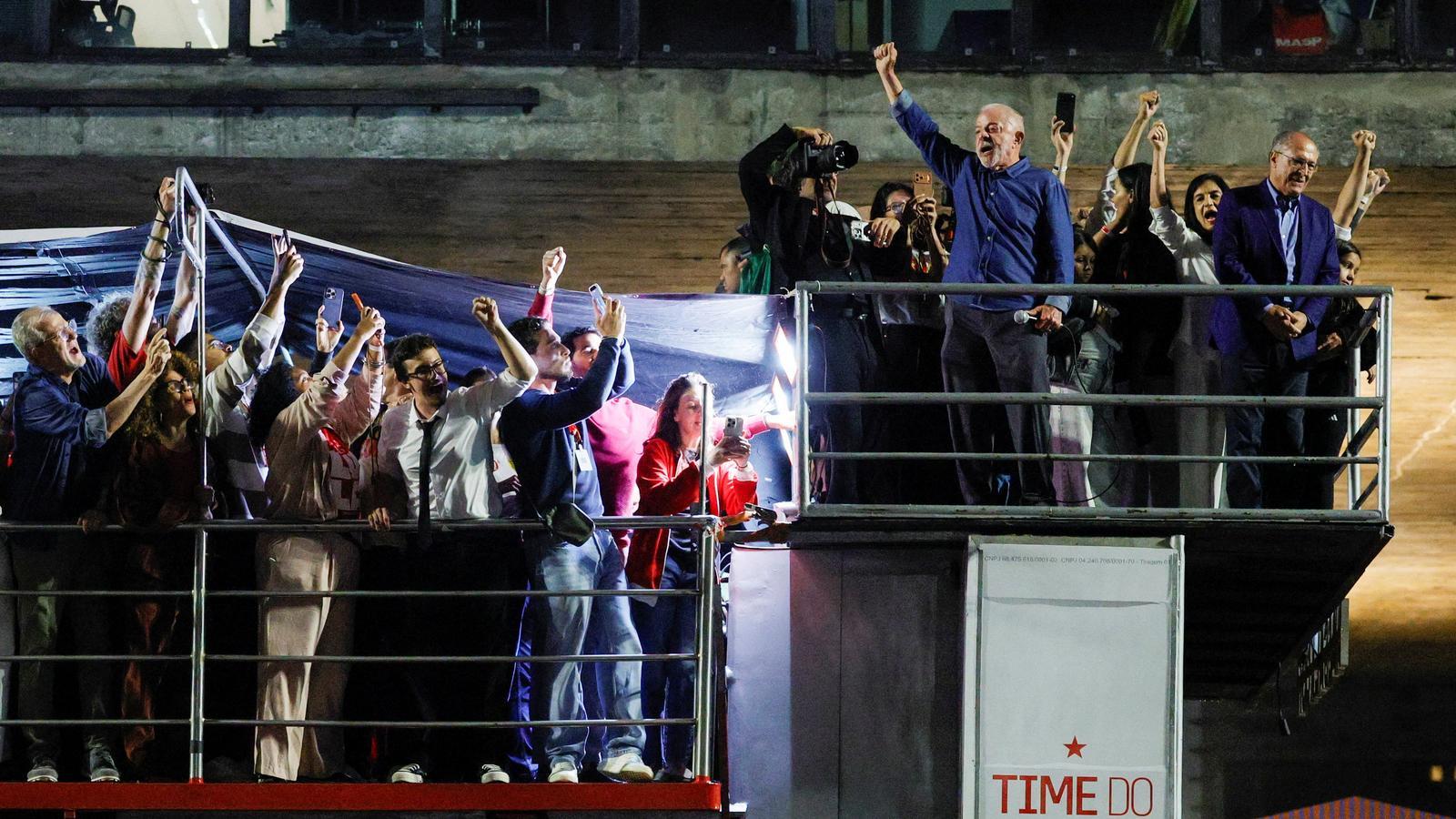
São PauloLula da Silva has added to his legend this Sunday with a resounding, improbable, and unprecedented electoral triumph, which will give him the possibility to exercise, at 80 years old, a fourth and final term as president of Brazil, with which he will close a long political career. There was no precedent in the New Republic –born from the 1988 Constitution, which the extreme right threatened to blow up– for the loser of the first round to be able to turn the situation around in the second round. And the "father of the poor", driven by the force of giant street mobilizations, has achieved it. The candidate of the Workers' Party (PT) has added 51.79% of the support (64,255,891 votes, the highest figure ever achieved by a candidate in Brazil), against 48.21% (59,825,984 votes) for Senator Flávio Bolsonaro, of the Liberal Party (PL).
Lula's reaction, which none of the polls prior to the runoff had anticipated, is monumental, because he has gained 10.3 million new voters compared to the results from three weeks ago and has improved in all states. The key to the left's victory, which breaks the domino effect of the far-right in Latin America, where Donald Trump's allies have won the last seven presidential elections, has been the successful tactic of widening the electoral base through the mobilization of abstainers—who have decreased by 3% compared to the first round. And he did so by stoking the discourse of fear among the poor and the elderly regarding the chainsaw that Bolsonaro's son would apply to social programs and pensions, following the ideology of Javier Milei in Argentina, with cuts that could exceed 50 billion euros.
The other successful axis of Lula's candidacy was politically dismantling the firstborn of the Bolsonaro clan, who, throughout his parliamentary life in Rio de Janeiro and Brasília, has established a very close relationship with paramilitaries, whom he has always provided cover for, and who has accumulated numerous corruption accusations. The most recent is his alleged involvement in the Banco Master case, liquidated by the Brazilian Central Bank: he reportedly asked for 24 million dollars from Daniel Vorcaro, the entity's owner who is currently in preventive detention, to finance a biographical film about his father, former president Bolsonaro.
Anti-Bolsonarism and the defense of democratic institutions, which the coup-plotting far-right threatened to implode with control of the executive branch and a parliamentary majority, have overcome anti-Workers' Party sentiment and anti-Lula sentiment, the permanent fuels of extremism for decades. “This election has been the defeat of denialism and lies. Every time I went to a debate, I felt uncomfortable. I never thought I would find myself in front of a genuine representative of the paramilitaries. I would never have imagined that I would find myself in front of someone with such ease, who does not have a single cell of humanity,” Lula pointed out in his victory speech in São Paulo, where he called for reconciliation in a country still torn by polarization. “There are no adversaries, I will govern for the 215 million Brazilians,” he said.
Message to Trump
For Lula, his fourth presidential triumph represents “the victory of honesty and nationalism” in the face of interference from large US tech companies and the secondtariff hike by Donald Trump, which remains in effect on Brazilian imports.
“The enthusiasm of the demonstrations that have taken place these days is a demonstration that this country does not accept being anyone’s backyard. We speak as equals with everyone,” he pointed out, in response to the coercive control that the Republican administration exercises throughout the American continent, which it considers its natural sphere of influence.
The Brazilian president has railed against "the interference of digital platforms", which have been accused of favoring the Bolsonarista candidacy, and has announced that they will have to "regulate them", which points to a new focus of conflict with Washington. “It is not possible that digital crimes are not treated the same as those in real life,” he remarked.
Bolsonaro does not recognize the result
Lula's euphoria, who has promised that he will carry out the best term of his career, contrasts with the stance of Bolsonaro's son. From Brasília, the defeated extremist candidate has announced that he will request the annulment of the elections, after Supreme Court Justice Cristiano Zanin decided to extend the closing time of the polling stations by two hours. The measure was taken due to problems in public transport in several cities in the country, such as Salvador and São Paulo, governed by far-right mayors allied with Bolsonarism, who allegedly deliberately reduced the bus fleet to try to hinder the mobility of the poorest voters, who are mostly Lula voters.
“What happened today was not normal, it was even unacceptable. A Supreme Court Justice, who had been Lula's lawyer, for the first time, takes up the pen at the request of a former client of his and changes the rules of the game mid-match. At 5:01 p.m., Justice Zanin, who is not part of the Electoral Court, bypassing the specialized electoral justice system, makes a decision to extend the voting by two hours. This had never happened in the history of Brazil,” he declared, surrounded by his campaign team.
He also remarked: "It is impossible for us to recognize the results," which will open a legal battle that could be accompanied by mobilizations, like those that occurred four years ago, when Bolsonaro's father lost the re-election to Lula and his most radical supporters gathered in front of army barracks calling for a coup d'état. From the United States, Trump supported this Monday the thesis of electoral fraud: "I haven't taken a position in favor of anyone, but they seemed like fraudulent elections to me," he indicated, without providing any evidence of irregularity, only to immediately assure that he "likes" Lula and that he gets along with him.
The defeat is a very hard blow for the entire Bolsonaro clan, as the eldest son intended to decree a pardon for his father, who is serving a 27-year prison sentence for an attempted coup d'état, and with whom he even wanted to climb the ramp of the Palácio do Planalto on January 5th, during the inauguration. Now it is also unfeasible for Flávio's brother, the former deputy Eduardo, established in the United States, to return to Brazil, where he could be tried for having promoted Trump's tariffs policy. The family had bet heavily on returning to power and, starting in December, Flávio will not hold any elected office for the first time in 24 years and will lose his parliamentary immunity, at a time when the Supreme Court is investigating his relationship with Banco Master and his ties to his friend, the lawyer Willer Tomaz, from whom the Supreme Court has ordered the freezing of 900 million euros because it suspects he is laundering money.
In this context, Flávio Bolsonaro has assured that the country's federal police have legally required him to hand over his passport, after his brother suggested that, in the event of losing the election, the best thing the former president's son could do was to leave the country. Faced with the judicial requirement, the loser at the polls has assured that he intends to comply with the judicial request and has denied that he planned to flee Brazil.
