Gemma Urgell: "Cheese gives us food and happiness: what more do we want?"
Cheese refiner
-
CAT -
CAST

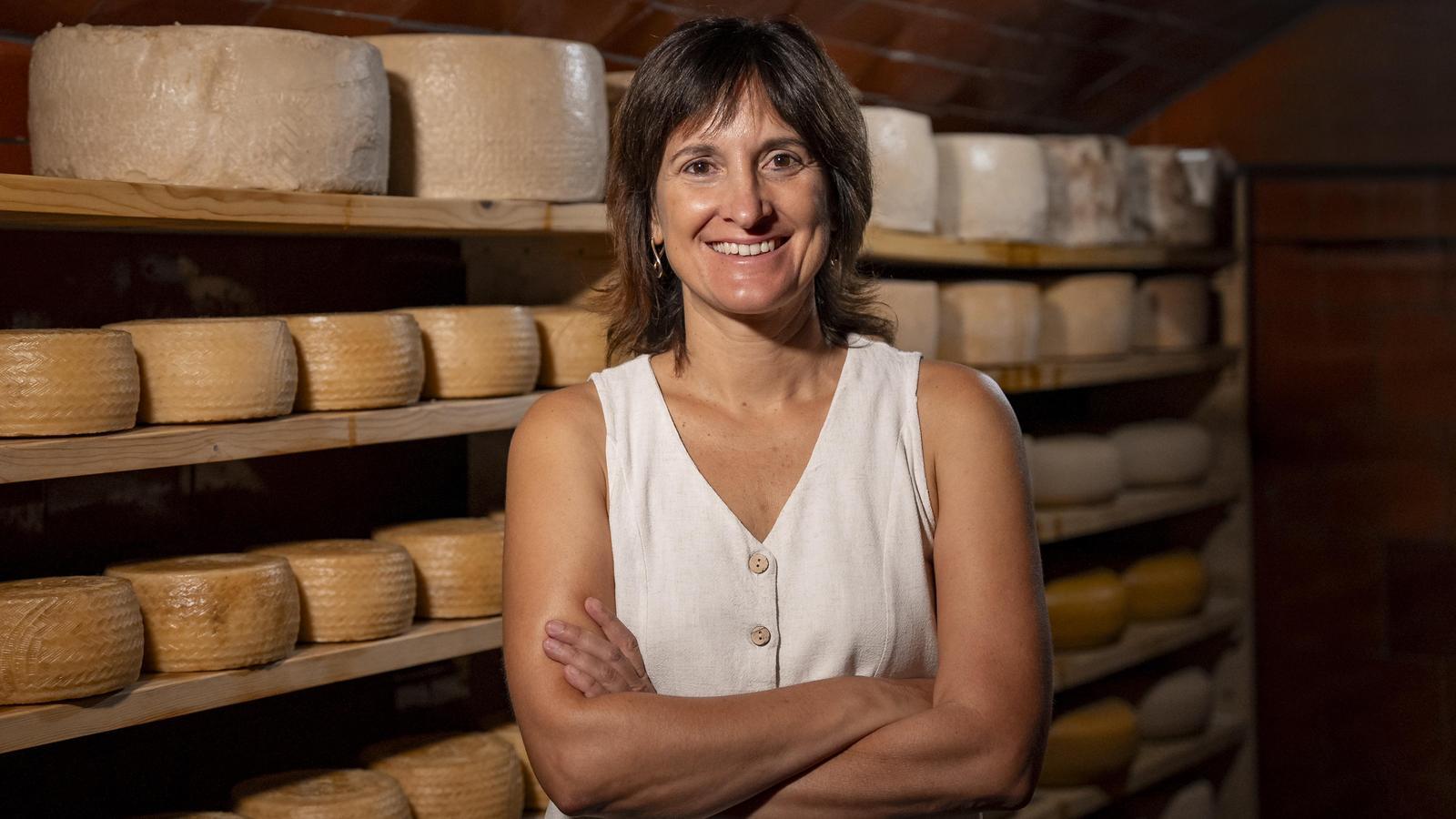
All four of them appear, at a stop midway through the trip, with the fun-loving demeanor of a family vacation. These camper van trips are also behind the Xerigots space that Gemma Urgell and her partner, Jordi Bertran, created in Vilafranca del Penedès. Now they have published Formatges (Rosa dels Vents), with recipes and tips, and also the explanation of their craft: that of a cheese affineur.
Why refine, like an instrument?
— For the affineur (French cheese refiner). The instrument is already made, and tuning it means getting it ready to start playing it. It is the same with cheese: we put it at the optimal point for consuming it.
But everyone tunes their violin to reach the same A. Is there an A in the cheese?
— There is no single language that says: it has to be this way to sound good. There is no dictionary, no manual, and no alphabet. We have a base and we play with tastes: the different types of milk, the different ways of preparing it. And it is this kind of anarchy that allows you to adjust it to everyone's taste.
Anarchy!
— I suppose this allows us to be more creative. But we also make more mistakes; we work a lot with trial and error, and then we write it down.
What is a common mistake?
— Overdoing it. You think: let's leave it a bit longer, it will work much better. And when you open it, it scratches the throat so much that it no longer has the creaminess you were looking for.
Are industrial cheeses also refined?
— On the contrary: they are designed to always be the same, and their ripening is slowed down. Thus, they cease to be food and a living ecosystem that changes with time, humidity, and temperature.
A living ecosystem. What a nuisance.
— It also happens with wine, with aged meats, with fish. It is part of the richness of gastronomy. Cheese has a magical point that makes it unique. Otherwise, we would all feed ourselves on pills and bars.
Sandor Katz says that cheese is a testament to human ingenuity.
— Cheese exists because of the actions of people who did not want their milk to go bad. It is very beautiful to see how each cheesemaker works in each area, depending on the tools and raw materials they have at their disposal.
How do they change?
— Great alpine cheeses can weigh 40 kilos, because they have impressive pastures, and cow's milk allows for large, long-matured pieces. When you taste a Manchego, you imagine the arid landscape.
And the Catalans?
— We have a very diverse ecosystem. There are the dry sheep cheeses from the Tormo mountain range and the large cheeses, French or even Swiss style, from Cerdanya. Catalonia is not historically a cheese-making country, and that has allowed us not to be tied to one way of doing things. If we were La Mancha, we would only make Manchego.
Like Adrià, who was able to experiment more because he was not so tied to a tradition?
— Completely. The cheesemakers here should not be confined to a single cheese. We have goats, sheep, cows, and now also a bit of buffalo. Whoever makes Garrotxa—which is on its way to having a PDO—also makes many other things. And there are super fun cheeses.
Fun?
— Fun because they can appear at any moment to save your day. Fun because you can share them. At the 15th anniversary party of Xerigots there were 124 cheeses.
What a… stench?
— To me it is not a stench, but I understand that it may seem so. In the end, the stench of feet also comes from a fungus. Everyone has their own web of scents. Perhaps those who complain about the stench, after a while find it pleasant.
Has a cheese ever made you cry?
— Crying, no. But it has given me goosebumps many times. And I have seen people at tastings with emotional eyes. I can say that I have seen people in ecstasy.
Some speak of addiction.
— You start and you don't stop. Or every day, at dessert time, your body asks for a little piece. It is scientifically recognized that the digestion of casein generates casomorphin, which is an opioid.
Should I be worried?
— No. They are very low doses. But it explains, in part, the happiness it generates in us. It is a product that gives us food and gives us happiness. What more could we want?
Which prejudices have disappeared in the 15 years that they have been dedicated to it?
— At the beginning, it was often said that “the doctor has forbidden it for me”. Now people know that if they eat a little bit, nothing will happen to them. And before, a brie was any white-rinded cheese. Today there is more knowledge. We have worked very hard.
And the idea that Catalan cheese cannot be as good as others?
— There are cheese dairies that do a brutal job, in the same division as the French, the Italians, and even the English. The thing is that we don't have a very large production.
If we had to ration it…?
— It would come out to very little per person. And yet, we consume little of it. Especially on the coast, towards Barcelona. In the Pyrenees, it is more in their DNA: people know it and restaurants cook it.
Why have you dedicated yourself to cheese, and not to bread or wine?
— Not to bread, because I am celiac. And not to wine either, because we live in the Penedès and we knew that there were many projects underway. We really like traveling with the motorhome, especially through France, and cheese was always present there. And, in fact, at home there had always been some: my father would end every meal with cheese.
Dedicate the book to his children. Do they eat Mini Babybel?
— They are quite the gourmets. The little one had a bit more trouble with cheese, but we have been re-educating him [laughs]. Now he always wants to grate good quality cheese.
We reach the end of the meal and there is no cheese. Cheesecake, yes or no?
— A few years ago I would have told you that it was a crime, because they were made with industrial cream cheese. Now there are bakeries, like Sant Llehí, in Cardedeu, that work with artisanal cheeses.
Therefore…?
— Ask what cheesecake they have. If they tell you it's Philadelphia, get out.
