Zadie Smith: "It still moves me to remember how well they treated me at the hospital when I was only 15 years old"
Novelist and essayist

-
CAT -
CAST
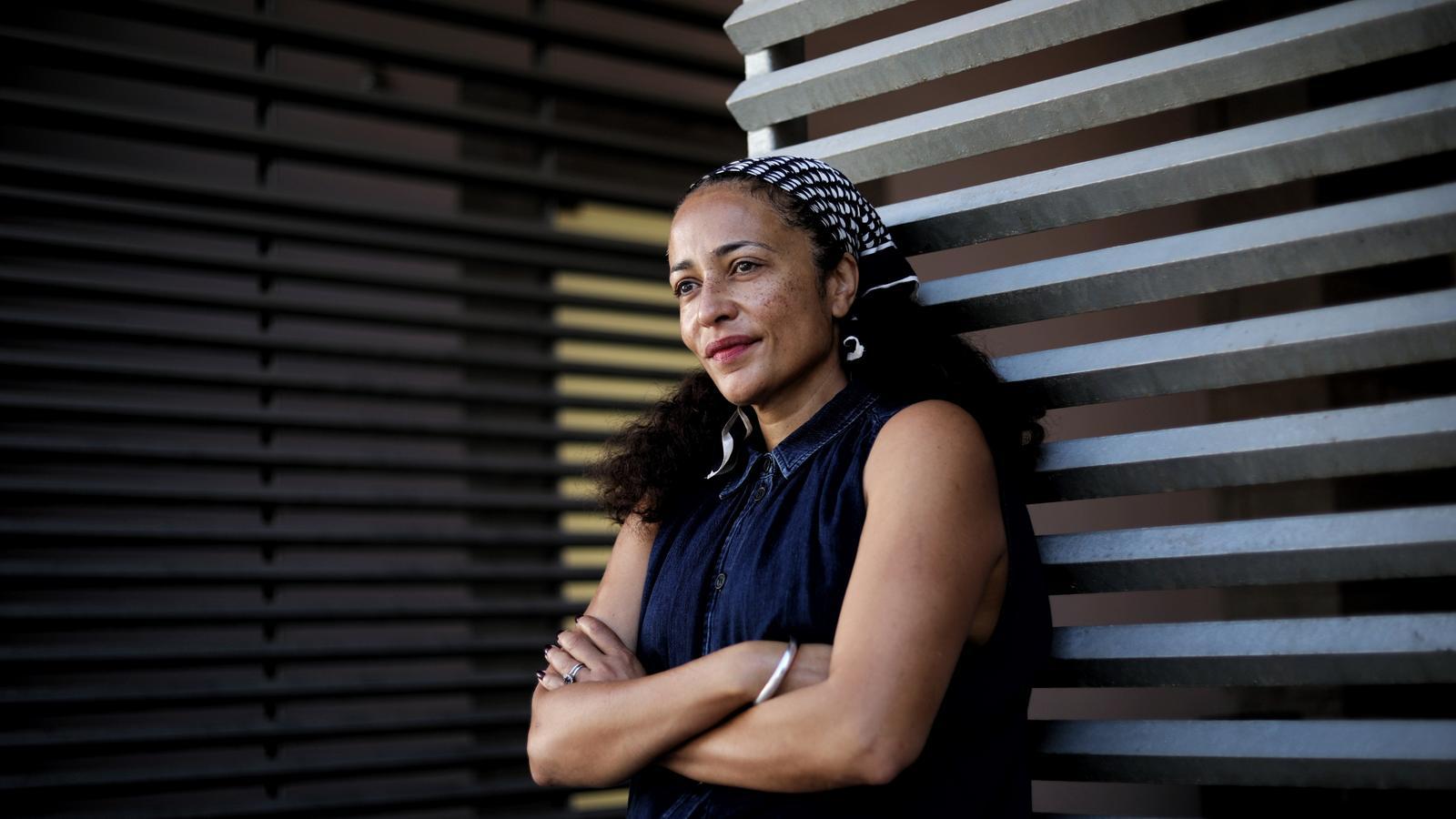
BarcelonaIn person, Zadie Smith (London, 1975) has as much character as the protagonists of her novels. For years, the author of novels such as White Teeth (2000) and NW (2012) –in Catalan at La Magrana– has combined fiction with essays, and this week she has visited Barcelona to present her latest and lush collection of non-fiction texts, Feel Free (Jande/Salamandra; translated into Catalan by Elena Ordeig Vila). In it, she recovers articles published in the press, prologues, award acceptance speeches, and some unpublished pieces where she combines autobiographical notes with burning issues of current affairs, such as addiction to mobile phones and the resurgence of racism. Smith, who has shared a conversation about beauty at the CCCB with the writer Édouard Louis, regrets having agreed to give interviews after having had a rough night. Perhaps that is why her answers are brief, although they cannot avoid containing, in essence, a sample of the novelist's intelligence.
One of the themes that appears recurrently in Feel Free is the passage of time. When it was released in English, it had been exactly 25 years since her debut, White Teeth, a novel thanks to which she received several awards and of which around six million copies have been sold in the twenty languages into which it has been translated. In Feel Free she asks herself how the world has changed since then. Could you tell me some aspect of this transformation that you consider noteworthy?
— It is too big a question to answer now. I have nothing original to say about it. Our life back then had nothing to do with the one now, for starters, because we were not glued to our mobile phone all day. The changes are so obvious that it is not worth talking about them anymore.
When, in any of the texts, he looks back at his adolescence and youth, still lived in a pre-digital world, does he do so with nostalgia?
— As people get older, many feel nostalgia for their youth. It is necessary to fight against this nostalgia. I think that people on the left must avoid it: one must look at history to find those elements that allowed citizens to move forward and fight to preserve them. It is important to do so on a personal level but also politically. We may feel nostalgia for the strength of unions in the 50s of the last century, but it makes no sense to feel nostalgia for the lack of rights for the homosexual population of that same era. Every era has its good things and also its shortcomings.
He describes his point of view as "socialist, humanist and existentialist".
— I said these three words because over the last two decades I have realized that if you do not define yourself, others will do it for you. The only label that I believe identifies me is writer, but by defining myself as a socialist, humanist, and existentialist I am avoiding being considered a Zionist, centrist, or neoliberal. I do not like others to construct an identity for me that I do not fit into.
Would I say that these three words are in crisis, today?
— They have always been.
Why?
— Socialism is a struggle, just like the preservation of democracy. Existence itself is a struggle. One must persist in these struggles, that does not change.
Do you think that, 25 years later, White Teeth is read differently than when you published it?
— I continue holding book clubs for this novel with people who have just discovered it. In it, I describe life in a neighborhood like the one I grew up in [Willesden, on the outskirts of London]. It continues to be the reality in which millions of people on the periphery live throughout Europe, but also in the United States and in many places in South America. Perhaps that is why it still catches their attention, White Teeth: it interests them or makes them laugh, I don't know.
How would you say the year 2000 was received?
— I have no idea.
But I gave presentations, gave interviews, went to book clubs...
— People had many ideas about multiculturalism as a political project, but I do not know which specific points they highlighted from the novel when they read it. I was not talking about any project, but about a reality. About the daily life of real characters.
One of the points that caught my attention when I started it was the connection of some characters with Jehovah's Witnesses.
— Half of my family are Jehovah's Witnesses. There are witnesses all over the world, it is another global movement. I surely earned myself some trouble with the witnesses, following the novel. But any subject related to the witnesses is problematic.
Did it cause you problems within the family?
— No. I am part of one of those extended Jamaican families in which half of its members reject religion. They are used to it. In the same way, I have become accustomed to dealing with relatives of mine who have a conception of the world that makes them as close to me as an alien from the planet Mars.
I have met some Jehovah's Witnesses who did not want to have a television at home. In the essay Some notes on mediated time he explains that it was not his case at all: he comments that he watched many hours of TV daily.
— Yes. All of us children from working-class families watched TV in the morning, in the afternoon, and in the evening, and we spent the weekend lying on the sofa watching it. In my generation, it was like that. People who are surprised by this reality must come from an upper-middle-class background. My parents worked all day and arrived home late. The TV was their substitute.
What kind of education did TV offer?
— It was a mediating force that gave you various examples of life. It did so through very diverse qualities. There were horrible programs, but others were wonderful. I remember a series like MASH, a nihilistic and existentialist vision of the United States' participation in the Vietnam War. It was of absolute cynicism and 100% anti-American, even though it was made by Americans.
In the essay, she explains that television gave a narrative sense to the world, and compares it with the perpetual present experienced by users of social networks like TikTok, Instagram, and X. It is a major change that worries her, isn't it?
— It's not that it worries me. It worries everyone. Luckily, many people keep their narrative muscles, even if in a latent state, and can go to see a three-hour film like the Odyssey by Christopher Nolan. I personally didn't like it much, but it is a story set in ancient Greece that a great many people around the world have seen.
In any case, this concern about how the algorithm defines us is present in Feel Free.
— I find it difficult to talk about the articles. Everything I have to say I have left in writing.
But my job is to ask you questions, and I find them to be interesting topics.
— Technology has an obvious effect on all of us. There is a show on British television, Love is blind, quite funny and charming, in which a few days ago they asked a very nice 28-year-old woman who the current Prime Minister of the United Kingdom was and she could not give any answer. There were people who were surprised by it, but it was not strange at all. Her phone's algorithm had not deemed it convenient to show her who the British Prime Minister was.
Do you think that letting the algorithm decide what interests us and what we should set aside makes us live more isolated and, therefore, makes us more egocentric?
— I do not like these kinds of arguments because they have a moralistic point. What is happening is not a moral issue. If we keep talking about today's citizens as if they were not as honorable as those who participated in the Second World War, we are lost.
Are we equally honorable?
— Of course. What is happening today is that we are victims of a brutal technological manipulation. And this is not happening on a small scale: there are millions of people affected.
In the essay Fascinada per suposar she explains that two of the reasons why she defends writing fiction are that it is an act of understanding and empathy towards others.
— Fiction will not save the world. It is a minuscule act, an ornament in a good social democracy. It has no power.
He had enough power to change his life.
— It gave it and it gives it meaning. But there are many people who are not interested in novels at all and that is fine by me. Writing novels has always been a minority act, and that will not change. To do so, you need to have reached a certain educational level. It has, therefore, an evident bourgeois component. It is a complicated and committed form of expression.
Perhaps that is why it is worth continuing to write novels?
— Yes. I will continue writing about it. What I will not do is spend another fifteen years of my life telling people that if they write or read they will have a better life. Nor will I dedicate myself to criticizing TikTok. Let everyone do what they want. We are adults, right? If in the year 2026 we still do not know if we are making good use of or wasting our time, we have no hope. Mobile phones are a good work tool and for advertising what we do digitally. In our private life we should know how to distance ourselves from them a little.
He has never liked talking much about his private life, but in Feel Free he recalls a complicated episode from his adolescence. When he was 15 years old, he fell from his bedroom window into the garden. It was 12 meters. It could have cost him his life.
— My adolescence was full of ups and downs. I suffered a few dramas. Falling from that window was one of them. I had to spend a long time in the hospital. I learned an important lesson: how well the British National Health Service worked. I received the best care from doctors and nursing staff, who worried night and day about my well-being. It still moves me to remember how well they treated me at the hospital when I was only 15 years old. When I left, I was lucky enough to be able to count on teachers who drove me to school, because my parents had divorced and my mother was at work. I learned a great lesson in kindness that year.
If the same thing had happened to him now, would the National Health Service have been able to help him just the same, in his country?
— It would be more difficult, but the National Health Service continues to be an extraordinary institution. My friend Hanif Kureishi, who unfortunately has had a lot of contact with it [at the end of 2022 he suffered a fall that left him quadriplegic], says with his usual sense of humor that during the two years he spent at Charing Cross Hospital he did not see a single white person among the medical, nursing, and cleaning staff. The anti-immigration rhetoric that many people use makes him roar with laughter. One must be grateful to all these people who have come from all over the world and who take care of a man whose entire body is paralyzed 24 hours a day, and they do it despite having insufficient resources.
In the book he warns of the resurgence of racism. He compares Donald Trump to a character of Flannery O'Connor who has no remorse for abandoning his "childish and mute" wife on the side of the road, during their honeymoon.
— The resurgence of racism has to do with the lack of resources. Many people feel that they have less than they did thirty years ago and that someone else is taking what is theirs. The sentiment against immigrants is born from here. You do not need to be a genius to realize it. In a country like the United Kingdom, a massive investment in infrastructure would be necessary so that the population would notice that they are well cared for in a hospital, that their children receive a good education and that they have a decent place to live. We are told that there is no money, but at the same time we know that every year more than 700 million euros in taxes are evaded in offshore economies like that of Panama.
A Feel Free talks more about the role that television played in their adolescence than reading. They also explain that, 25 years ago, the press mainly talked about men who wrote, even though there were also many valuable female authors, among whom stands out Hilary Mantel, Margaret Drabble and A.S. Byatt. This has changed.
— Yes. Now everyone reads women, right? It shouldn't be so strange, because we women have had a key role in the history of the novel. The first readers of the genre when it began to become popular in the 17th century were women. Even serialized novels like Pamela, by Samuel Richardson, were addressed mainly to a female audience. It is an ideal literary genre for women: they can read novels in any corner of the house. The main reason why we have written less than men is because we have taken care of our children. It is no mystery. None of the great authors of the past had offspring. George Eliot. Virginia Woolf. Jane Austen. It was starting in the 70s, when childcare stopped being an exclusive issue for mothers, that female authors proliferated. Now, luckily, there are many men who also take care of raising children. At home we have done it half and half with my husband, and both of us have been able to continue writing.
