The National Police investigates the death of Jesús de Miguel: what consequences can it have for Jesús Owono?
If the case ends up being taken to court, he could be sentenced for reckless homicide to a penalty of between 1 and 4 years in prison
-
CAT -
CAST
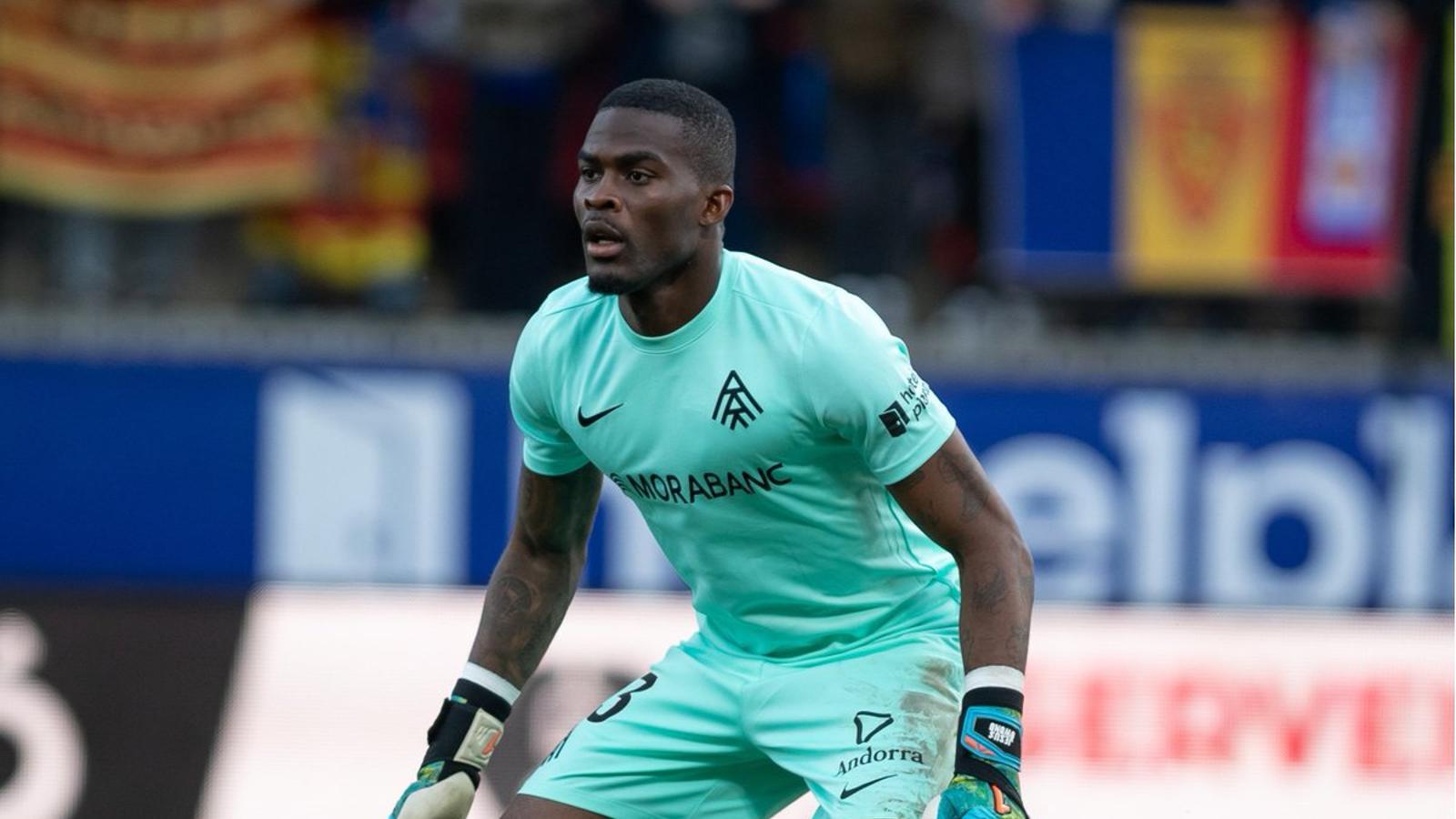
BarcelonaThe world of football is in mourning after the death of Tenerife player Jesús De Miguel. The footballer suffered a cardiorespiratory arrest following a tackle by the Andorra goalkeeper, Jesús Owono, and was rushed to the hospital, where he passed away overnight. Condolences were quick to arrive and the Spanish Football Federation (RFEF) has suspended the cup matches scheduled for this Tuesday as a sign of respect. But beyond the dismay, many fans are wondering to what extent this action could lead to criminal consequences for the Andorra goalkeeper. Could he be tried for reckless homicide?
ARA has contacted several lawyers, both criminal and sports law experts, to address the issue. First of all, for the case to reach the courts, the prosecution would need to act ex officio or a complaint would need to be filed to act as a private prosecution. For now, the National Police have opened an investigation to clarify the facts. This is a standard point, as the protocol stipulates that hospitals are required to inform security forces when there is a case of violent death that was not due to natural causes, as was the case with Jesús de Miguel. This does not mean that the case will end up in court. But if it does, it would be for reckless homicide, which is how "all those actions that cause death but did not seek death" are considered, as explained by Enna Vera, a criminal lawyer from Era Cooperativa Jurídica.
Reckless homicide is regulated in article 142 of the penal code. If it is considered minor, the penalties are usually a financial fine. But if it is considered serious, the sentence is between 1 and 4 years in prison, provided that the responsible party is considered guilty. In this scenario, the goalkeeper Owono would only have to serve this sentence if he were sentenced to more than 2 years, since otherwise he will not have to go to prison.
A case that has almost no precedent
There are almost no precedents of this type in football, so it is difficult to anticipate. "The most important thing is to know if there is intentionality, and that is very difficult to prove," clarifies Xavier Alert Canal, a lawyer specializing in sports law. "If the aggression were off the field of play or with the game stopped, there would be no doubt that it would be a criminal matter. But in this case, playing football involves assuming the risks inherent to a contact sport," he adds. And he clarifies: "Even if the consequence is extraordinarily serious, one must assess the dimension of the tackle and distinguish between unsportsmanlike play and aggression intended to cause harm." An opinion very similar to Vera's: "The line between conviction and understanding that the death occurred through a risk you run when playing a sport is very fine" and, after reviewing the play, he is clear that "the goalkeeper does not perform that act to kill the player, but rather he caused his death unintentionally."
But everything ends up depending on the interpretation, and that is why the investigation already begun by the National Police is key, which will not only analyze the tackle by goalkeeper Owono on De Miguel, but also the medical attention the Tenerife player received both on the field and at the hospital. The agents will have access to all the images captured by the television cameras –the broadcast did not offer any replay, as a sign of respect– and also to the security cameras of the Heliodoro Rodríguez López, and will be able to take statements from everyone, both from goalkeeper Owono and the medical staff that attended to him. From there, and according to the conclusions, the public prosecutor's office may decide to take the case to trial. Regardless of this, both the family of the late footballer and CD Tenerife can appear as a private prosecution, since they are the direct victims of this death.

