An immersive journey to walk among real-size dinosaurs
L'Ideal reopens with a Jurassic experience after eight months of renovation
-
CAT -
CAST
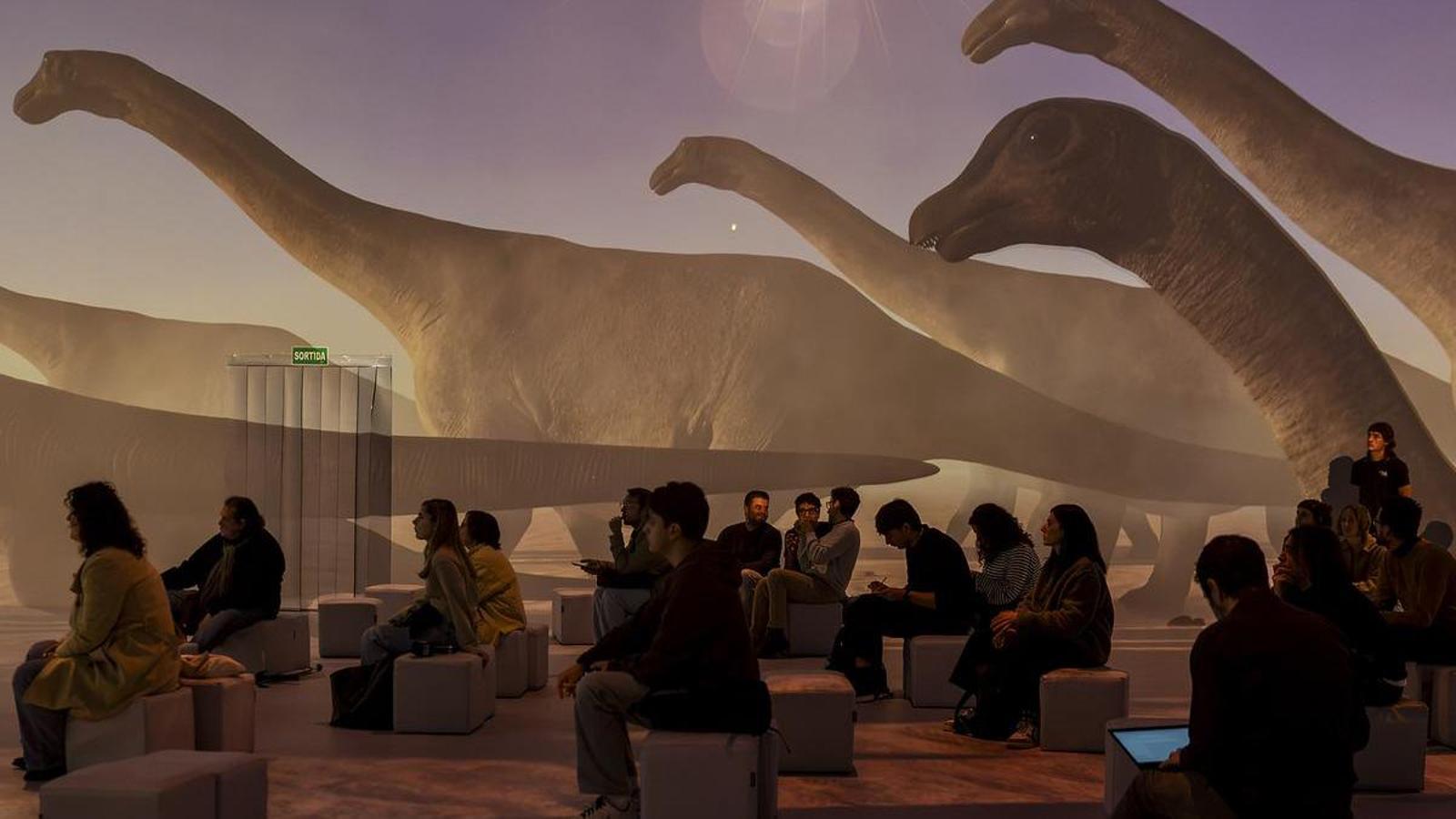
BarcelonaThe Ideal Centre for Digital Arts inaugurates this Friday, November 6th Dinosaurium, an immersive experience that combines art, science, and technology to reconstruct the ecosystem of the dinosaurs. The production, which has the scientific advice of researchers from the Catalan Institute of Paleontology Miquel Crusafont (ICP), proposes a route of more than 2,000 m² distributed across seven spaces. The proposal reopens the Ideal space in Poblenou, after eight months of renovation, with the immersive room, the metaverse, and the interactive spaces updated, and has incorporated 400 m² previously intended for internal use to create a new virtual reality room in 360° format.
The experience includes large-format immersive projections, virtual reality, interactive installations, and fossil reproductions. Among the main contents, a 20-minute film stands out, which covers the latest paleontological discoveries, from the investigation of fossils to the evidence regarding the existence of feathered dinosaurs.
It also incorporates a metaverse that allows walking among dinosaurs at real scale and interacting with them, with unique reactions created with artificial intelligence and a 360° virtual reality experience that recreates the impact of the asteroid that caused their extinction and the consequences for life on the planet. “How long does the end of the world last? An instant. The reconstruction, on the other hand, thousands of years. The activity questions you directly as the protagonist. The Earth will survive climate change, the eruption of a volcano, a new meteorite, but we will not see it,” says the centre's director, Jordi Sellas, while asking us to “take care of the planet.”
The tour is completed with interactive spaces in which visitors can participate in virtual excavations, discover the geological layers of the Earth, and create their own dinosaur reconstructions. The proposal also incorporates an original soundtrack by Rafel Plana, performed by the Budapest Symphony Orchestra, and fragrances created expressly to evoke the Triassic, Jurassic, and Cretaceous periods.

The Pyrenees 66 million years ago
The collaboration with the ICP aims to ensure the scientific rigor of the content and to connect the experience with the latest paleontological research and discoveries. Specialists from the Institute advise on the reconstruction of animals and their ecosystems based on the available scientific evidence, in a proposal that translates academic knowledge of the discoveries made in Catalonia.
“Dinosaurs exist thanks to scientists and artists,” asserted Sellas, reaffirming the importance of the “paleoartistic” tandem. Over the years, the imagery has changed, up to the latest discoveries pointing out that dinosaurs had feathers. “It will surely become outdated. But the degree of obsolescence is getting smaller each time. We have been studying dinosaurs since 1840, almost 200 years. As we advance, we reach a point where the curve remains almost flat. And we are reaching that point,” explains the head of the Mesozoic research group at the ICP, Àngel Galobart, who highlights that Catalonia is the last home of the dinosaurs before the meteorite.
Since the beginning of the excavations, scientists have found almost 12,000 pieces at the sites in the Pyrenees, from Coll de Nargó to the southern part of La Noguera. "There are six species that are native to here,” points out the researcher. In the interactive exhibition, there are “made in Pallars" reproductions of the bones found, two of which are still under study and will constitute “two new species.” “In the scientific field, we have a lot of impact, because this is published by powerful impact journals,” he reiterates.

Galobart celebrates the initiative because experiences like Dinosaurium, are "essential" for transferring knowledge to the public. "Our reach, as scientists, is reduced to this geeky sphere that we paleontologists inhabit," although he acknowledges that there is still work to be done in terms of discovering the dinosaurs of Catalonia. "It is a shame that people do not know that there were dinosaurs here. And this is where we fail, because, obviously, we are small and we have the survival, restoration, and museography team that we have. It is not just about showing it to people, but about conserving and documenting all these fossils," adds the paleontologist. For now, the paleontological institute is making massive efforts to preserve the remains in the territory so they can be visited at the Conca Dellà Museum, in Isona (Pallars Jussà), and to transfer their knowledge to initiatives like Dinosaurium.
