George Clooney: "In the United States we have already overcome other difficult moments"
The actor receives the honorary Golden Lion from the Venice Film Festival, which opens with 'Ink', by Danny Boyle, a chronicle of the making of the newspaper 'The Sun'
-
CAT -
CAST
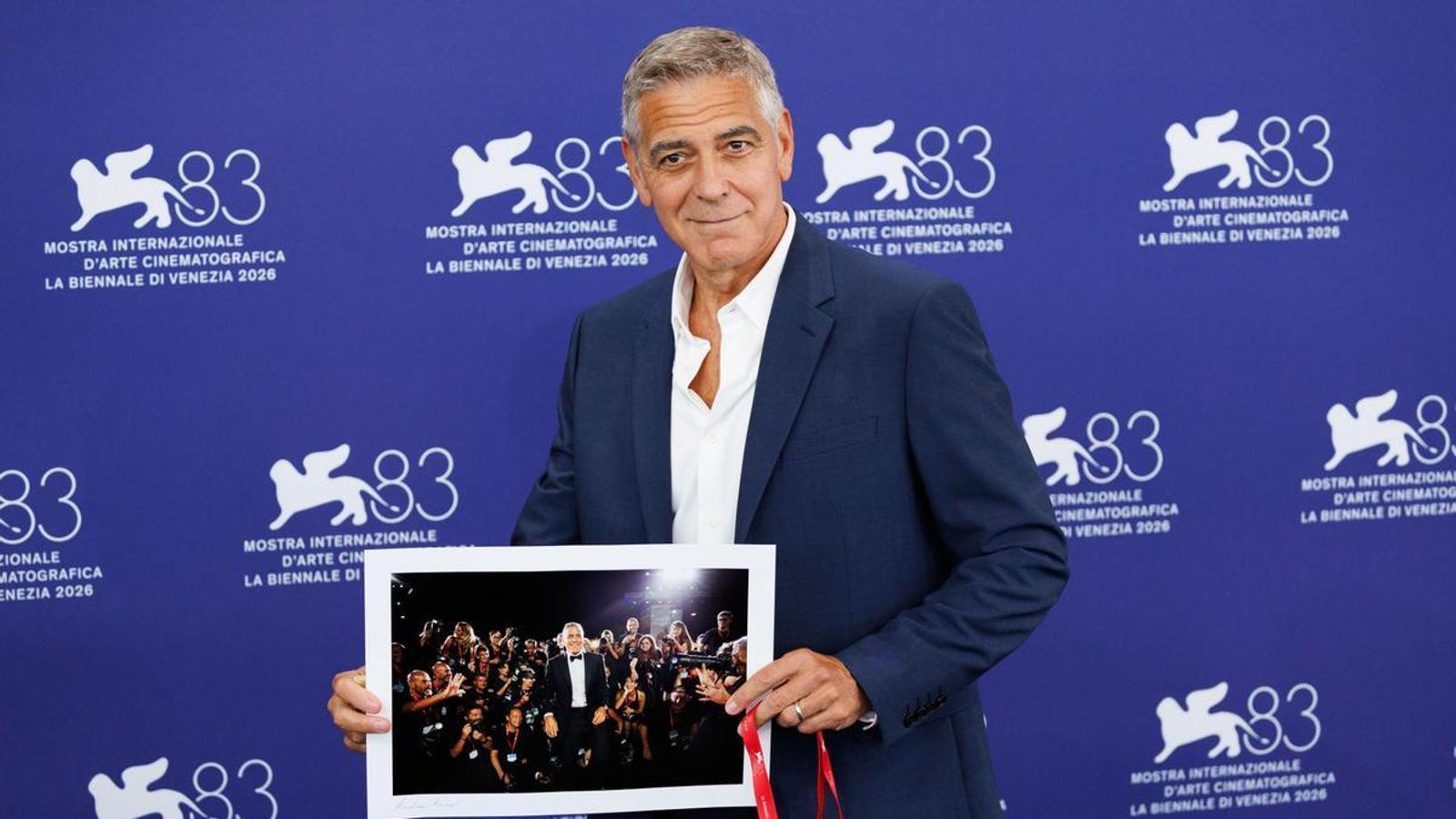
VeniceThe Venice Film Festival has kicked off its 83rd edition with a calculated combination of glamour, authorship, entertainment, and critical spirit. The elegance and media appeal were provided by George Clooney, who received an honorary Golden Lion this Wednesday. Curiously, last year Clooney was already seen receiving an award for his career in Venice, but it was on the festival's screens, in the fiction of Jay Kelly, Noah Baumbach's film. In reality, the link between the Hollywood star and the Festival dates back a long way, since 1998, when Clooney was still part of the cast of Emergencies, the actor stepped onto the festival's red carpet to present A very dangerous mess next to Jennifer Lopez. “My love story with Venice is almost thirty years old, and my most precious memory was my wedding – in 2014, with Amal Alamuddin, at the luxurious Aman Grand Canal Hotel. If I don't say this, I could get in trouble at home,” Clooney commented to the accredited press, showing off a charming and mischievous smile.
Regarding the footprint left by Venice in his career as an actor and director, Clooney wanted to celebrate the Biennale as "a place full of hope", in the sense that "only at a festival like this can you present a small and humble film like "}Good night and good luck and nominated for an Oscar for Best Director". However, not everything has been roses and violets in Clooney's visits to Venice. "I remember when we came to present Intolerable cruelty, by the Coen brothers, and during the screening the audience didn't laugh at any of the film's jokes. When the screening ended, the silence was agonizing, and I told Catherine Zeta-Jones that perhaps it was best we ran out,” he recalls.
The American nightmare
Known for his sympathy towards the American Democratic Party, Clooney has shown a mixture of sadness and hope when asked about the reality of the United States. “We are living in an unfortunate time, to say the least, but I tend to be optimistic, and I think we will get through it. In fact, I am old enough to remember that in 1968 the country was in flames. We lost Martin Luther King and Robert F. Kennedy in the same year. We have overcome other difficult times before,” he says. But despite wanting to convey a certain confidence in the future, the actor has not missed the opportunity to criticize the Trump administration. “The current situation makes me think of the concept of kakistocracy, which designates a government formed by the least qualified people. Right now, in the United States, we have a kakistocracy. Fortunately, in November there are elections that should act as a counterweight to the current situation, and in 2028 we will regain some normality.”
Beyond the tribute to Clooney, the central theme of the first day of the Festival has been the concern for the state of journalism at the present time. The opening film, Ink, by Danny Boyle, uses the chronicle of the birth of the British tabloid newspaper The Sun to meditate on the devaluation of the concept of truth. Clooney himself, author of the aforementioned Good Night and Good Luck, wanted to express his commitment to the media and the journalistic profession: “Today the richest people in the world own the Washington Post, Twitter, and many other news outlets. This is worrying, but there is still room for good journalism. My wife and I are children of journalists, we admire the profession, and in fact, our foundation has among its missions trying to free journalists who have ended up in prison for confronting different regimes,” added the actor.

Cinema with the smell of ink
“We wanted to make a period film that actually spoke to the modern world.” This is how Danny Boyle describes his first film to compete for the Golden Lion. Ink is a film that combines nostalgia and urgency in the portrayal of the forging of The Sun, in 1969, at the hands of editor Larry Lamb and magnate Rupert Murdoch, played by an inspired Jack O’Connell and Guy Pearce. It had been a while – perhaps since 2015, with Steve Jobs– that the director of Trainspotting couldn't find a script that could give meaning and gravity to his effervescent and usually harmless style. In this case, the combination of an artificial staging, a frenetic editing, and a blazing collection of musical themes, from Tom Jones to Diana Ross, give energy and vivacity to the chronicle of the popular triumph and the moral ruin of the film's protagonists.
The key to Boyle and screenwriter James Graham's success – who adapts his own play – lies in the decision not to judge easily reprehensible characters hastily and definitively. “We didn’t want to turn Murdoch into a monster. In fact, I share his hatred of the establishment with him – admits Boyle. – I wanted to present the founders of The Sun as a group of rebels to capture the viewer's complicity, and thus lead them by the hand towards a territory of darkness”. Listening to Boyle and having seen the magnetic Ink, it's tempting to define the film as a mix of The Wolf of Wall Street, by Martin Scorsese, and The great carnival, by Billy Wilder.
