Railway catastrophes in Girona lands
The writer Ferran Agulló described the accident that he suffered in Llançà, on the train where Pau Casals was also traveling
-
CAT -
CAST
GironaOver time, the railway has been the scene of numerous fatal accidents. The reality is this: due to various circumstances, beyond the safety measures established in signal codes and traffic controls, trains have collided with people, animals, vehicles, railway equipment, and other trains, and have also been victims of the dominant weather conditions on exceptional days. As an example, and leaving aside individual accidents, we focus on significant episodes that have taken place on the tracks of the Barcelona to Portbou line, the densest in terms of traffic in the Girona district.
Gaserans, Celrà and Llançà, unfortunate scenes
Chronologically, the first major catastrophe was recorded in the early days of railway history. On the night of October 7 to 8, 1863, between the stations of Hostalric and Breda, in Gaserans, the calamity unfolded. The tragedy was caused by a heavy storm, which undermined the bridge of the can Abert torrent and left a sad toll of 21 dead and 11 injured, most of them dragged away by the water of the stream. The locomotive and eight of the ten carriages that made up the expedition fell at the mercy of the impetuous current.
On October 13, 1918, at 5:15 in the morning, two trains collided violently at Celrà station. One of the trains, which was transporting goods and coming from Girona, did not take into account that another one was approaching from the direction of Bordils, a special one; it was a convoy carrying more than 400 repatriated workers, coming from France, originally from various provinces, but especially from the southern half and the eastern part of the peninsula. A strong storm of rain and hail coincided in time and space, and complicated the scene of the accident. The two locomotives crashed into each other. The number of injured exceeded sixty and the death of eight passengers had to be lamented, including a 3-year-old child.
Another deadly collision between two trains took place in Llançà on April 22, 1926, a rainy day. Involved in the accident were an express train that had left Portbou at 9:40 and a freight convoy, loaded with potatoes destined for France. Coincidentally, the cellist Pau Casals and the writer Ferran Agulló, the godfather of the Costa Brava, were traveling on the first of the trains; he signed a detailed chronicle of the event in La Veu de Catalunya. Among other things, he explained: “All of a sudden, the three passengers in the compartment, a Frenchman and a young lady who seemed to me to be Catalan, saw ourselves thrown from our seats: suitcases and overnight bags fell upon us and I heard a cry of terror. I got up and ran to the next compartment. What a horrible sight! The corridor, the two compartments, everything was a jumble of scrap metal, wood, cushions, glass; all dislocated, all in pieces… And I threw myself at some wood, but it was in vain; people arrived immediately: through the window I saw the freight train with its cars forming something like a roller coaster… Some shredded, others intact”. Among the four mortal casualties were the express train driver and the businessman, lawyer, and politician of the Regionalist League Joan Lligé Pagès.
Collisions that wound and kill
On other occasions, during the second half of the 20th century, the collisions did not cause deaths, but they did cause a good number of injuries. This happened on January 8, 1962, around 8:25 PM, when the express train traveling from Barcelona to Portbou had stopped, imperfectly, at Flaçà station. It was a long convoy of fifteen units and part of the composition—the tail carriages—collided with the commissary service train, which was passing directly through that point. The third-to-last carriage of the express and the locomotive of the freight train overturned. Fourteen were the injured on that unfortunate day.
On July 7, 1962, at 5:30 PM, the omnibus train coming from Barcelona, headed by a fuel-powered Mikado, entered Portbou station in the wrong way, onto a dead-end track, and crashed into the station's facilities. The error was due to the station's own maneuvers controller. Nine injured were the result of the accident.

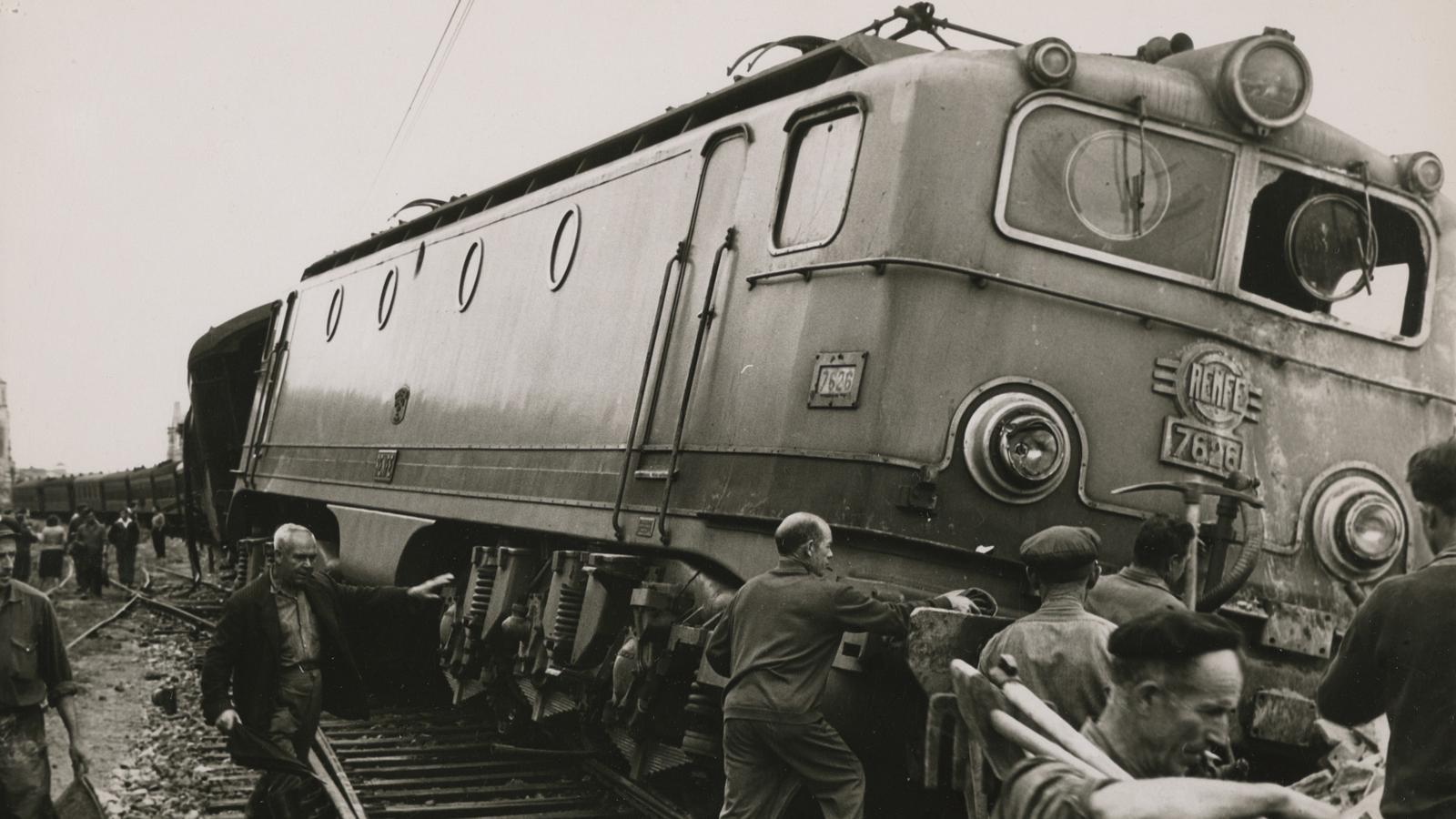
Already in the electric train era, on April 20, 1964, the Hispània Exprés that was heading towards Barcelona collided at the Camallera station, at 8:50 in the morning, with a freight train of about forty wagons that was heading towards Germany loaded with oranges from the Valencian Country. Due to an error by the switchman, who directed the express onto the same track where the freight train was stopped, the Alsthom electric locomotives of both trains collided head-on. The express train driver had time to jump onto the platform. As a result of the collision, 28 passengers were injured: one seriously, two with reserved prognosis, and the rest slightly. The person who was most seriously injured was the driver of the freight train, who fractured his legs. A journalist who reported the event even wrote that this was "the most spectacular railway accident in the province of Girona since this service was provided, and that was a century ago".

At level crossings, fatal accidents suffered by pedestrians and vehicle drivers have been numerous and frequent, especially on an individual scale. They had to be lamented throughout the line. As an example of collective tragedy, we can mention the one that was recorded on September 13, 1963, when the express train that had left Portbou at 8 in the morning collided, at the Can Punxa level crossing, in the Girona neighborhood of Pedret, with a telegraph van. The crossing had no guard. Two occupants of the vehicle died instantly, and a third lost their life, shortly after, at the health residence where they had been admitted. Another black spot in this same sense was the Sant Pau de la Calçada level crossing, in Figueres. On November 11, 1991, an Empordà couple lost their lives there when, driving a Renault 9, they collided with the train heading towards Barcelona. The vehicle was dragged more than a hundred meters and the victims had to be rescued by firefighters from the wreckage.
The tragedy of Sarrià de Ter
Outside of the Iberian gauge tracks, the most unfortunate accident of the Palamós to Girona and Banyoles narrow-gauge railway (the so-called Baix Empordà tramway) took place on September 7, 1938, in the middle of the Civil War. This means of transport did not have its own route, away from the road, and this often complicated its circulation. The most mournful event took place in Sarrià de Ter, at the bend of the Pont de l’Aigua, when a tanker truck, loaded with gasoline, collided with a passenger train heading to Banyoles. A tremendous explosion in the tanker truck and, simultaneously, in the train's tractor, which ran on heavy oils, increased the magnitude of the tragedy. Furthermore, seven houses near the scene of the incident, sprayed by the burning gasoline, were also affected by the fire. In total, seventeen deaths were counted, including the driver of the railway locomotive and the driver of the tanker truck, as well as a score of injured.
