One ablation every fifteen seconds and one woman murdered every ten minutes: how can it be?
The author of 'The Braid', Laetitia Colombani, presents the novel 'A Day Without Women'

-
CAT -
CAST
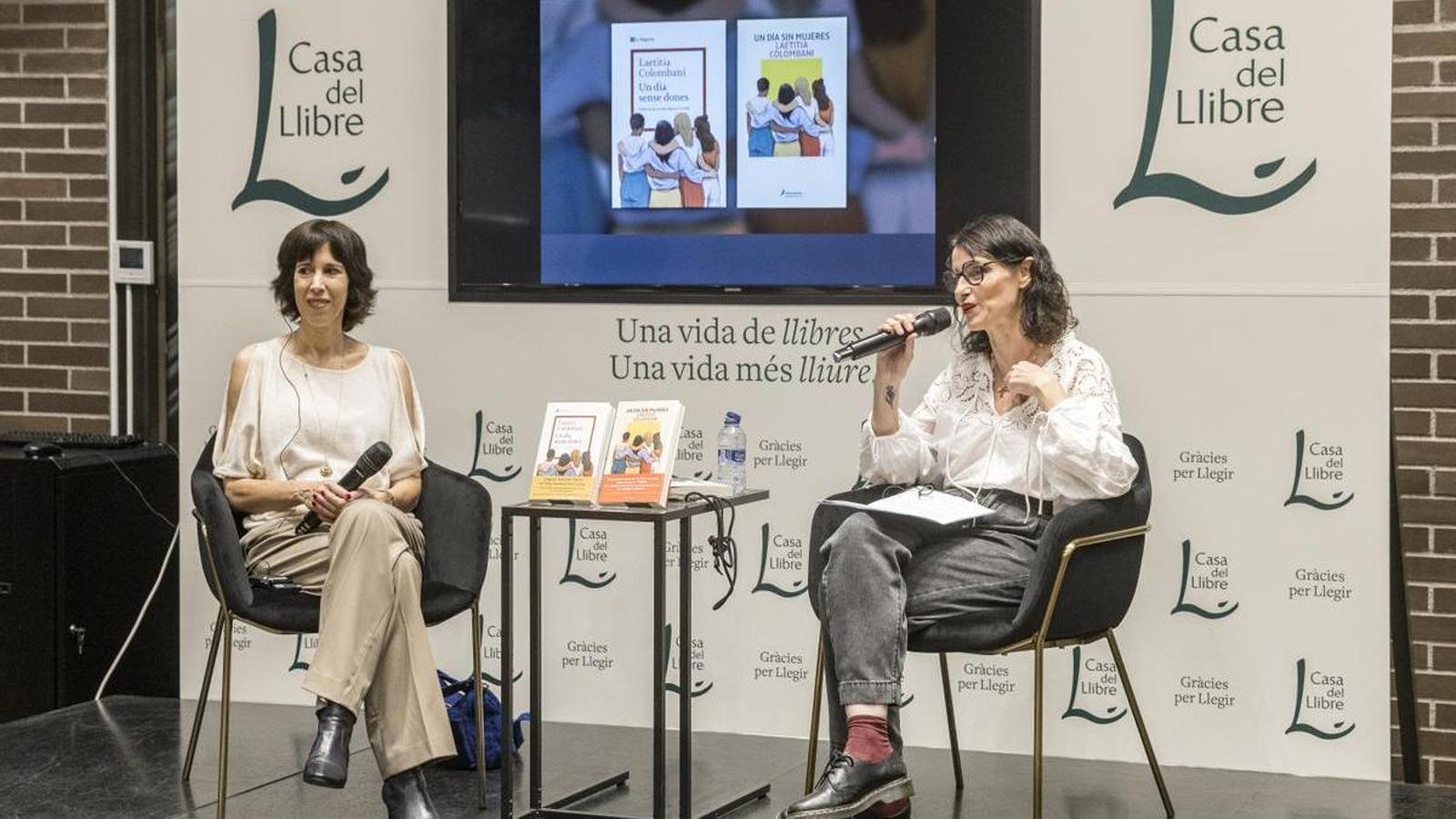
BarcelonaI wanted to write a chronicle of the presentation of Laetitia Colombani's new novel, Laetitia Colombani, A Day Without Women (La Magrana / Salamandra, 2026), without using the verb to braid. I try a few times and give up. It’s not that I’m in a hurry to pull the ace of The Braid out of my sleeve to hook you into the article, but I have to use the simile of weaving and braiding because the author returns to that structure with which she found success. Let me explain the success: Colombani published her first novel, The Braid, nearly ten years ago, which was an immediate global phenomenon and which, with 8 million copies sold in forty languages, changed her life.
The French author braids (now only metaphorically) the stories of four women from four continents who, after overcoming their personal misfortune, end up converging in a joint action, which the title already explains to us. The origin of the novel was discovering the strike that Icelandic women held in 1975 and which turned the island into "the most egalitarian country in the world." The hypothesis, ultimately, is what moves March 8th every year: what would happen if women all over the world went on strike? "They all have their particular motives. A sociology student in Iceland or a worker in a maquila in El Salvador is not the same, but we have all experienced discrimination or physical, sexual, legal, or workplace violence. I have not seen equality anywhere I have been. Even in Iceland, one in three crimes is a femicide," Colombani told Mar Garcia Puig this Monday at La Casa del Llibre.
Social denunciation and emotional connection
The literary grace of Colombani is that she can describe situations of harrowing inequality with a luminous kindness. Here we have Michiko, who suffers the workplace harassment to which women who are mothers in Japan are subjected: seven out of ten resign when they become pregnant, despite having completed ultra-competitive studies and jobs. Then there is Hawa, a Senegalese woman who becomes a doctor in France but cannot overcome the childhood mutilation: 6,000 girls suffer ablation every day on the African continent – one every fifteen seconds, a dozen while you read this article –. Katla is the Icelandic girl who starts the feminist movement after losing her best friend at the hands of her boyfriend: a woman is murdered every ten minutes in the world at the hands of her partner or someone in the family. And Ana María is the sacrificial seamstress in a factory who is not only exploited at work, but whose daughter is also imprisoned: "In El Salvador and six other countries in Central America, the prison sentence for an abortion is higher than for murder, from 30 to 50 years, even if it is involuntary. But they also do not have access to contraceptives," explained the author.
If you add it all up, it provokes incredulous indignation. But the writer finds the right balance of social denunciation and emotional connection. She does not leave her characters alone, banging their heads against reality, but accompanies them with people who love them and who act as lifelines. "It is a book about the bond, like all my books. I like the idea that we are all connected," affirms the author of The Victors, who is now performing in the theater the narrator of The Braid, which she herself adapted. In Catalonia, in addition to the 50,000 copies of the novel's translation, the theatrical version directed by Clara Segura had more than 90,000 spectators, which should have brought more of an audience to La Casa del Llibre... If it weren't for the fact that on Monday, Dolores Redondo presenting a new release at the Teatre Condal and Mariana Enríquez at the Sarrià Library were counter-programmed: things that happen. "In my books, I explain harsh realities, but I need to put hope into them. I am an optimist –claimed Colombani–. We have the urgency to change the world. I, at the very least, will have done my part".
