Jordi Savall: “We need politicians to be fair”
The maestro conducts at the Liceu the opera 'La clemenza di Tito', by Mozart
-
CAT -
CAST
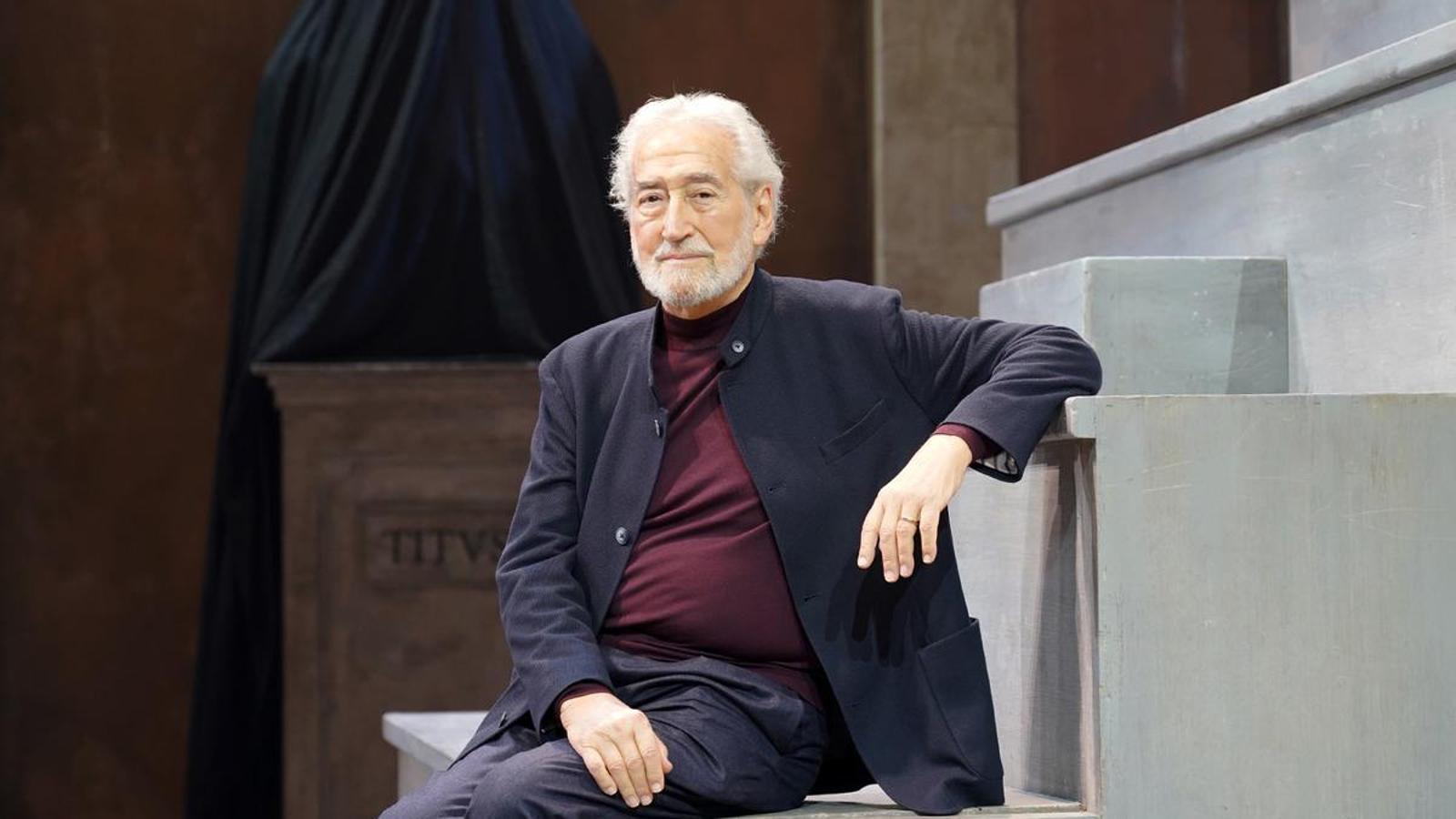
Barcelona“La clemenza di Tito is a good example of what a politician should be. Someone who shows that power is not about abusing people, but the opposite: being clement and having a sense of justice,” explains Jordi Savall at the Saló dels Miralls of the Gran Teatre del Liceu. He says this at the end of a press conference organized for the four performances of Mozart’s opera that will take place on November 25, 27 and 29 and December 1. “It is a perfect title for the environment we are in now, when we need politicians who are fair,” adds Savall, who uses as an example the protagonist of the opera that Mozart composed in 1791 for the coronation of Leopold II as King of Bohemia: the emperor Titus Flavius Vespasianus, who ruled the Roman Empire between the years 79 and 81 and who is also remembered for having accompanied his father, the emperor Vespasian, in the military campaign, not so just, that crushed the great Jewish revolt between the years 66 and 73. In the libretto of La clemenza di Tito, Titus must face a conspiracy instigated by the desire for revenge of Vitellia, the daughter of the dethroned emperor Vitellius, and in which Sextus, the emperor’s friend-traitor, also participates. In Mozart’s opera, the greatness of Titus is manifested in clemency. “The work leads to the forgiveness so characteristic of the Enlightenment,” notes the artistic director of the Liceu, Víctor Garcia de Gomar.
Four were also the number of performances, out of the eight scheduled, of La clemenza di Tito that had to be canceled in 2020 due to the covid pandemic. In fact, the production arriving now at the Liceu is the same, with stage direction by David McVicar. But there are two relevant differences: in the pit, instead of the Liceu Orchestra (which at that time was conducted by Philippe Auguin), there will be Le Concert des Nations, under the baton of Savall; and the choir will be that of the Capella Nacional de Catalunya. That is to say, “the rapport, the telepathic element” that characterizes the work of maestro Savall with his ensembles, as Garcia de Gomar says. “It is enriching that the Liceu gives the possibility to present Mozart’s opera with an ensemble that respects the colors, articulations, nuances and phrasing just as he composed them,” explains Savall, who brings into play an orchestra of 35 musicians with period instruments to achieve “an emotion that comes not from power but from dialogue and nuances, so important in Mozart’s music”.
Regarding the cast, the Liceu and Savall, with the essential collaboration of Luca Guglielmi and Lluís Vilamajó, have made a very careful selection in which three singers stand out who are making their Liceu debut: the American tenor Jack Swanson as Tito, the Finnish soprano Aurora Marthens (Vitellia), and the French mezzo-soprano Marianne Crebassa (Sextus). The cast is completed by the Norwegian soprano Lina Johnson (Servilia), the Norwegian mezzo-soprano Marianne Beate Kielland (Annio), and the German-American baritone Gabriel Rollinson (Publius), all three also debuting at the theatre on the Rambla. Aurora Marthens joined the production on October 29th to replace Karine Deshayes, who suffered a leg injury that prevented her from participating. "I was in Finland when they called me and told me that the maestro wanted me in Barcelona," recalls Marthens. "It has been three very intense weeks, and I am very grateful to be surrounded by this team."

A “beautiful and coherent” staging
David McVicar created the staging for this production of La clemenza di Tito for the 2011 Aix-en-Provence Festival. “It was designed to be performed outdoors, with a horizontal layout and a wall as a backdrop,” explains Leo Castaldi, the revival director of the opera at the Liceu. The wall is reproduced on stage when the production is in a theater like the Liceu. The costumes are also maintained, inspired by the “post-revolutionary Napoleonic” style, just as Mozart did by setting the action in the era in which he composed it. “The costumes we use for Titus are very similar to those seen in portraits of Leopold II,” says Castaldi. “It is a very beautiful staging, and consistent with the era in which La clemenza di Tito was created,” says Savall about a production that, as in all of David McVicar's, stands out for the psychological depth of the characters. “They are characters worked on to the point of obsession,” asserts Castaldi.
