To delocalize or not to delocalize Shakespeare, that is the question
Stratford-Upon-Avon revolts against the University of Birmingham's plan to move the institute of studies on the playwright to one of its campuses
LondonTo relocate or not to relocate Shakespeare, that is the question. An almost existential dilemma for the bard's hometown, Stratford-upon-Avon, 150 km northwest of London. The bombshell dropped last Friday, when the rector's office of the University of Birmingham informed the staff of the Shakespeare Institute that, starting from the 2027-2028 academic year, the center would move to the Edgbaston university campus, 40 km away, thus ending more than 75 years of presence in Stratford. The move also left the future of Mason Croft, the historic building that has housed the center since 1951, as well as its garden and the adjacent grounds, in limbo.
Five days later, the same university had to backtrack – at least for the moment – in the face of the deluge of local, national, and international protests from academics, actors, and admirers of the playwright. The campaign opposing the initiative has managed to gather at least 16,000 signatures. As a result of all this movement, the Vice-Chancellor of the University of Birmingham, Adam Tickell, was forced to announce that he had “heard” the message, that he was freezing the decision, and that he was opening a six-month period to study whether the center can continue to have a “vibrant and viable existence” in the playwright's city. The university rules out economic reasons for the decision, although it has pointed out that in recent years, the demand for postgraduate studies in Stratford has fallen, in contrast to the growth of related areas at the Birmingham campus.
Upon learning of the decision, the director of the Shakespeare Institute, Professor Michael Dobson, announced that he would resign before cooperating with the decision. “We have neither participated in it nor been allowed to influence it,” he wrote in an email to his colleagues. Dobson also questioned whether the move could guarantee the continuity of the master's program in Shakespearean studies. “Students come to the institute because they want to be in Shakespeare's city and close to the Royal Shakespeare Company, not because they have a special interest in Birmingham,” he argued. The center has a library of 60,000 volumes, considered the largest collection specialized in Shakespearean studies in the country.
Adding to Michael Dobson’s threat was the protest from the Liberal Democrat member of parliament for the Stratford-upon-Avon district, Manuela Perteghella, who described the project as “shocking”. Other equally forceful voices have been those of great figures of British theatre: among others, the actor Samuel West, who has promoted the campaign together with the actress Janet Suzman. West and Suzman have warned that the value of the centre cannot be measured solely by “numerical or economic” criteria. Will Tosh, director of education at Shakespeare’s Globe in London, has also joined in and asserted that the proposal is “nonsense”.
Another institution directly affected by the potential relocation of the Institute is the Royal Shakespeare Company (RSC), based in Stratford since its founding in 1961. The company’s management has recalled that the Institute is a fundamental piece of the city’s cultural fabric, which forms part of an ecosystem that combines research, theatrical performance, and historical heritage.
Henley Street and New Place
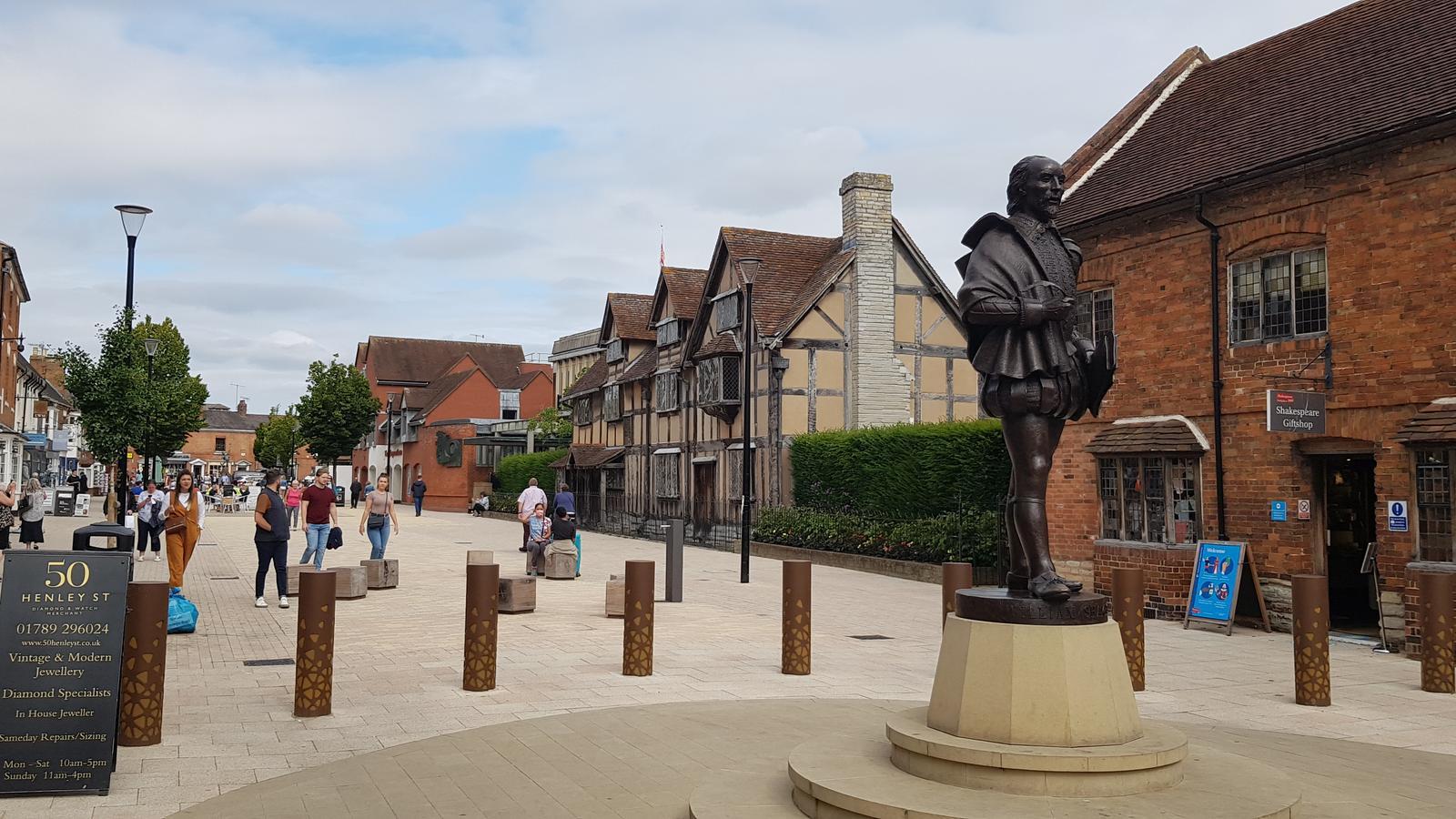
To evaluate the controversy, one must understand what Shakespeare represents for Stratford-upon-Avon. With just over 30,000 inhabitants, the town is much more than the writer's birthplace. Its identity, its international projection, and a good part of its economy are linked to him. Each year it receives visitors from all over the world who tour the great settings of his life: the family home on Henley Street where he was born in 1564, the residence he bought when he was already a successful author, New Place, and the Church of the Holy Trinity, where he was baptized and where he is buried.

Stratford is also one of the great international centers for the performance and study of his work thanks to the programming of the Royal Shakespeare Company. Alongside it, the Shakespeare Birthplace Trust watches over the heritage linked to the playwright's biography and promotes research and dissemination. The church where his remains rest completes a triangle of historical, religious, and cultural references.
Moving the Institute would be experienced almost like an amputation. The postgraduate research center was founded in 1951 by the University of Birmingham. Its distinctive feature is precisely the location: for three-quarters of a century, it has been the only university institution in the world that has been able to offer studies and research on Shakespeare in his very hometown. For its defenders, the link is not a tourist attraction or a decorative element, but an essential part of its academic identity.
A place to “dream” with the bard
“Stratford has been the place where people come to dream of Shakespeare since the 18th century,” recalled Dobson. The director maintains that its presence has contributed to keeping the city on the international intellectual and academic map. Studying Shakespeare in Stratford also allows for a direct relationship to be established between the texts, the spaces, and the historical context in which the creator moved. “A visit to the remains of New Place, for example, helps one understand to what extent the commercial success of his works allowed him to accumulate a considerable fortune and acquire one of the most affluent houses in the city.”
The head of the school of English, drama, and creative studies, Gianna Bouchard, had argued that concentrating Shakespearean studies at the Edgbaston campus would allow for better integration of the Institute into a more dynamic university environment. Rector Adam Tickell has insisted on this argument while announcing the period of reflection regarding the possible move. The university, he said, must be “honest about the challenges and opportunities” that the center faces. Dobson has received the announcement of the rethinking as “a beginning,” but has made it clear that he wants a definitive rectification. The issue, therefore, remains open. It is not just a matter of deciding where classes are taught or where 60,000 books are stored. It is a question of identity.
