Mariana Enriquez: "It frustrates me a lot not to be able to see ghosts"
The Argentine writer dedicates 'Conversación con la oscuridad' to exploring how horror literature, the gothic, and ghosts have influenced her
-
CAT -
CAST
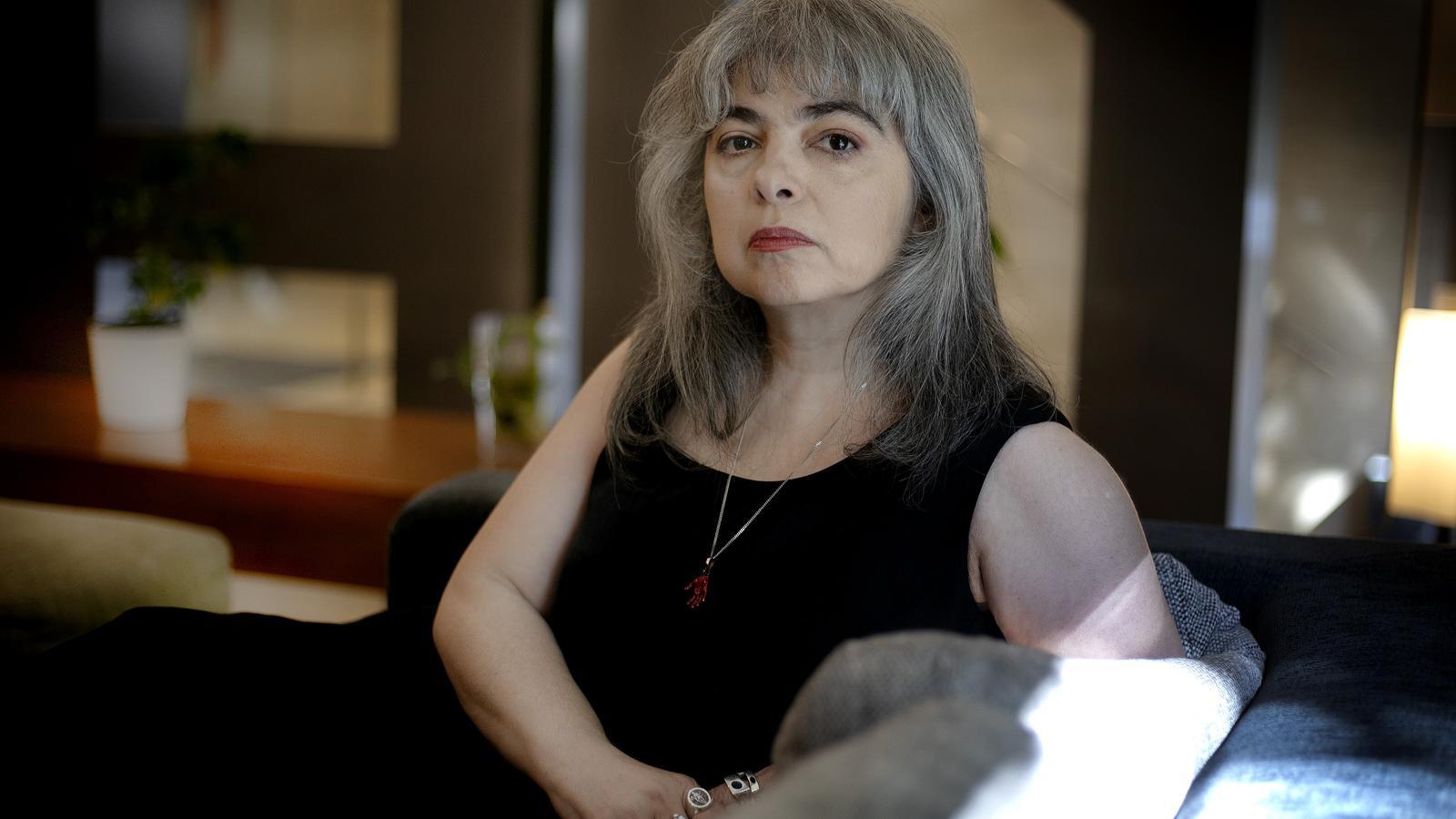
BarcelonaA year and a half ago, Mariana Enriquez (Buenos Aires, 1973) left Argentina and settled in Launceston, on the north of the island of Tasmania. Before leaving the country where she had been born, raised, worked, and, finally, triumphed with novels like Nuestra parte de noche (Anagrama, 2019), Enriquez needed to take stock of the authors who had marked her throughout nearly four decades of obsessive reading. "While I was finishing that book, Archipiélago [Ampersand, 2025], my library was traveling by ship from Buenos Aires, and it could have been lost forever –she recalls now from Barcelona, with a new essay just published, Conversación con la oscuridad (Páginas de Espuma, 2026)–. For a few days, I fantasized about the idea of the shipwreck: it would have opened a period of inevitable mourning, but at the same time it would have forced me to start a new library from scratch".
Since Mariana Enriquez's thousands of books ended up arriving in Tasmania, the writer was able to continue digging into the roots of her literature. If Archipiélago focused on the importance of having read from a very early age authors like H.P. Lovecraft, Stephen King, Shirley Jackson, Cormac McCarthy, Alan Moore, and Silvina Ocampo, Conversación con la oscuridad explores from a theoretical point of view how horror, the gothic, body horror, and spectrology have influenced her literarily.
In the foundations of Enriquez's taste are "mythologies like those of the Guarani culture and also the Greek one, episodes from the Bible like that of the Massacre of the Innocents [collected in the Gospel of Matthew], the stories of Julio Cortázar, and novels like Wuthering Heights, by Emily Brontë". Also, films of the slasher subgenre and the fact that her mother was a doctor. "Since I was very little, they let me watch slasher movies, where often a killer would chase creatures and kill them, but, on the other hand, they didn't allow me to watch The Exorcist –she recalls–. It's curious, because a priest can cure you of possessions. The killers ended up giving me nightmares". Regarding doctors, she recalls that she was obsessed with studying and scribbling in the anatomy books that were lying around her house. "Doctors never speak delicately about what they do with patients –she says–. I realized that very early on thanks to my mother's work".
Historical and personal traumas
"When I decided that I would write horror, I had to think about what the fears and historical traumas of my society were, which at the same time ended up being my own personal fears and traumas," she comments. Instead of writing about Lovecraft's monsters or the gothic that germinates in castles like Count Dracula's, Enriquez "delved into the historical, political, and regional dimension" of the genre. "The generation of the disappeared is that of my parents, and the trauma they suffered is directly mine," the author continues. "Living through the dictatorship and the post-dictatorship implied a direct, daily, and constant exposure to horror." Enriquez recalls that the first time she mentioned the ghosts of the dictatorship in a story was in one of the tales from Los peligros de fumar en la cama (Anagrama, 2009), inspired by an anecdote that a friend, the daughter of disappeared persons, had told her: "She played with a Ouija board with other friends to talk to their parents, to know if they were still alive or if they had been killed." "Writing about these themes, I have not sought or found any refuge," she adds. "I do not compete with reality, I take elements from it and incorporate them, and I even deform them when it suits me."
Reading Conversación con la oscuridad one can see how Latin America has become an ideal territory for cultivating horror literature, with contemporary examples such as those of Fernanda Trías, Mónica Ojeda, and Ana Paula Maia. "To political violence and trauma are added cynical democracies, political corruption, inequality, the economic crisis, and, in many countries, criminal violence as a structure of power," opines Enriquez, who draws in the essay a very complete map of her obsessions, which have been "numerous" and which continue to grow thanks to filmmakers like Julia Ducournau, Ari Aster, and Paco Plaza and the reading of writers like Diego Muzzio and Attila Veres. "Lately, I have been turning over in my mind why we female writers and filmmakers place such great importance on the body," she comments. "For a woman, looking in the mirror is not the same as when a man does it. I am not speaking only of medical-aesthetic pressure, but also of the tension of knowing that we can be recorded at any moment."
Structured into five major chapters –called "vertebrae"– the book navigates through literary ghost stories like Beloved, by Toni Morrison, through the unhealthy Argentine devotion to the lifeless body of Eva Perón, through numerous cinematographic and musical allusions, or through the most extraordinary house of spirits the author has heard of, a castle located in Romania. "Iulia's father, Bogdan Petricieu, during the mourning for his dead daughter began to receive messages that dictated to him how he had to build a castle that would function as a portal between the world of the living and that of the dead –she recalls–. He believed the messages came from her. They dictated to him not only the architectural plans of the construction, but musical scores and a dictionary of terminology of the Afterlife that he did not manage to complete. If the story is true, it is one of the few architectures dictated by a ghost. I would love to be able to visit this castle someday".
Despite her obsessive writing and constant reflection on horror, Mariana Enriquez laments the absence of supernatural experiences in her life. "It frustrates me a lot not to be able to see ghosts –she asserts–. My aunt encounters them constantly. The only time something a bit strange happened to me was that one night I saw a shadow passing behind me in the room, and when I asked my father the next day if it had been him he told me that he had not moved from the bedroom. It was a day that I had not been drinking nor had I taken any other drug, I assure you".
