“I would have gone crazy, if I hadn’t written about the genocide that was lived in my country”
The Franco-Rwandan writer Scholastique Mukasonga receives the Free Voice award from the Catalan PEN for having denounced, in works like ‘The Barefoot Woman’ and ‘Our Lady of the Nile’, the persecution and genocide of the Tutsi community in Rwanda
-
CAT -
CAST
BarcelonaThe painful, moving, and necessary voice of Scholastique Mukasonga (Gigonkoro, 1956) “exists by a miracle”, recalls publisher Valeria Bergalli, who a couple of years ago began publishing her work in Catalan and Spanish through the Minúscula publishing house. “Her books have an extraordinary quality and are born from an experience as traumatic as the 1994 Rwandan genocide,” she continues. “By explaining the inexplicable to us over and over again, Mukasonga introduces us to a world that was hitherto unknown.”
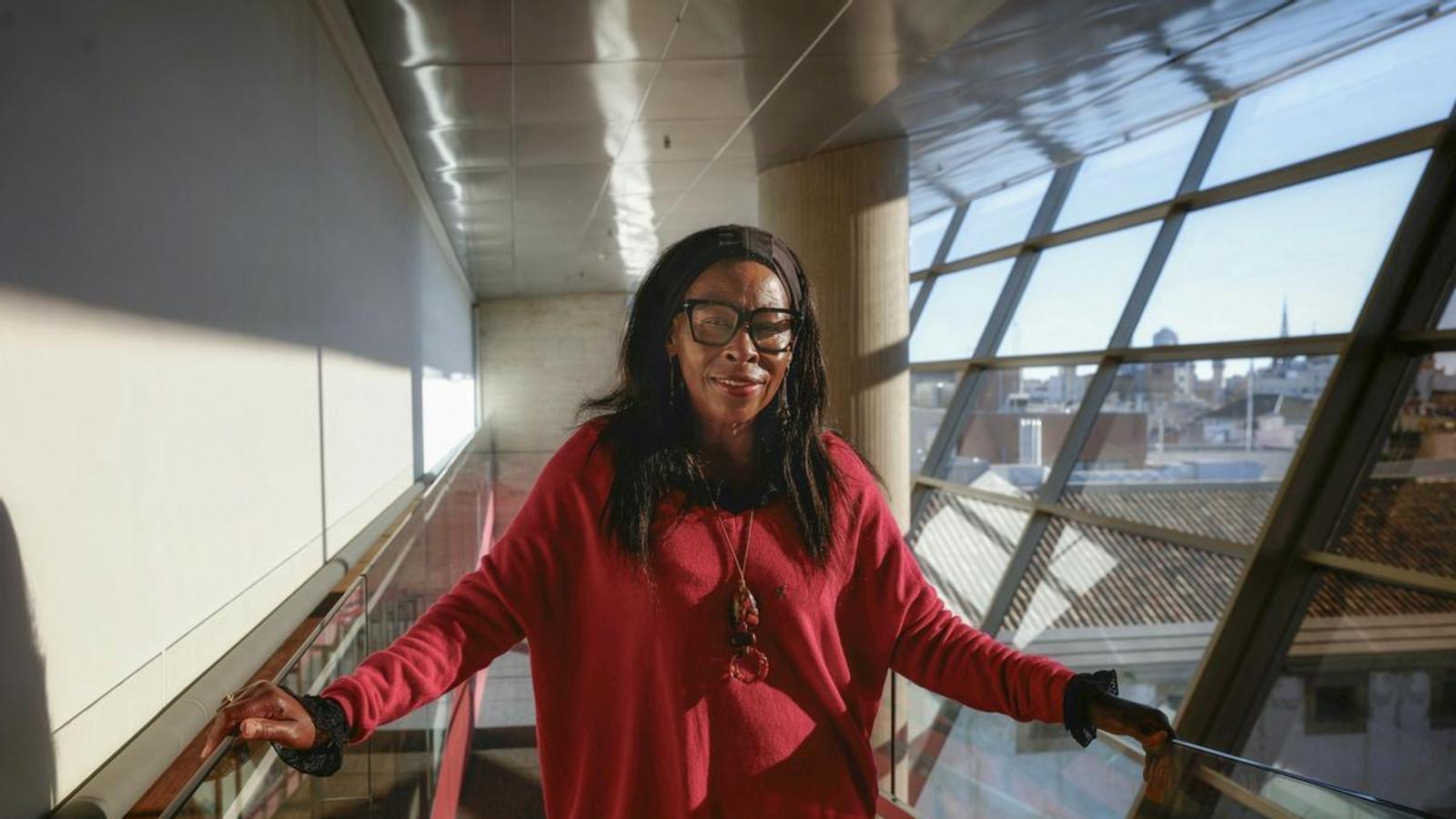
It took ten years after the genocide of the Tutsi community in Rwanda for Mukasonga to dare to travel to the country where she had been born and raised in the mid-20th century. “It was as if I had gone there the day after the killings,” she explains now from the CCCB, where she received the PEN Catalan Veu Lliure award. “It was such a painful experience that it placed me in an extreme situation. I would have gone mad if I hadn't written about the genocide that took place in my country.” Mukasonga wanted to “address the entire international community” with her books, with the goal that “all that would not be forgotten,” even though what reached the public at the time the events took place – between 800,000 and a million deaths in just two months – were partial truths splashed with prejudices, such as it being a matter of “tribal and ancestral struggles,” as the author now recalls.
Mukasonga's literary career began in 2006 with Inyenzi ou les cafards, where she reconstructed her childhood in the village of Nyamata and the rivalry between Hutus and Tutsis, fueled by the colonial legacy. “First we were a German colony, later Belgian, and finally French,” she says. “Colonization was one of the elements that allowed for the creation of the genocide, which did not arrive overnight. It was an ideology that grew among us, as we lived together. We shared everything, but we ended up killing each other among neighbors.”
Discovering discrimination
A key novel to explain the beginning of the differences is Our Lady of the Nile (2012; in Catalan by Minúscula, translated by Marta Hernández Pibernat). “After some years in Nyamata, where we were all Tutsis, I had the opportunity to enter a boarding school for secondary education, and there I shared my studies with daughters of powerful people who made me discover discrimination –she admits–. Until then, I did not know that people like me were called cafards [cockroaches]. The years at boarding school I had to fight all alone against adversities of all kinds”. As she explains in Our Lady of the Nile, the 1973 military coup caused the Tutsis to be “singled out and persecuted”. It was then that Mukasonga walked the fifty kilometers that separated her from Burundi, where she studied social work and worked for Unicef until she emigrated to Normandy in 1992. “The other great culprit of the genocide was religion, because in 1994 it was said that it had been God who gave the authorization to exterminate all the cafards”, she says.
The publisher Minúscula has just published another important book by the author, The Barefoot Woman, translated by Mercè Ubach. “My mother, Stefania, was murdered, like all the Tutsis of Nyamata, in April 1994 –she explains–. She wanted us to cover her body when she died, because she said that a mother’s body should not be seen by anyone. It was not possible, because her remains disappeared. Persecuted until the last moment, my mother wanted to save us from the bloody terror of day-to-day life”. The Veu Lliure award from the Catalan PEN has recognized Mukasonga’s work because, in the words of its president, Laura Huerga, “it preserves the collective memory of the Tutsi people and denounces the persecution against their community, the Rwandan genocide and the forms of colonial and patriarchal violence that have crossed it”. Soon Minúscula will publish in Catalan Sister Deborah (2022), one of the latest novels by an author who sounds like one of the possible candidates to win the Nobel Prize in Literature.
