Guide to understand how the lefts collaborate and rival: the puzzle of Colau, Rufián and Montero
The Broad Front and Podemos go together in three communities and organize joint events there, but they face each other electorally in the rest of the territories

-
CAT -
CAST
MadridAfter four general elections with unity, the Spanish left has fragmented. It is no news that the bridges between Podemos and the space that Sumar has embodied during the legislative term are broken. This has meant that, despite some timid attempts, the divergences between the two formations have made it impossible to reach an understanding to articulate a single ballot for November 29th. But there are three exceptions: the Valencian Country, the Balearic Islands, and the Canary Islands. These are three isolated cases that require certain balances when planning the campaign events for the Broad Front, Podemos, and Gabriel Rufián. Without coinciding on the stage, the regional candidates have shared rallies with different state candidates who are facing each other electorally in other communities.
Weeks ago, the doubt that loomed was whether one would get to see a rally of the ERC leader with Irene Montero and Ada Colau. It was not easy, but the convergence of forces in some territories opened the door to recovering an image of unity. It has been impossible. In the Valencian Country, for example, even though Compromís, both publicly and privately, opened its arms to any form of public collaboration by the state leaders and avoided imposing vetoes, it immediately became clear that recovering the unity of 2016 or 2019 would be a chimera. For this reason, in four days, Irene Montero, Ada Colau, and Gabriel Rufián have passed through Valencian lands without coinciding. Compromís has advertised the three events with three posters with an identical design. Without knowing the context, nothing would make one think that the people appearing on them, when they leave the Valencian Country, diverge on so many things.
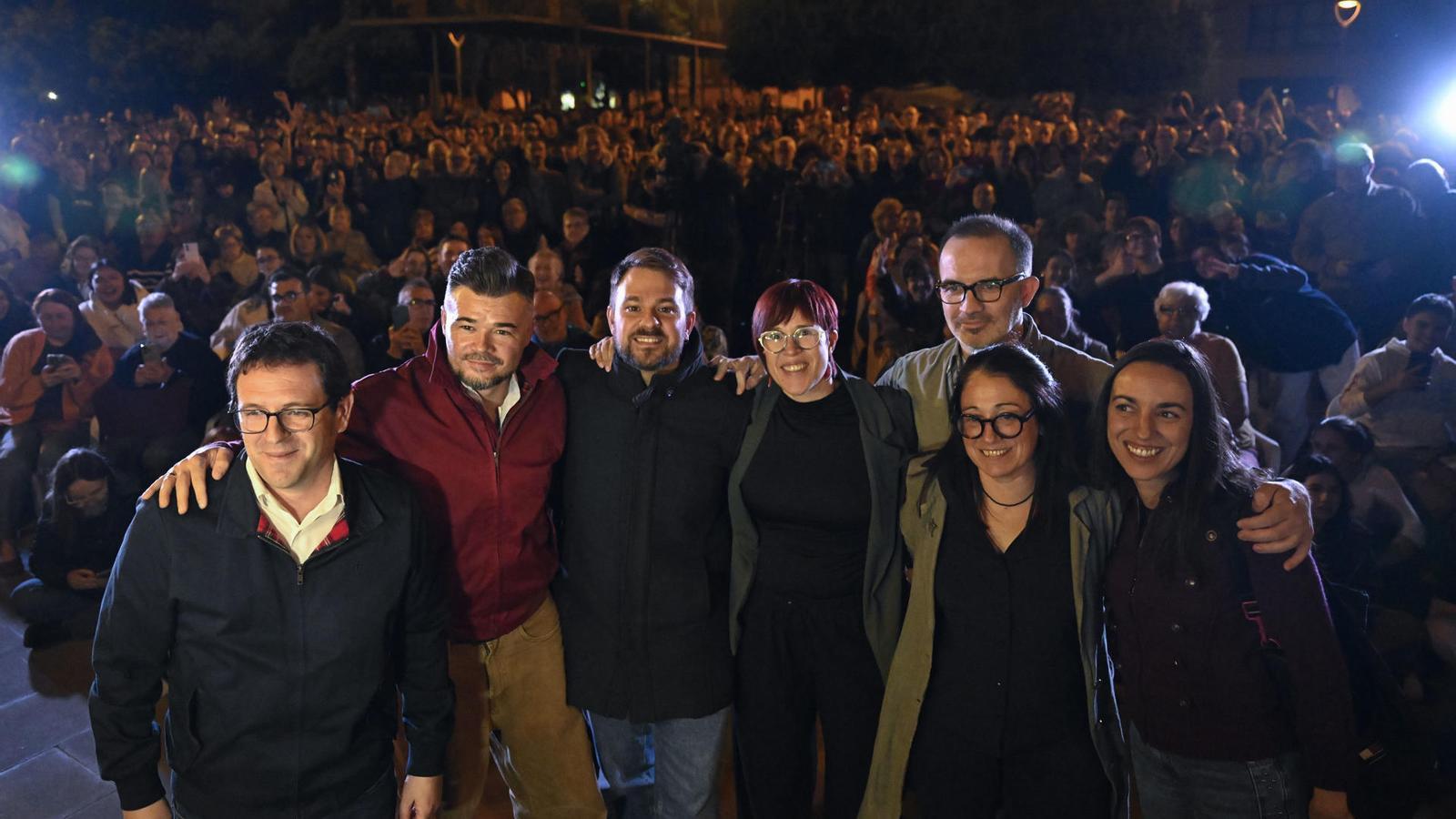
The maximum representation of this tightrope walking took place this Thursday. In the morning, Àgueda Micó and Alberto Ibáñez –who head the list for Valencia– accompanied Ada Colau in a meeting with victims of the DANA in Catarroja and participated in a small-format event in Benetússer. In the afternoon, 70 kilometers away, the two Compromís candidates made an appearance –they went up on stage, but did not speak– at Gabriel Rufián’s rally in Vila-real. Before starting, the leader of the ERC highlighted the Valencian Front before the media: “What has been done here is exactly what should have been done everywhere: simplify and optimize the electoral offer on the left”. The one who was there on Monday was Irene Montero, who went to Elche. She spoke to the media alongside two local officials from Compromís and Mari Tere Pérez, the leader of Podemos in the Valencian Country and number 1 in Alicante.
This reality is superimposed on a context in which Podemos has sharpened its darts directed at the Broad Front. On repeated occasions, the candidate for the purple party has presented herself as a left with an “autonomous project”, has criticized that the Broad Front is running with the PSOE in the Senate –to try to prevent a majority of the PP and Vox from being able to change the majority of the Constitutional Court or reform the constitution– and has reproached the forces around Sumar that “all the toads” have had to be “eaten by the left”. In contrast, the candidacy headed by Ada Colau avoids friendly fire and refrains from referring to Podemos in campaign events. They act as if they did not exist and focus their messages on the regression that the arrival of the PP and Vox to the Moncloa would imply and on the pressure –increasingly accentuated– towards the PSOE.

The Balearic and Canary Islands
The first example of cohabitation was in Palma. Ada Colau went there before starting the campaign and participated in a rally in which the number 1 of the candidacy, Carme Gomila, who is from Ara Més, also intervened. And she herself shared the stage five days later with Gabriel Rufián and Irene Montero in a rally in which the ERC leader defended the role of the “good people” of Podemos and criticized –biting his tongue– the role of Sumar and Més Madrid. “The front is us,” he went as far as to exclaim. It is the same proclamation that he coined in Nou Barris. “This was not about entering the PSOE to be subjected to the PSOE, this was about subjecting the PSOE from its left,” he added.
The other moment of navigating between two waters was experienced in Las Palmas de Gran Canaria. Last Saturday, Irene Montero participated in an event of the Union of the Canarian People. In front of a poster with the logo of the United Left and the Sumar Movement, two of the parties that have promoted the Broad Front and that she has criticized for their “closeness” to the PSOE, she defended “left-wing, progressive, and republican alliances.” Ada Colau will be there on Sunday, accompanied by two of the people who also coincided with Irene Montero: Luis Campos, the head of the list in Las Palmas, and Iratxe Serrano, who is part of Podemos.

Sovereignist left-wing parties
Another apparent contradiction ahead of November 29th is the role of the pro-independence left. In recent days, Irene Montero has championed the “tandem” with Gabriel Rufián, and the ERC leader has been full of praise for her. But what is happening in Galicia and the Basque Country? There, Podemos is running alone and competing, among others, with the BNG and Bildu, two forces that Rufián has always praised. He openly embraces them at rallies and holds them up as an example, even alongside Irene Montero, but they are electoral rivals to Podemos. What is the key to this puzzle? Rufián himself took it upon himself to verbalize it in Palma: “I ask you to vote progressive, vote for whoever you want. Everyone needs to do well because, if not, we won't add up,” he reflected. And that is how he resolved the coexistence of ballots that collaborate and compete in different parts of the State.
