Javier Ferreira: “There are 4,000 million possible ‘gamers’”
Co-CEO of Scopely

-
CAT -
CAST
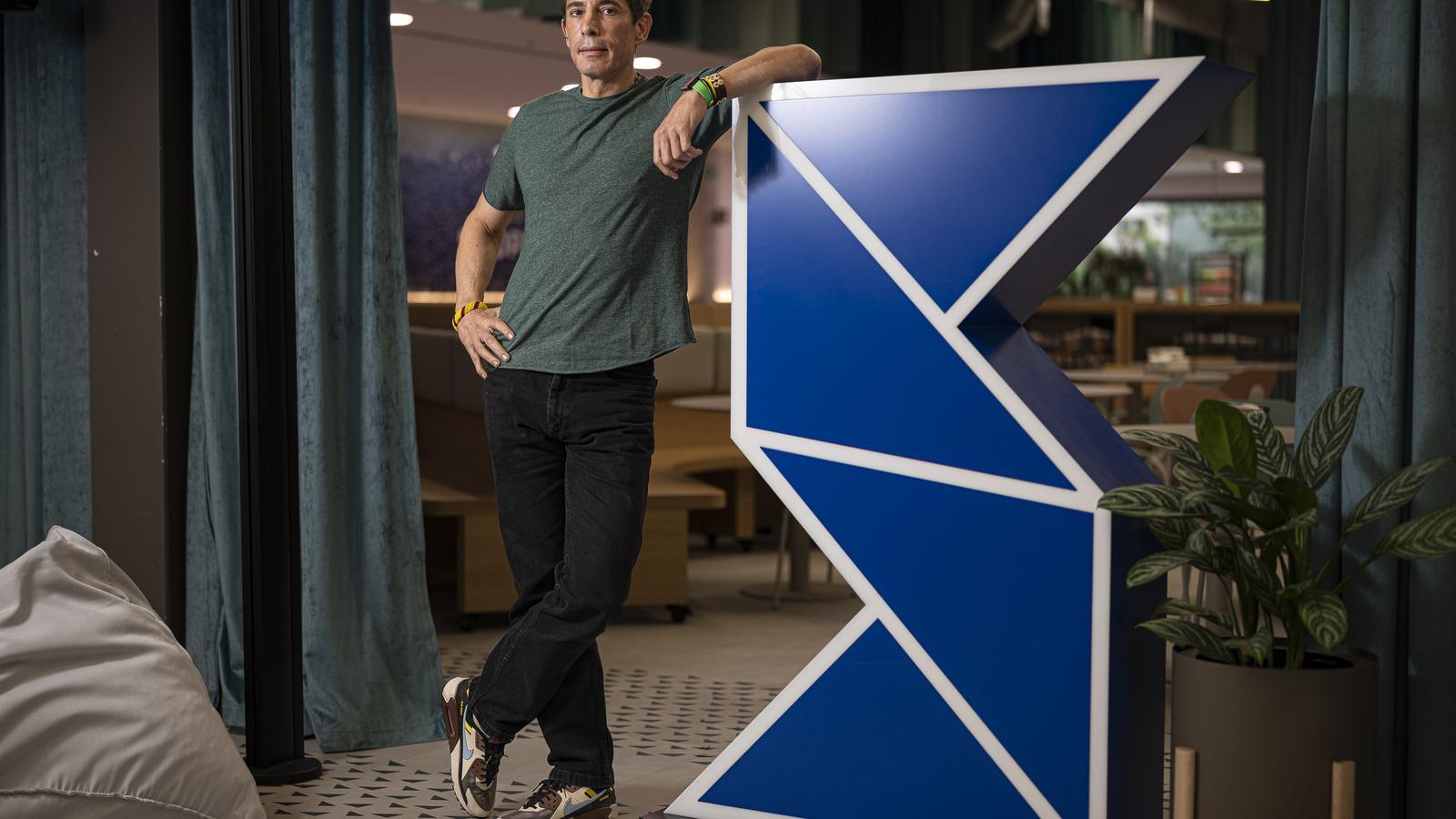
BarcelonaAmong all the big tech companies, innovative startups and hubs multinational that the district brings together, 22@ houses the offices of one of the largest mobile video game companies in the world. This is Scopely, the North American giant that has in its catalog such gigantic products as Pokémon Go or Monopoly Go, among other brands well-known among players. With 850 employees at the Barcelona facilities –and with an expansion on the near horizon– Scopely is one of the hubs of a digital entertainment ecosystem that has in the country's capital one of its favorite places. This is confirmed by Javier Ferreira, co-CEO of the company, who receives Empreses to talk about the future of Scopely, the state of the industry, and how video games have conquered the world.
At what point is Scopely? How is the company right now?
— For me, we are always at the beginning. We have had a very consistent growth trajectory over the last twelve, fourteen years. We have grown in revenue every year, and the goal is to continue on this path. We have had some very important launches, particularly Monopoly Go, which was the fastest mobile game to reach 6 billion in revenue, and it is still performing very well. We also had the acquisition of Niantic, now Scopely Explore. Pokémon Go was launched in 2016, and 2025 was its record year for revenue. The vocation is always to grow, and we do that by improving products, games, and by listening to users. We also have significant ambitions with new games; we have a few in development, some from Barcelona, and I believe they will be a significant boost in the coming years.
Scopely's main games are well-known brands, such as Monopoly, Pokémon or Star Trek. Will the strategy continue along this path?
— The bet, more than on intellectual properties, is on communities. Obviously, creating this type of fan base with an original IP is more complicated. And we have focused on serving and developing for fans that already exist. In the future, the strategy will be continuous, although we are open to original IPs wherever there is an audience. This is the case of Pixel Flow, which had a stratospheric launch, practically creating a new genre. Our business is based on creating products that become the preferred entertainment of users. Approximately between 70% and 80% of the revenue we generate comes after a year of the game's launch. It is a form of long-term loyalty.
How is a mobile video game kept alive over time?
— The historical lens of video games has been units sold. If you cling to this factor, in the mobile case, it is downloads. Downloading the game is, obviously, the beginning of the journey; but what really matters is how many users we have each day, each week, each month. It is true that most games have initial peaks of downloads, and then they have a sharp drop. This happens because they do not generate the dynamics that bind the users. Pokémon Go came out 10 years ago, and remains very strong. Star Trek Fleet Command is from 2018, and it is still a very important product. This is achieved by investing in keeping the game fresh, new, and fun. For it to evolve for the user, who is the one in charge. The business begins when we launch it, but after the launch is when a direct relationship with the user begins, and we can evolve the product based on their needs.

How do you balance the investment between this sustained development and new products?
— The sector is gigantic. In revenue, it is the number one by far in the entertainment category. But it is more interesting to talk about users; and the audience for the video game sector is, we could say, everyone. This is the mobile gaming revolution: there are 4 billion potential gamers. This means that any game has a very low market share: Scopely games have millions of players every day, but from millions to billions there is a big difference. The threshold for launching new video games is very high, because there are already great products on the market, and players have a lot of content available. Therefore, to launch one that has scale, you have to do something very powerful. You have to get someone to abandon an entertainment they love to move to your product. In short, there are opportunities everywhere, but the only way to be successful is to develop the type of experience that leads a player to dedicate years to it.
The mobile gaming audience is much broader than that of consoles or computers. How are all these very different profiles attracted at the same time?
— The audience range for our games is 18 to 70 years old. We are making games for everyone. That is why we speak of casual games: it is not that the relationship with the product is casual, which it is not; rather, the mechanics are more accessible, and this makes access universal. Returning to the evolution of games, our product is not fixed; it changes every day. This allows users to decide how they play. In Monopoly Go there may be an event that interests you and you play it; or not, and you are on your own journey. They are very broad services, which support this diversity of users.
Do these casual mechanics help users access more complex games?
— People play differently today than they did 10 years ago. The person who discovered Candy Crush 15 years ago has effectively been playing it for a decade and a half, and this allows them to now consider more complex mechanics. There is much more willingness, more demand, for deeper and more complex games.
How does this process inform the company's strategy? Do you view the market differently when acquiring or developing new games?
— Everything is becoming more complex. When we think about new games, or acquisitions, we seek to optimize a series of metrics: connection with the game, frequency of use, daily usage time... We do not try to maximize it, but rather to generate continuity. We always look for games that exhibit these kinds of metrics. And this can be a Pixel Flowor, a Pokémon Go, which are completely different games.

These are precisely two recent and very successful acquisitions. Is a time of stabilization coming, or are you continuing to be active in the market?
— We remain very active. We have designed Scopely in such a way that each franchise is almost a mini-company within our structure. We want each team to be completely focused on its players. We do not share resources between games, nor are there people working on Monopoly and Pokémon at the same time, for example. This allows us to scale very effectively. With the acquisition of Niantic or Pixel Flow we not only acquire the product, but we also bring in teams with a lot of experience in developing it. Afterwards, Scopely contributes a lot in terms of technology that allows teams to function better, but they maintain a lot of independence. That is why the growth capacity is potentially infinite. We are always looking for new opportunities, and we work to launch new products without this having any opportunity cost.
It has been just over a year since you moved the Barcelona offices to the current location. How do you assess this period?
— We arrived in Barcelona in 2017. We have spent an entire lifetime here, almost. We have deep roots, not only because of the scale, but because of the infrastructure we have there. Here is the headquarters of Scopely's technological platform, which is the core of the business, it is embedded in all products. The problem we have had in the city, so to speak, is that we have always exceeded expectations. Especially because we have grown a lot in terms of talent. At this moment there are a series of very important products, such as Yahtzee, Scrabble or Stumble Guys, which are operated 100% from Barcelona. And we are also developing new games in the city.
Are we waiting for developments from Barcelona?
— Yes, yes. There will be important news. Work is being done in the city on very interesting products, and they could represent steps forward in our trajectory. This is what drives growth. I repeat, we always exceed expectations, and we do it in a very organic way. It is not that we are suddenly bringing 5,000 people here; it is that the teams are growing, and people are arriving. It has been a success story for the company.
Is there an expansion in sight?
— Yes. We are growing. We need an additional building to the existing ones.
What does Barcelona have to be so attractive to the video game industry?
— Three things. On one hand, local talent; even independently of the video game arm. From a technology standpoint, here you can hire engineers of extremely high quality, equal to or better than those we can find in the United States. The talent base is very important. Then there is the ecosystem: for years there have been companies operating at this intersection of technology and video games, and that facilitates growth. And regarding global projects, Barcelona is a very attractive city. When you tell someone that they have to move to Barcelona, they don't say no. And that has allowed us to create a very international office. In the case of Scopely, we have 850 employees in the city, and with growth prospects.
And the video game sector in general? At what point is it?
— The pandemic, obviously, was an anomalous period with some massive spikes in users. Afterwards comes a period of stabilization, which is defined by this wave of users in recent years. Before, it was a product for minorities, because you needed a console, or a computer, which cost money. Now there are other business models, other platforms. But when there is this kind of evolution of users, it is unlikely to continue growing in the same way. The sector, right now, is digesting this reality, but it is doing so from a position of great strength. Not only in terms of revenue: on a cultural, social scale, it is a very consolidated industry. From now on, I believe growth will come from new ways of playing, new ways of interacting. This is where the sector finds itself right now.
