The old factory where a hundred professionals put to the test another way of building
More than a hundred bioconstruction professionals and artists from Konvent put to the test another way of building at the old textile colony of Cal Rosal, in the Berguedà.
7 min
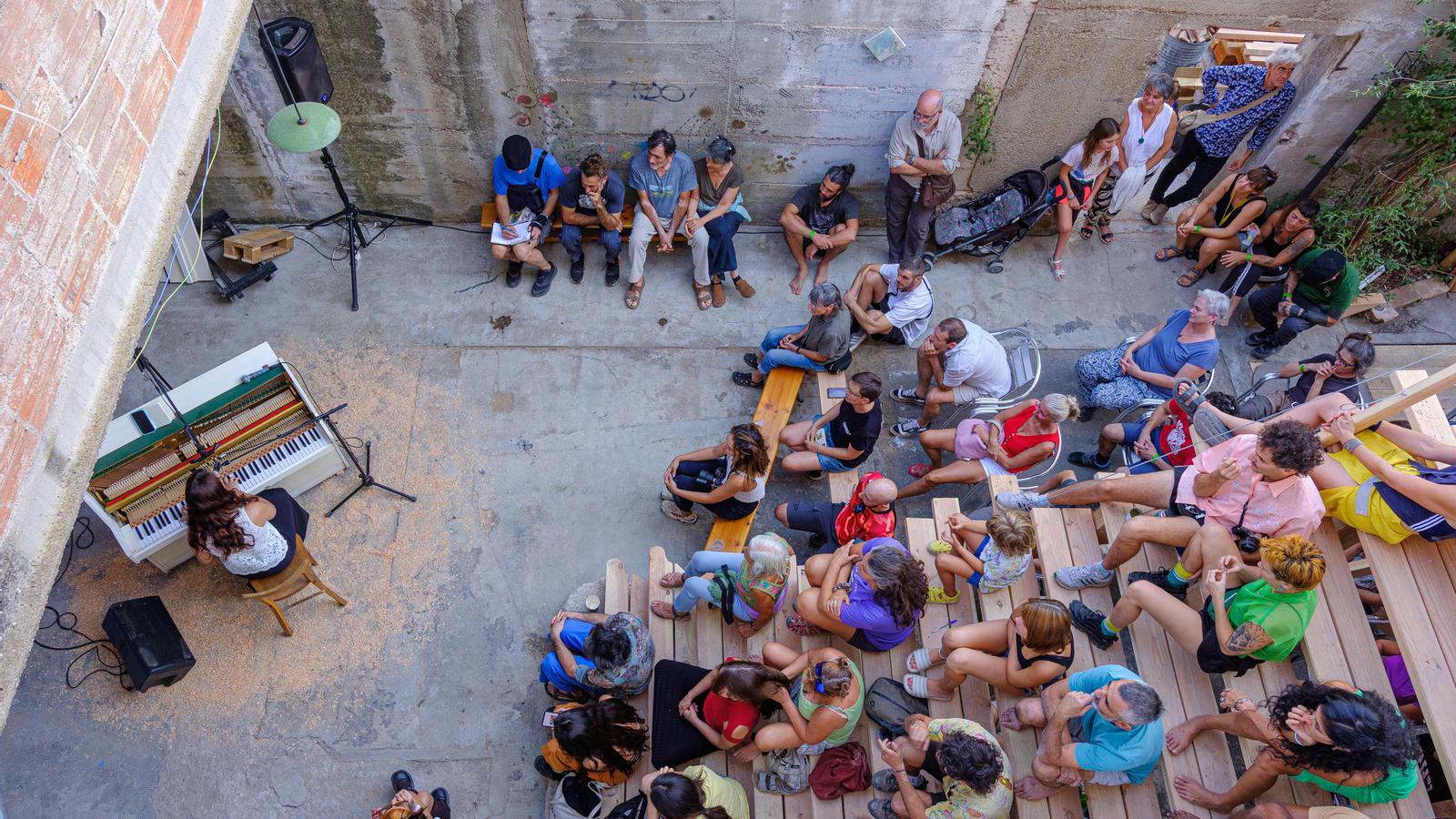
Bru Ferri concert at the Konvent del Berguedà during the open days at the Forma sessions.Nuno Perestrelo
Cal Rosal (Berguedà)An upright piano with its strings exposed rests on a carpet of sawdust. For the first time in six days, at the old textile colony of Cal Rosal, in the Berguedà region, silence has fallen. The artist Bru Ferri prepares to play and sing. But first, he acknowledges the work of the tired yet moved audience before him. In less than a week, among many other things, the stage where he will perform has been built. And not just in any way, but with natural, traditional construction, making each piece by hand. Wood, earth, lime, stone, and plant fibers serve to recover traditional techniques such as the Catalan vault, wooden joinery, stuccos, and earth construction. "Without spaces, there is no culture," Ferri claims.
Everything has been built altruistically by the audience itself: more than a hundred artisans, master builders, and architects dedicated to bio-construction in Catalonia who have flooded the facilities of the Konvent multidisciplinary art center to demonstrate that another way of building is possible. The seating area of this new stage is made of solid wood with traditional joinery. Until just three days ago, Ildefons Alonso, a member of El Petit de Cal Eril and music producer for groups like Remei de Ca la Fresca, used a long, straight temporary ladder to access his studio, which the artists also used to climb up. Now, as David Chia, a dancer and resident of the Konvent, jokes, in the blink of an eye, the naves of the old factory have the "staircases of the Girona cathedral".
General view of the Cal Rosal factory from the Konvent.Nuno PerestreloRenovation of the trusses of one of the Cal Rosal warehouses.Nuno Perestrelo
From the top of the stairs, Gerard Mateu has had to stretch out and listens to the music with a kind of dizziness. "What we have experienced is comparable only to the adrenaline after a 'correfoc' with the Diables de l'Onyar: a dizziness that makes you hungry and at the same time makes you want to vomit," explains this bioconstructor and interior designer from Estudi Consciència, who participated in the construction of the staircase. It is an example of what was experienced during the Forma del Konvent workshops, which were held for the first time last month in Cal Rosal. A practical vindication of the value of trades and the transmission of knowledge, but also of the role of women in construction. As Mateu summarizes: "The first day we met, the second we prepared the material, the third and fourth we built everything, the fifth we put up the handrails of the staircase and the sixth a piano concert is already being held there for the first time.
The seed: friendship
The idea emerged years ago between two good friends from Girona: the artist and muralist Jofre Oliveras, a resident of Cal Rosal for a decade, and the architect, bio-builder, and member ofthe Orígens School and the Mora Network, Martí Ferrer. "We had already carried out many previous actions, from the artistic and architectural perspective, and we had been thinking for some time about doing something at the Konvent," explains Oliveras. "The old nun's convent, where the artists live, has been articulated for a long time, and what we wanted was to look towards the factory warehouses, looking at strategies to work on the rehabilitation of industrial spaces –reflects Ferrer in turn–. But instead of meeting to chat, as if it were a congress, meeting to work and build together".
Martí Ferrer (center) and Jofre Oliveras (right) during the initial visit to agree on the interventions at Konvent.Nuno PerestreloGerard Mateu (right) during the construction of the staircase at the Cal Rosal warehouses, in Berguedà.Nuno Perestrelo
After an initial technical visit during the summer to define the intervention spaces, the days were structured into different commissions based on the trades. Wood, applied to the staircase and the repair of some large trusses. Stone, in the construction of a large cobblestone area at the convent's doors. Earth and reeds, in the creation of an exterior room for people with reduced mobility, where the old chicken coop used to be. The Catalan vault, in the recovery of another staircase. And stucco, in the creation of a large mural at the entrance of the complex with the map of the Cal Rosal colony, the first large textile factory built in the Alt Llobregat, with a curious model of residence and control: the presence of a convent of nuns where the workers lived and the little ones could study. A building that, when the factory was collectivized and the nuns left, passed to the town's youth.
The young man who was given the keys in the 90s of the last century was Pep Espelt Farràs, who transformed the space into an artistic and self-managed laboratory and who has become, in a way, its guardian. He listens to the concert from the window, moved by the collective energy formed over five days. What makes it possible for more than a hundred people to work for free? And what remains of this energy when everyone returns to their usual job? "This is an act of love, of faith, and a demonstration that it is possible to do it in another way –summarizes Ferrer–. If a construction project is already complex in itself, imagine a project where everyone is master and lord of what is theirs".
Pep Espelt, cultural manager at Konvent.Nuno PerestreloThe Konvent team preparing lunch for the Forma conference.Nuno Perestrelo
To make this collective energy possible, Konvent put care at the center: beds for everyone; hot, healthy, and freshly made meals; live music in the evening, and a space for children that allowed families to balance work with child-rearing. Children also participated in the interventions, making a hazelnut dome, while clay coatings were being applied nearby.
Espelt claims that Konvent does not go against the grain, but rather has a vision of culture, like the CCCB: "We are not underground, we are people who add up. We are the well-cared-for margins, without excluding the beauty of the margins. We must normalize difference". A spirit that also champions bioconstruction, still with little weight in Catalonia but gradually growing. The Forma conference has had the support of the Bioconstruction Guild of Catalonia, a meeting point for professionals in the sector with an interest in promoting sustainable construction with a positive impact on the environment. Renovations with health criteria, efficiency in the use of resources, and reduction of environmental impact, using natural materials and techniques adapted to each project.
Care space at the Forma del Konvent conference, where the children held an exhibition.Nuno PerestreloThe living space built with natural materials and earth coatings in the old henhouse at Konvent.Nuno Perestrelo
The role of women
The stories of the professionals who are part of it are born from this beauty of the margins that Konvent vindicates. Daniela Silberman, a board member of the Bioconstruction Guild, started building with straw when she lived in the United States and joined a cooperative in Washington DC. Now that her daughters have grown up, she is back to work so that the administration and European regulations take into account the health of buildings. At the same time, she considers that "the role of women is easier in bioconstruction," also because it is "a smaller sector, where there is an awareness of the place you inhabit."
If it weren't for the dimension of care offered by Konvent during the days, Alba Pawlosky would not have brought her seven-year-old son. "I did it for him, so he could live the experience," she says. She is 30 weeks pregnant with her third child and these days she has helped in the construction of the room in the old chicken coop, where all kinds of bioconstruction techniques have been applied: from the floors to the reed walls and clay coatings. Pawlosky was one of the pioneers in earth construction, a task she performs in parallel to being an architect. "It fascinates me what has happened here, because when we set a common goal we are unstoppable –she says–. But even more so to see how more and more women have changed sectors and are also laborers. Most of the people who have come have normative lives, and beyond that we build. What has happened is a call to recover utopias."
Mural made of stucco at the entrance to the Cal Rosal industrial site with a map of the area.Nuno PerestreloChildren jumping on a trampoline in front of the Konvent in Cal Rosal, in the Berguedà region.Nuno Perestrelo
On the last day of the event, after the piano concert, the party continues in the Konvent garden. While the children sell the drawings they have made, displayed in the hazelnut dome, the driving team shows all the interventions carried out in the space, as if they were works of art. Agnès Mateus, performer and multidisciplinary artist residing in the old colony, acknowledges that the challenge of hosting so many people for so many days was massive, but that the return has been on another level. "You have changed this space, you have changed the Konvent from the root: new ground, new access, our circulation through the spaces... We will live in a different way after your visit. We have tried among ourselves to take care of each other: we are no longer two things, we are all one. Thank you".
Pavement at the door of the Konvent.Nuno PerestreloMural conceived by artist Jofre Oliveras in collaboration with Anna Castilla Vila, stucco worker.Nuno Perestrelo
The textile colony that had a convent
The Cal Rosal textile colony, in the Berguedà region, began construction in the mid-19th century and closed its doors permanently in 1992. At the height of its activity, in the seventies, 1,200 people worked there. Founded by the Rosal brothers, it had an atypical structure: a nun's convent was involved in the daily life of the factory. The building served as a residence for some workers –although living there could cost almost more than their daily wage–, but also as a school and dining hall.
Pep Espelt Farràs, son of a worker, turned the space into a self-managed artistic laboratory. In 2004, the Konvent project was born there, a multidisciplinary artistic center with a community of about thirty resident artists. It organizes festivals such as Kontrast, dedicated to art and electronics, and Gest, for circus, as well as the Que Rebenti la Baells natural wine fair. It is also part of the Berguedà Cycling Spring.