Comfortable houses of straw, wood or mud that would withstand a hurricane
Girona has a unique sustainable building ecosystem that promotes housing with natural materials

-
CAT -
CAST
GironaHouses built or renovated with wood, earth, straw, or a wide variety of biological materials are proliferating in the Girona regions thanks to a unique ecosystem in Catalonia that brings together dissemination and training entities, architects, surveyors, and all kinds of sustainable construction professionals. It is a very well-connected network that helps, among many other things, to train self-builders, share experiences, resolve doubts, obtain labor, and find natural materials with a zero (or negative) carbon footprint.
Martí Ferrer, coordinator of the technical area of the association Group for the Recovery and Study of Architectural Tradition (GRETA), details an organizational chart that, due to its complexity and organization, is generating an effervescence that is expanding the benefits of bioconstruction to sectors that until recently were refractory to it.
The pillars of the Girona bioconstruction scaffolding are formed by GRETA, which carries out dissemination, study, and training (with the Union of Construction Entrepreneurs) and seeks to influence planning and urbanism; the Orígens Bioconstruction Workshop School, which trains self-builders and offers a wide variety of courses; and the Xarxa Mora, which connects 160 sustainable construction professionals in an active WhatsApp group where doubts and needs are resolved. "It is a unique case, because in Catalonia there is no structured and decentralized network like the one in Girona," concludes Ferrer.
I want a straw and mud house
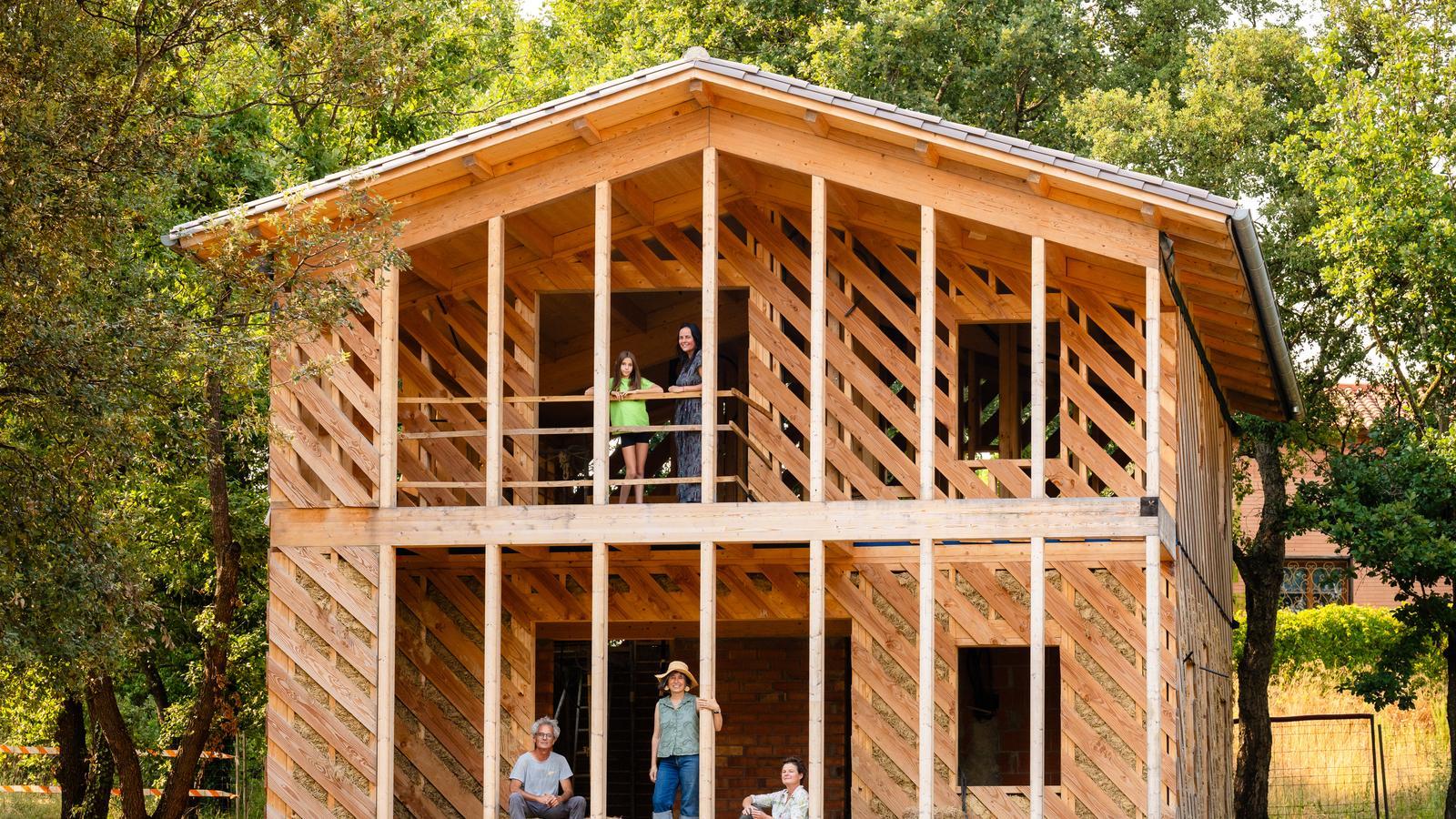
What drives a person to commission a straw and mud house? Laura Tàrrega, a professional specializing in the conservation and management of cultural heritage, learned about adobe and raw earth houses in Morocco. “It’s important to live in nature. I had rented a renovated chicken coop, but I also like the feeling of rest that these organic houses provide,” she explains. Her straw and mud house, half-built on a plot in the Mas Llunès urbanization (Bescanó), will make the most of the sun’s warmth in winter through a glass-enclosed gallery that will open in the summer. The climate control will be minimal. The structure supporting the house, designed by architects Olga Muñoz and Laia Escribà, is made of wood, with hollow walls filled with a mixture of straw and mud, which Tàrrega, like many other owners of eco-built houses, has helped to knead and place. It will then be plastered with a mixture with more earth than straw, and a final layer of lime.

Ricard Turon, manager of Genial Houses – a studio specializing in efficient and sustainable houses –, calculates that this type of housing can be 15% more expensive than a traditionally built house, but that it has many advantages that amply compensate for the investment, such as improvements in terms of "the carbon footprint, maintenance costs or water vapor permeability". Carles Brunsó, in charge of the work for the same company, assures ironically that, now that he is close to retirement, and knows how to build wooden houses, "mud houses are arriving". Genial Houses' participation in this case is considered "an experiment" from which they will acquire a lot of knowledge. The architects who have designed the house based on their client's needs are, however, fervent defenders of rehabilitation through bioconstruction. "Often, it is better to maintain than to demolish. Sometimes we tear down fantastic buildings to build real crap," adds Laia Escribà. The work began in 2024 and has progressed according to the availability of all participants. The owner hopes to be able to move in within a year.
Pioneer of the land
Oriol Balliu, who works under the trade name Puraterra, is one of the pioneers of earth construction and his name usually appears in any conversation about bioconstruction. The family home he built in La Pera (Baix Empordà) with his partner, Marta Muñoz, became his university and the seed of a professional life change. La Pera has been for years a place of pilgrimage for those who wanted to verify that a house made of mud blocks (COB technique) could be very attractive, and that if it had "good boots and a good hat", as Balliu says, no downpour could undo it. In 2007 they began to extract earth from a hole in the same plot of land as a building material. They were placing compressed moist earth blocks inside a wooden formwork. The house was finished in 2013 and the void that remained was turned into a cistern. The fascinating construction of the house led Balliu to leave his job as an environmental educator. He now defines himself as an earth construction specialist who also produces materials for this type of work.

Waterproof cow dung
“Earth is the most universal, most economical, and most sustainable material. That's why historically you find earth houses everywhere; in Catalonia, in France, in Morocco, or in India,” explains Balliu, who warns that current construction criteria must be changed, “which consumes 40% of the country's energy.” Balliu believes that building is too focused on insulation, and what is needed is to “act on the building’s temperature, not on the air.” He admits that these houses are more expensive, “but you can't compete with plasterboard.” The secret to making them cheaper is self-construction. “It’s a joy to participate in building your own home and start saving. And to have the key given to you by the carpenter and not the real estate agent,” he assures.

Balliu explains that hemp, rice husks, straw, sunflower, sheep wool, and some agricultural by-products are making a strong entry into the world of bioconstruction, and as a curiosity, he points out that his house has an exterior coating with 25% cow dung, which is "the best local waterproofing additive".
Restore with taste and conscience
It is difficult to find an example of a comprehensive urban restoration carried out with more taste, imagination, and variety of biological and recovered materials than the one that Carola Pérez-Badua and Gerard Mateu have carried out in their house in the Santa Eugènia neighborhood of Girona. They are at the head of the Consciència studio, from where they promote comprehensive restoration projects for spaces with history. The “ingredients list” for their home is endless: rice husks from Pals, river pebbles, mud, straw, wood, cane, bamboo, lime, stone, fallen tree trunks, natural pigments, old pavements, or bricks recovered from an abandoned brick factory.
They have managed to breathe new life into a nondescript house that had been boarded up for 10 years in an apparently unattractive location, between workshops, vegetable gardens, and apartment blocks. Gerard Mateu has been dedicated to bioconstruction for 20 years, after working as a painter and performance artist, and like many other professionals in this sector, he is capable of playing all the roles: bricklayer, plasterer, carpenter, or even interior designer, although this is the specialty of his partner Carola. Both share an interest in reusing materials that is not at odds with aesthetics. They bought the house in 2018 but could not start the work until 2020. "We did it little by little, without getting into debt, as we had the money, even though it was a major renovation, as we only left the four walls," highlights Pérez-Badua. Actively participating in a large part of the construction and having the right professionals at hand saved them a lot of money. "Girona has been a pioneer in bringing together bioconstructors: plumbers, bricklayers, builders, carpenters, plasterers, basket makers, and other specialties," assures Mateu.

Straw on the roof and pebbles in the foundations
They had it ready to move into in 2024. It is 110 m² of usable space where open spaces are prioritized, with a roof insulated with straw bales and a floor that prevents humidity with a sanitary slab of river pebbles that creates a ventilated air chamber and stabilizes the construction.
Humidity is kept constant between 50 and 60%, both in summer and winter, thanks to a second skin of 6 cubic meters of clay with which they have covered the interiors. Energy consumption is very low and soon, based on energy balances, they plan to install the photovoltaic panels they need. They have a well that, for the moment, they use to water the green roofs, like the one on the garage. In 2024 they moved in, although they still lack details. Pérez-Badua assures that the restoration of abandoned houses is often "more creative and fun than building a new house, besides that building is very expensive". Many people from Girona know the work of the Consciència studio for the restoration of La Brutal, the hamburger restaurant in the old town of Girona that was promoted by television chef Marc Ribas.

Apology for bioconstruction
The Mallorcan bioconstructor Siddhu Sintes, based in La Garrotxa, explains that he started building “as a response to a personal housing need.” This first contact with natural and recycled materials led him to make raw earth, stone, wood, straw, and lime the basis of his constructions. “Raw earth is essential; it has a universal presence, it can be kneaded, compacted, and reused without adding energy,” he explains with great didactic vocation. “The earth inside regulates humidity, temperature, absorbs bad smells and noise. The thermal sensation is incomparable to what any other material offers,” he adds. According to Sintes, current industry is building houses with toxic elements: plastics, paints, volatile organic compounds (VOCs). “Sometimes, the air inside a house is worse than outside —he warns—. My mother suffered from insomnia for more than 20 years and when she slept for the first time in our earth and straw house, she woke up in the morning and said: ‘I slept wonderfully.’” According to this bioconstructor, it is enough for a house to be plastered with earth to provide it with more well-being. He believes that what is currently lacking is to unite “contemporary aesthetics with natural material” in order to recover the break in knowledge transmission that traditional construction suffered.
Everyone realizes that bioconstruction must grow because EU directives demand decarbonization. A little-processed material has little encapsulated energy and “the construction sector is currently facing a reconversion like the industrial sector in the 80s,” assures Sintes.

A house that will sound good
Miquel Vilarrasa, a musician and agricultural engineer, single-handedly, by hand, kneaded a thousand adobe bricks (mixing soil from the same land and straw) which have been used for the interiors of the ground floor of the house being built in Riudaura, La Garrotxa. For now, he assures that it does not reach the 1,500 or 2,000 euros per built meter that is usually used as a benchmark for bioclimatic houses. Surely, he adds, it is because he has invested "many hours of labor". He started the house 3 years ago and is progressing as he gets money. On the exterior there are 580 straw bales coated with a transition of clay, clay with lime, and a final layer of lime, which is the traditional exterior protection material in almost 90% of this type of construction. The house has been designed by architect Mirco Zecchetto, from Casa Pasiva, which offers advice and options to universalize and reduce the cost of bioclimatic construction. Jesús Ramírez, a building surveyor and rammed earth wall builder, explains that the house has been made with the CUT system (from the English Cell Under Tension) of double wooden studs, where the straw bale is placed and compressed. A slat is used to secure every two straw bales. Vilarrasa explains that the construction process has been very fun and that, since he plays the trombone and the flugelhorn, he will greatly appreciate the sound absorption that the house will provide him. He is determined to move into it in the winter.

According to the builder's calculations, a house like the one in Riudaura removes the same amount of carbon dioxide from the atmosphere as two houses like this one with conventional materials emit during their construction. “When the large construction companies fully incorporate the CO₂ balance paradigm, that’s when it will really take off,” assure the architect and the quantity surveyor.

Preach by example
The circle of this route for bioconstruction closes with a brave project: the rehabilitation of La Llereda, a house under traditional sharecropping with a rental contract in Cogolls (Les Planes d’Hostoles), where Martí Ferrer and his partner Bàrbara are applying traditional techniques. In an isolated and difficult-to-access space, without water, the house was left half-reformed years ago. La Llereda is within a 112-hectare property owned by a single owner, which also has two other houses: El Vilar, dedicated to rural tourism and organic market gardening; and El Portet, which combines rural tourism with cheese making with a herd of goats. The rehabilitation is progressing according to money and time to convert the main house into a training center for bioconstruction, with classrooms and accommodation. For now, they live in a comfortable renovated barn of 50 square meters, optimizing every little corner. They collect water from the land in winter, which they use to water a garden with lush tomato plants that grow in the shade of the willows, which will later be used to make fences and baskets. Here, everything is made use of.
