How are pensions defended?
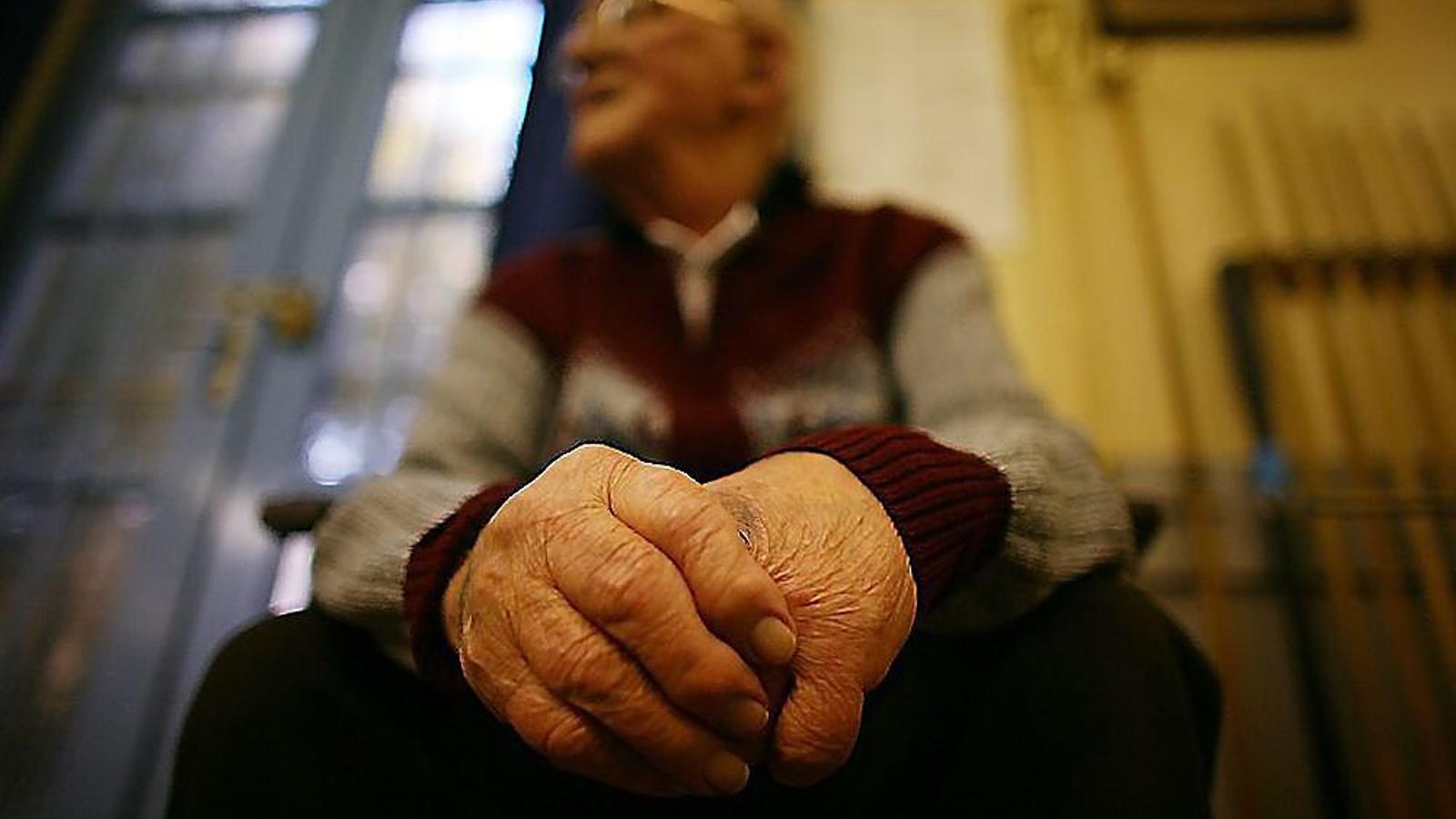

Pensions are the elephant in the room of Spanish politics. On one hand, because pensioners represent one out of every three voters. Therefore, no political party that does not want to fall into marginality can afford to suggest that, if it is up to them, pensions are at risk.
On the other hand, however, anyone who knows the four basic rules of arithmetic knows that a generation that has had few children cannot expect to receive a very generous pension in relation to the salaries of those children.
Let's run some rough numbers. A generation works, on average, between the ages of 20 and 65, except for 10% of the time (when they are on leave, unemployed, studying, or early retired), retires at 65, and survives until 85. That is to say, they collect a retirement pension for half the time (20 years) that they have worked (40 years). If this generation has had two children who reach working age per woman, there will be two contributors for every pensioner (because each one contributes for twice as long). This means that if 30% of the salary is withheld from contributors (between the employer's contribution and the employee's contribution) to pay for pensions, these pensions can be, on average, equal to 60% of the young people's salary. If, instead of two children of working age, the generation in question had had 2.5, the average pension could be equal to 75% of the average salary.
The current situation in Spain is that pensions are 74% of the average salary but there are little more than two contributors for every retiree (2.35, according to the most reliable source I have found); that is to say: pensioners are being paid as if they had had more children than they actually did. This already constitutes, obviously, a problem.
The big problem, however, is that the ratio between contributors and pensioners is falling year after year as us boomers retire and are replaced by our few children. It is estimated that the ratio could be 1.4 in the 2050s, which would imply that pensions would have to be progressively cut in half.
If we do not want to cut pensions, it is necessary to work more, and we can think of two basic modalities: that we do it ourselves or that others do it, and in Spain we are testing both.
On one hand, the retirement age has risen from 65 to 67 years. This is a very effective measure, because one contributes for two more years and collects for two fewer years. But it is insufficient, because since us boomers have only had 1.8 children per woman, this modification allows pensions to be equal to 60% of salaries, far from the current 74%. Maintaining pensions at this level would require raising the retirement age above 69 years.
The other option —that others work— we are testing by creating jobs for immigrants. In fact, under equal conditions, an immigrant turns out better than a native, because they do not need public support during the first years of their life. In this sense, there are many who argue that immigration is either a solution or the solution to the financing of the pension system.
But immigrants also end up retiring, so when the calculations are done correctly, it is concluded that immigrants only contribute if their salary is high and if they do not have dependent adults (which in practice means that both members of the couple work). That is why the most detailed study on immigration in the Netherlands concludes: “Western immigrants [...] provide a benefit to public accounts if they arrive at an age between 16 and 50; on the other hand, they are a burden if they arrive at other ages. Non-Western immigrants are a burden, regardless of the age at which they arrive”.
Since this scenario is not at all attractive, some propose that the solution to the pension problem consists of shielding their revaluation with the CPI through an explicit provision in the Constitution. Unfortunately, this solution would have the same low effectiveness as article 47, which explicitly establishes that “all Spaniards have the right to decent and adequate housing”.
Others—from ideologically antagonistic positions—propose replacing the current pension system with a capitalization-based one. This solution arrives a few decades late, because applying it now would require doubling workers' contributions to Social Security, half to pay for the pensions of retirees and the other half to save up for their own retirement.
Do we not have solutions? Of course we do, but they demand sacrifices. Who is to decide them? As Fuster used to say, if we do not do politics ourselves, someone else will do it for us. The extension of the retirement age was imposed on us by creditors, and now we will have to see if the Parliament that emerges from the polls takes the bull by the horns or if it waits for history to repeat itself.
