Dennis González: "I want to be the first Olympic man in artistic swimming"
Artistic swimmer
-
CAT -
CAST
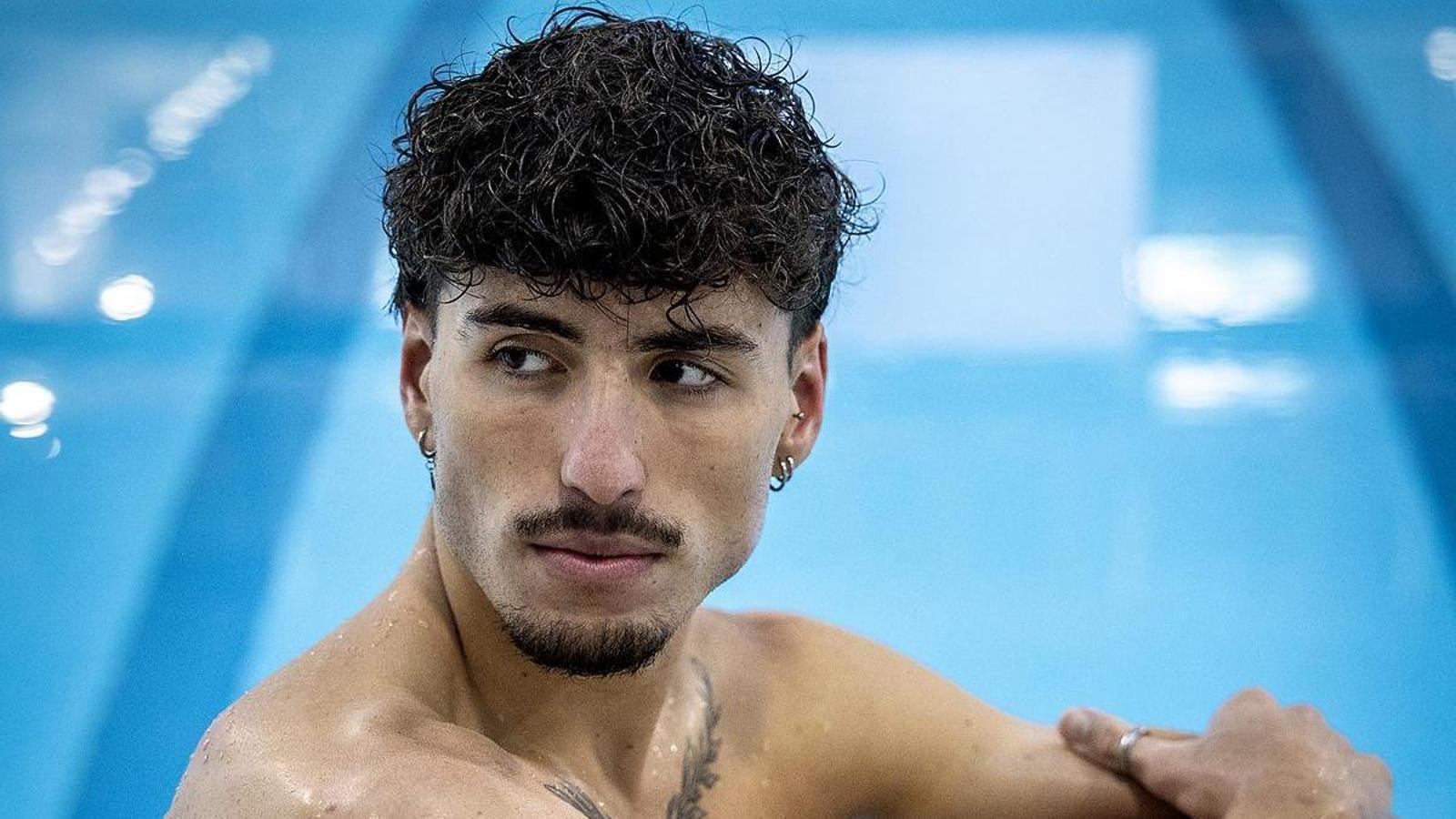
Saint Cugat of the VallèsDennis González (Rubí, 2004) has been training for more than five hours and is watching a recording on a screen of the exercises he has just performed in the pool with the Spanish artistic swimming team. He looks focused. He is the only man on a team in a sport in which, until recently, only women competed. But González has made his way, has won medals in World Championships and now wants to be an Olympian. He works under the orders of Andrea Fuentes, who has been revolutionizing the national team with her methods for two years now. He looks happy. He receives the ARA just after leaving the CAR pool in Sant Cugat, without having time to rest. But once he starts speaking with enthusiasm he does not seem tired.
This year he was able to take a little vacation, since the next two might be tough.
— Yes, we were given slightly longer vacations because we are facing two special years thinking about the Games. We have been working for about two months now and we are happy with what we are achieving. It is time to prepare new exercises and face new challenges for the upcoming competitions, as the scoring system is changing.

They have raised their voice to criticize the way artistic swimming is usually scored, because the creative part is valued less than they would like and, instead, physical elements that can cause back injuries are prioritized.
— A person constantly bending their back is not healthy. It's just like that. We already know that high-performance sports will never be perfect. I'm not criticizing everything, eh? I love sports and I defend them. But it's also not about leaving us disabled once we retire. In the last European championships, there were a lot of injured people. A great many casualties. There were many girls who wore girdles to better manage their back pain outside the pool. Girls who were exhausted. Luckily, the rules have been changing to try to prevent movements that could lead to injuries, but it is still a sport with risks. It happens with the issue of apnea, which is another aspect that we are looking at and working on. We spend a lot of time underwater without breathing.

The history of artistic swimming at home begins with an era in which, to compete with the Russians or the Chinese, crossing some limits was accepted. Now we are in a new era in which the coach Andrea Fuentes maintains that it is possible to win while enjoying training.
— It is exactly like that.
It is a revolution... humanistic, I do not know how to define it.
— Well, yes. It is as you say. Andrea was also a swimmer. In fact, she was trained by Anna Tarrés. Both of them have evolved; the Tarrés of now is not the same as she was years ago. Those were different times. Before, you could be beaten at school and now you can't, right? Andrea herself and we know that we want to win the gold, but if to achieve it we have to do something that goes against our values, we will not do it. If the Russians want to kill themselves training and keep losing girls along the way, then that is up to them. We will not hurt ourselves to try to win. This is very noticeable in the way we work. The way we do it, the effort comes more naturally. When you are forced as a student or swimmer to do something, it is hard to give 100%. Because you are being forced. You go with fear, with tension. If you do it with enthusiasm, you can achieve great things. I suppose some rival teams train more hours, but they do not train better than us.

You are a generation with clear ideas. Ambition can coexist with enjoying life outside the professional sphere.
— We are different from the Russian or Chinese women. Because we are from where we are. It shows in the artistic expression and in the fact that we want this vital balance. The feeling I have is that something very beautiful is happening.
At the Paris Europeans, the Russian team returned to compete after years of sanctions. And what they did was copy your group routine and win the gold.
— A sign that we are leading the way. The night before competing they told us, that they had copied us. The judges know the exercises that are presented and one day before, the rumor spread. It is not funny, but it also filled us with pride to see that they value us. If Russia wants to win the gold like that, well go ahead, congratulations. But you have copied us. Years ago people looked at the Russian team to see what they were doing and now it is the other way around, they look at us. We have two years left until the Games, which is what we want.
Two years that can be very special for you.
— It is my dream. In the preseason, I spoke with Andrea and I told her that I would do whatever it takes to be there. And since in the Games there is no men's individual program or mixed duet, I have to be in the main team. Eight swimmers and two boys at most. Logically, you have less visibility than in an individual program, but I will do whatever is necessary to be there. I do not want to skip any training because I have to prepare a solo program. If later on I see myself prepared to prepare the individual exercise for the World Championship, great, but it is not the priority. What I want is to bet on the Games.
Going from prioritizing exercises alone or in pairs to doing so in such a large group must be a complicated change.
— It is not easy, but everyone helps here. I like this challenge. At the Paris 2024 Games, men could be Olympians in this sport for the first time as part of the team of eight swimmers, but there were none. Therefore, the door to being the pioneer is still open. I can be the first male Olympian in artistic swimming. And it is an opportunity I do not want to miss.
How did you experience the Paris Games? Did you watch them on television?
— I remember it perfectly. I was in a vacation apartment on the Costa Brava. My friends went down to the beach and I stayed on the balcony with my coffee, with the computer on, and I watched them. And talking to my mother. It was special because I already knew them all, I felt connected to them. It was exciting to see that they had won a medal. It filled me with a desire to emulate them.
When the friends returned from the beach, did they find him with a different look?
— Of course! I told them that I would do the same. That I would go to some Games.
He spoke about his mother, a key figure. What does it mean to you?
— She has always been my inspiration. She has given me spaces to talk, to express myself... I learn a great deal from her, but she also learns from me. She helps me to be a better athlete and I help her to be a better teacher. I believe I wouldn't have reached this point without her, because she has done the impossible for me. At the beginning, few people and few clubs bet on me. Few people in the family trusted that I would succeed. And mom has always insisted that I try. Phones stop working without the SIM card. Well, I am the phone and she is the card. Without her, I don't work.
Another important figure is Pau Ribes, the pioneer in artistic swimming, who retired in 2002.
— When I was a child, my mother worked as a synchronized swimming coach, as artistic swimming was called back then. And I would get in the middle of the girls and play, but aware that it was a sport for them. I didn't know that men could practice it. One day on television I saw the program Informe Robinson, in which they talked about Pau. It was a surprise. After watching I don't know how many World Championships and I don't know how many Games with my mother on television, it turns out that there was an option for me to be able to do it. I told my mother that I wanted to try it and she trained me for a whole year to prepare for an exhibition. At that exhibition, Pau Ribes came. He was my idol and he was there. And not only that. He jumped into the water, gave me advice, encouraged me, and we swam together. It was very beautiful.
As a pioneer man in artistic swimming, he cannot focus only on competing. He also becomes a spokesperson.
— I am clear that I am a role model. But not only for young people, but also for parents. If they see me compete, I can help change their point of view. And they have to educate the boys and girls. So it is important that they also open their minds. I have to focus on doing my job and, if I achieve success, I will have more of a voice. This way my message will reach more people and I will be able to inspire others. Personally, I like doing interviews and talking, because since it is a minority sport, I am clear that there are people who want to practice it and are afraid of what others will say.
Just as Pau Ribes jumped into the pool to help him, does he do the same for the young people coming up behind him?
— Yes! Right now it is one of the things that motivates me the most, the fact of helping. We have organized some meetings with the boys from the lower categories in Spain. And I love it because you see their evolution and you feel fortunate. Young boys full of energy are coming up. Even if it is difficult, I try to find time to open up and talk to them.
Outside the pool he is a cheerful person, but inside he is very competitive.
— True. Things about being a high-performance athlete. With my teammates, we always motivate each other positively to improve. In a group dynamic, comparing yourself to others can be dangerous because you can end up feeling like crap. Sometimes you see teams where they don't help each other at all. And here it's the opposite. I love the atmosphere we have. We are very demanding, but in a positive way.
It feels like Andrea Fuentes is looking to create spaces to unite the group and for it to be enjoyed. You all went together to Puerto Rico and you have also gone to fashion shows.
— Yes. In a team sport, it helps a lot to stick together. We spend many hours suffering in the pool, you end up being very cold and you end up exhausted. So, sharing spaces to laugh is very important. It is necessary that not everything is about training and pushing yourself to the limit. When she sees that an exercise is becoming too heavy for us, she tries to propose more fun dynamics. For example, we went to the Barcelona Fashion Week to see a swimsuit designer and we talked to her to think about how the ones we will wear in the next competitions will be. You always get something positive out of it. In the preseason in Puerto Rico, for example, we met the gymnastics team from there, to learn techniques they had. We have also been visited by an American coach who comes from the world of rhythmic gymnastics and she helped us improve the whole flexibility part so we don't get injured. Sometimes it seems like we are having a lot of fun, but we are also learning.
As you see it, have you thought about whether you will want to be a coach in the future?
— I like the idea. It is something I have thought about many times. But right now, my goal is the Los Angeles Games.
You are one of the sports in which the most hours are worked. Less than others more media-focused. Doesn't it make you angry?
— It is true, but we will not play the victim either. It is what we have to do. I think there is a lot of hard work behind it that is not seen. Today, for example, I started with the whole physical part. Then I worked on the jumps. Later, the swimming part and an artistic part. Then we did the technical part and then we did the physical workout in the water. Yes, it is many hours. In other sports they train for two hours and head home! We do not.
