Remei de Ca la Fresca, the band that sounds different from all the rest
Hyperactive, oneiric and forceful, the quartet from Arbúcies faces its first Razzmatazz with a new EP and consolidates itself as one of the most original and disruptive bands on the national scene
5 min
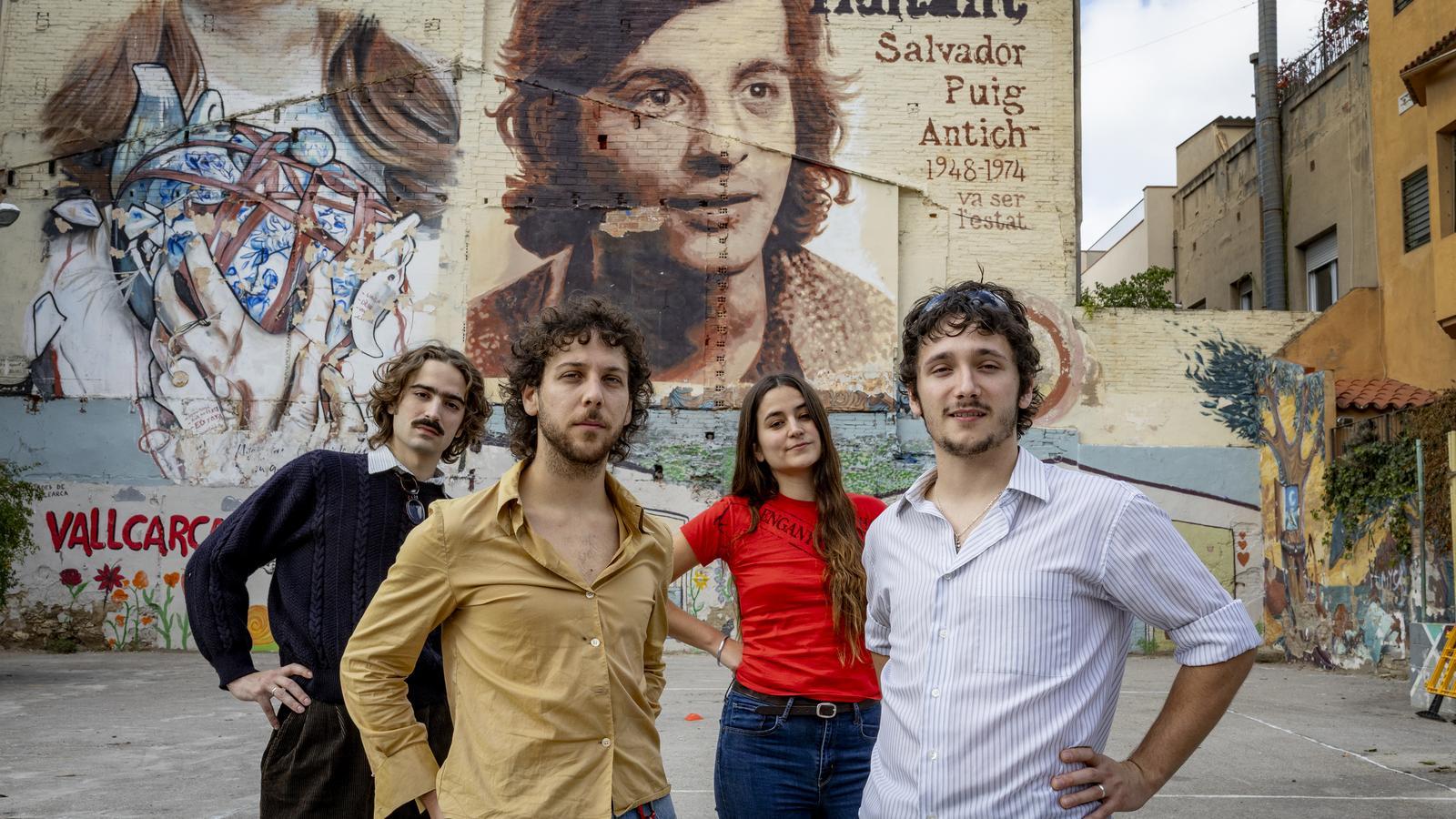
Remei from Ca la Fresca, in front of the mural in homage to Salvador Puig Antich in the Vallcarca neighborhood in Barcelona.Francesc Melcion
Barcelona“There are other groups much more of the moment than us. Or that are, I don’t know, more on everyone’s lips”. This is said, a little overwhelmed by the question, by Xantal Rodríguez. She is the singer and lyricist for Remei de Ca la Fresca, a rock combo from Arbúcies with just over six years of history. There are objective reasons to think that, really, they might not be the band of the moment: they don’t play in any of the four or five photocopied and massive festivals that populate our geography, with –always– the same names, nor are they the ones chosen to represent the brewery of the day, nor do they collect astronomical figures of online plays. Mind you, they have something much better: they are different from the rest. Try to find someone nowadays who in this country marries, as they do, visceralness with energy, lysergia, vindication, magnetism, and insurrection. No need to waste time searching: it doesn't exist. And let's add hyperactivity, because perhaps they are not the group everyone talks about if we look only at numbers, but they start November returning from a British mini-tour, presenting a documentary at the In-edit festival, releasing a new four-song EP, and holding a concert in the large room of Razzmatazz in Barcelona. All this in a couple of weeks. And now what? Who gives you more?
The radiating core of Remei de Ca la Fresca are Xantal Ródriguez and Artur Piera, who are a couple and the ones who started the project. Later on, Iago Rueda and Víctor Álvarez would join them. They all know each other from the town, from forever. “Iago and I went to school together, and we met Víctor when we were teenagers,” recalls Piera. And then Xantal would arrive, who is older and got along with the rest because she was a drama teacher for two of them. Before becoming a band, they were already hanging around the small musical circles of their town. “Every Thursday there were some jams at Transparent –a cultural meeting point in Arbúcies– and it was super cool and unprecedented. We were the youngest and the veterans monopolized everything, but when there was a little gap we would sneak in. That’s where we started to grab a microphone, to play in front of an audience,” recalls Rodríguez.
Due to the time gap, only she lived with certain intensity the years in which the town in La Selva became one of the epicenters of national indie music. This is because between 2005 and 2015, Arbúcies hosted the PopArb, a gathering that centralized the independent Catalan proposals of that time. Today it has remained, with good reason, as one of the main reasons to understand the rise of our pop of this century. “It was very important for me. To be 17 or 18 years old and be able to walk to a festival, with all kinds of people from outside. I still hadn't even gone down to Barna, I hadn't seen anything. At PopArb I discovered many bands: El Petit de Cal Eril and Joan Colomo, people who have since left a big mark on me”. The idea of forming a band and playing at PopArb stuck in Xantal's head. Looking at it, they were understandable aspirations: “That is easier in Barcelona, but when you leave a town and form a band, where do you play? You don't know any places, there aren't any,” she says.
A lockdown band
It probably would have ended up forming anyway, but it was during the pandemic that the project crystallized. They started it between two of them. “We did what we could. What we could with what we had,” recalls Artur Piera. He was the musical element, and Xantal the lyrical one. “I had a notebook that I wrote in for myself, I called them essays, the typical thing they call an escape route.” And once Remei de Ca la Fresca existed, everything accelerated.
In no time at all they had won a contest, made a minihit (Nascut descarat, a free version of the classic Born slippy, by Underworld) and released a first demo. And they started playing and playing and playing. And then they made another hit, which sounded in even more places (another version, Tot el que volem és okupar-te el xalet, a free take on MIA's Paper planes). And finally a second album, L’ham de la pregunta, in which everyone finally paid attention. Five years had passed.
This is a story, more or less, typical of many other names in the scene. But they, as we just said, are a different band. In Remei de Ca la Fresca they have other objectives, other aspirations: theirs are convoluted, aggressive and poetic, psychedelic, political, hallucinogenic songs. If you like easy tonalities and verse-chorus-verse structures, this is not your band. “We look for ways to surprise ourselves,” they say.
This group from Arbúcies doesn't always make things easy for the listener: what we hear doesn't always go where one imagines, nor do the guitars, heavy and powerful, take us where we thought initially. And then there is Xantal, who doesn't sing with a canonical register either, but rather varies within the same song, between a punk scream and rhapsody, with everything that remains in between. If one listens to them, one encounters a wild and indomitable mixture of Triana, the progressive rock of the seventies, Pau Riba, Els Surfing Sirles and Rage Against the Machine, one of the totems with whom they are most compared. “From the beginning it has been very important for us to do something that is different,” they say if asked. And they achieve it.
Remei from Ca la FrescaFrancesc Melcion
Even more direct
Mesures extraordinàries, is their new work, a four-song EP that will help vary their live setlist before they start working on their next album. “It’s Groundhog Day when you do the same concert every day. Instead, now we have four new ones to play,” explains Rodríguez. The essence compared to their previous work is similar, but they have made strictly musical variations: “I have the feeling that L’ham de la pregunta has something more dreamlike and more magical, that each song goes in a different direction, and yet these four to a certain point are more forceful –they say–: It is the first time that we make new songs thinking about the enjoyment of playing them at concerts“.
Returning to Rage Against the Machine, on Mesures extraordinàries they have ended up making their definitive tribute song, Designed in USA, made in China: “We looked directly for the sound. We have been told many times that we remind them of the group, even though it didn’t seem like it to us, and we went to make the song that really does sound like them”, explains Artur.
With the Californians they share ups and downs, mid-tempos, guitar explosions, and recited choruses. But above all, it reminds you of their essence, the authenticity, and a magnetism they exude that is inseparable from their music. Aura, it is called nowadays. These people, Remei de Ca la Fresca, have aura. “We love the bands that you see live and with which you connect with an energy that is difficult to define”, explains Xantal. She is right, and in fact, with them, exactly this happens to you when you see them on a stage.
“Don't let it drink any more water, for now it all belongs to the rich”
Every struggle needs a soundtrack. In Arbúcies, various collectives have been battling for years against the local water bottling plants owned by large multinationals like Nestlé and Danone. These companies operate thanks to the 1973 Mining Act, which considers water a mineral resource and, therefore, one that can be exploited until it is depleted. The struggle aims to treat it as a common good that should not be privatized, especially after suffering the extreme drought episodes of recent times.
This banner has also been carried into music by Remei de Ca la Fresca, both in their songs (Mal de muntanya) and in public statements. Their latest combat artifact is Però abans d’això hi haurà set (But before that, there will be thirst), a documentary directed by Màrius Intente and Pau Ballesté that follows the band in their day-to-day life. This accompaniment includes highlighting their commitment and activism to save the water in their home. “It’s a follow-up of our tour interwoven with the struggle of the Aigua Clara collective in Arbúcies, with whom we have a relationship,” explains Xantal Rodríguez.
The idea came from the two directors, who wanted to make a piece about the group, a reason not very convincing to the band (“We haven’t been around long enough to have a documentary,” they say), and in the end, they all found this more protest-oriented path that goes much further than just a film. The proposal reached In-edit, which got involved and just premiered it in its recent edition. “The directors have done a fantastic job, they filmed us for many hours. It’s a bit embarrassing, but the documentary is very worthwhile, and it’s all for the sake of the water struggle,” the singer assures.