From wicker to chestnut, the art of Catalan basketry is reclaimed
The Catalan Association of Basket Makers recovers traditional techniques and keeps alive a trade that is memory and identity
-
CAT -
CAST
Basketry is an ancestral practice with origins in the Neolithic, or even before. It was born from the need to transport and store food. In the Iberian Peninsula, remains of basketry and ropes up to 9,500 years old have been found (specifically in the Cueva de los Murciélagos, in Granada). The Romans first, and the Muslims later, contributed new techniques that were perfected until its golden age, from the 18th century to the beginning of the 20th, when the trade became professionalized and became a pillar of the rural economy.
In prehistoric societies and in many indigenous cultures, basketry was an eminently female art, necessary for the gathering and storage of food, but in the Middle Ages and Modern Age, when basketry became a profession and a trade recognized and regulated in the cities, men came to control the guilds. From that moment on, only men could be officially recognized as “master basket makers”. The women of the family worked many hours in this trade, preparing the material, peeling the cane, softening the wicker, but they rarely appeared in the official records of the trade.
Even so, in Catalonia and the Valencian Country, the palm leaf basket makers were famous, who wove soft materials such as esparto, palm leaf, or wheat straw, sitting at the door of their homes while doing other household chores. Even now, the masters of Artpauma, in Mas de Barberans, are guardians of the work of the palm leaf or fan palm leaf, a historically female trade of the Terres de l’Ebre. They work maintaining ancestral techniques, as well as implementing them in contemporary works and making collaborations in the world of art or fashion.
Ona Trepat Rubirola, in Pla de l’Estany, is another example of the application of the traditional technique in works of artistic and contemporary scope. She is a prominent Catalan visual artist, sculptor, teacher, and basket maker who applies the fusion between contemporary art and traditional weaving techniques with vegetable fibers. Aleix Grifoll, originally from the Vic plain, is also one, and he summarizes it like this: “The world of basketry takes me down paths I had never expected. I have made baskets on a stage for the play El canal, from the Salt Performing Arts Creation Centre, with electronic music, people singing, lights, and virtual images... I never thought I would end up on a theater stage sitting and making a basket”.
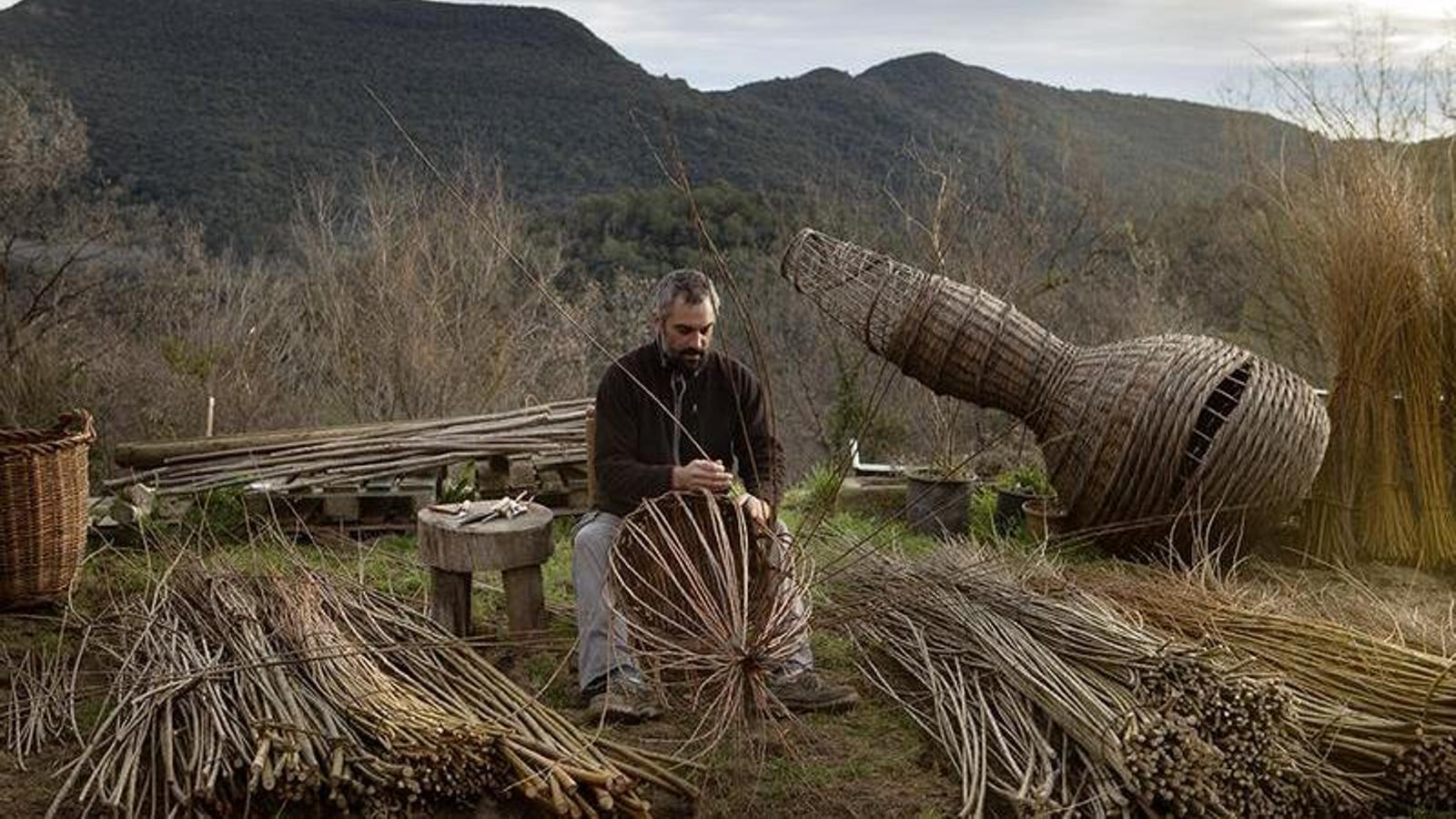
Aleix was president of the Catalan Association of Basket Makers for five years, until a few months ago. The entity, founded by the basket maker and researcher Roser Albó, was born in 1996 with the aim of promoting, disseminating, and uniting all those passionate about this traditional craft. We speak with Aleix at the house where he lives among forests and fields, located at a point between Banyoles and Girona, "paradise," as he defines it.

It is a sunny morning, and Aleix is working outside, with the Can Sieres hill in the background. “The Association is an anchor point so that all basket makers who wish to can stay in touch to help each other. To resolve doubts about how to make a piece or about some material, to pass on an order to someone else, to ask for help with a job... This way we are all networked”.
Basketry is a manual and sustainable craft; it is the reflection of the knowledge, skill, and values that have been passed down through generations. Each piece shows the ability of the hands that wove it, the tradition and culture of each place. The raw material used is born from the earth, from fields and ponds; it is worked with the hands to give it shape, and when it is no longer used, it decomposes and returns to the earth.
The practice of craftsmanship requires concentration, focus on the work, patience, and perseverance. In a world led by haste, craftsmanship is a slow practice, closer to mindfulness, which is so fashionable, than to mass production. The ability to read the material and the knowledge of the matter is the artisan's fingerprint.
Back in the 19th century, the writer and critic John Ruskin called for a return to the pre-industrial era and celebrated craftsmanship as a form of resistance to capitalism and mechanization, where the artisan had creative freedom and a spiritual connection with their work.
For Aleix, traditional basketry is the foundation of everything. “I feel that tradition is being lost a little, and now it is time to revalue it. To value the hands, the time spent on it, the material, all the dedication. We all, as basket makers, work to maintain this precious craft”. “For me, basketry is like a meditation. When you are with a basket, you are in your own world. Even if you know it is for a specific person, you try to connect with the person for whom you are making it... In a basket, there is always an emotion, a marked feeling. And then someone sees it and resonates with it...”.
Researching cultural roots
At the Catalan Basketmakers Association, everything is decided by assembly. All the basketmakers take action so that the craft remains alive: the Association participates and collaborates with the basketry fairs held in Catalonia and also organizes basketry courses throughout the year, in Salt, in Barcelona, or in any other part of Catalonia, at the basketmakers' workshops.
“We want to promote, in a shared way, the search for the cultural roots of the world of basketry. To study, research, and disseminate the ethnological reality of the basket makers of the Catalan Countries. To exchange our knowledge with men and women who, in one way or another, have participated in the history of basketry craftsmanship,” they say from the Association. They also hold internal training sessions in which highly experienced basket makers teach them how to make pieces that are no longer used, or are no longer made, so that they are not lost.
“A few weeks ago,” Aleix tells us, “at the Association, we made a potato-peeling basket, which is a double basket with a handle, and we have also made a strawberry basket, a 'vigatana' or long basket, a 'canastró', a 'terrelló', a bed-warming basket, which is a basket with different handles inside which a piece of pottery with embers is placed to warm the bed, and that is how we have been going along...”
Also with the Última Vertebra Association, pieces such as the carnation basket made of wicker and reed have been recovered. It is a traditional Catalan piece that was very important for the basket makers of Salitja and the Selva plain, such as the Serra Planella family, experts in making this type of piece. Or a 'budellera', which was a gut basket or slaughter basket, and the 'garbella', which were two wicker pieces that were formerly used in pig slaughtering. Or a snail basket ('caragolera'), also a traditional Catalan wicker piece, with a cross bottom, a lid, and a handle at the very top, which served to purge the snails before cooking them and was hung on the wall by the handle. This piece is still used, especially in the regions of Lleida.
“I believe that basketry is currently a craft that many people are interested in learning. Then, making the leap to dedicate oneself to it professionally is another matter. You can make a living from basketry, but it requires a lot of skill,” says Grifoll.
Workshop commissions are very important for basket makers, but so is giving workshops and teaching basketry; going to schools, explaining things, making structures for schools... Teaching and passing the baton to new generations.
Each basket maker ends up specializing in a subject, and each one works with the subject they know best, or with a type of fiber, or with a type of market.
Recovering wicker fields
With a few members of the Association, they have also recovered some wicker fields in the plain of Vic, Osona, from the company Pont de Carós, which had wicker plantations to make wicker structures with live wicker. “But live wicker doesn’t work very well here, because it has to be watered, and here the issue of irrigation is a problem, and they gave it up.” Among several basket makers, they have recovered these fields and are planting varieties more suitable for basketry. They have also recovered old, traditional wicker beds that existed in farmhouses and country estates, from basket makers who have already retired because their hands no longer worked for them. “For the farmers who had wicker fields, it’s good for a basket maker to pass by there, they like it, and the basket maker maintains and prunes them, it’s an exchange.”
Wicker was planted mostly near irrigation ditches or ponds to take advantage of the water and obtain raw material to work with if they had to make baskets for storing or transporting things: potatoes that went by ship to England, for example, or carnations, which were distributed from the Maresme region everywhere by train.
Naturally, wicker plants are not found in the Pyrenees or by the sea: they are from flat land and inland, and they need water, which is why they live naturally along the banks of rivers. An advantage of planting wicker on the banks is that it stabilizes the slopes. “When Gloria happened, in some plantations that were on some river banks in Folgueroles, when the river overflowed it washed away three meters of path where there were no wicker plants, and where there were wicker plants the slope did not move. This is because they usually have a very strong taproot and then some superficial roots that intertwine a lot, and they stabilize the banks very well when there are floods.”
Another fiber they work with is reed. “We work a lot with reed –he tells us–, it is very good for making baskets. Wicker is stronger, but it weighs more. Reed is quite resilient and is very light, and since it is very abundant, you have a lot of material to work with.”
Bulrush, like the one collected by Ona Trepat in the surroundings of Banyoles, is another of the materials most used in basketry. Bulrush grows in the water, and they usually harvest it in some pond or lake, where it grows naturally. But it is more controlled and sometimes permits are needed to harvest it, since wetlands represent a refuge for biodiversity on a global scale.
These are the materials with which Aleix works the most, but one can also work with chestnut, with hazel, making strips of fiber with a knife. "Making the strips is complicated, but with a knife the whole process can be done, it is part of the art... It is years of craft."
"From the Association, we would like there to be a regulated school, in the format of a vocational training course, for example, as already happens in the field of agriculture, so that the trade is not lost and so that people see that being an artisan is another option you have in life, that having a trade means a lot. Being a basket maker is a passion."
Basketry has really changed little over the centuries; the tools and the technique are practically the same as those our great-grandparents used, what changes is the context, and above all the hands of the one who manufactures. These artisans will preserve the heritage and pass it on to the next generations. Craftsmanship is tools, knowledge, and emotion, but it is also identity and memory.
