The last Amazigh tattooist of Tunisia
Manel Mahdouani stands as a bulwark of a millenary tradition and battles to preserve the collective memory of the first inhabitants of the Maghreb

-
CAT -
CAST
TunisIn the small and prosperous town of La Marsa, right in the middle of legendary Tunisian Carthage, a dozen tattoo studios now proliferate, giving an idea of how trends and globalization find cracks in the smallest country of the Maghreb. They are no different from the studios in the center of Barcelona. You could get tattooed there with characters from La casa de papel or Peaky blinders and the designs preferred by tourists, such as moons and abstract figures, for which a European would be willing to pay up to 600 euros.
But among all this wave of modernism, we find a place that, from the trenches, watches over the culture of Amazigh tattooing. The Amazigh –free people, in their literal translation– are the ethnic group native to North Africa that has inhabited for 20,000 years the territory that today belongs to Morocco, Mauritania, Algeria, Tunisia, Libya, and Egypt. Historically, this people has taken ink marks on women's skin as a symbol of protection and matriarchal power.

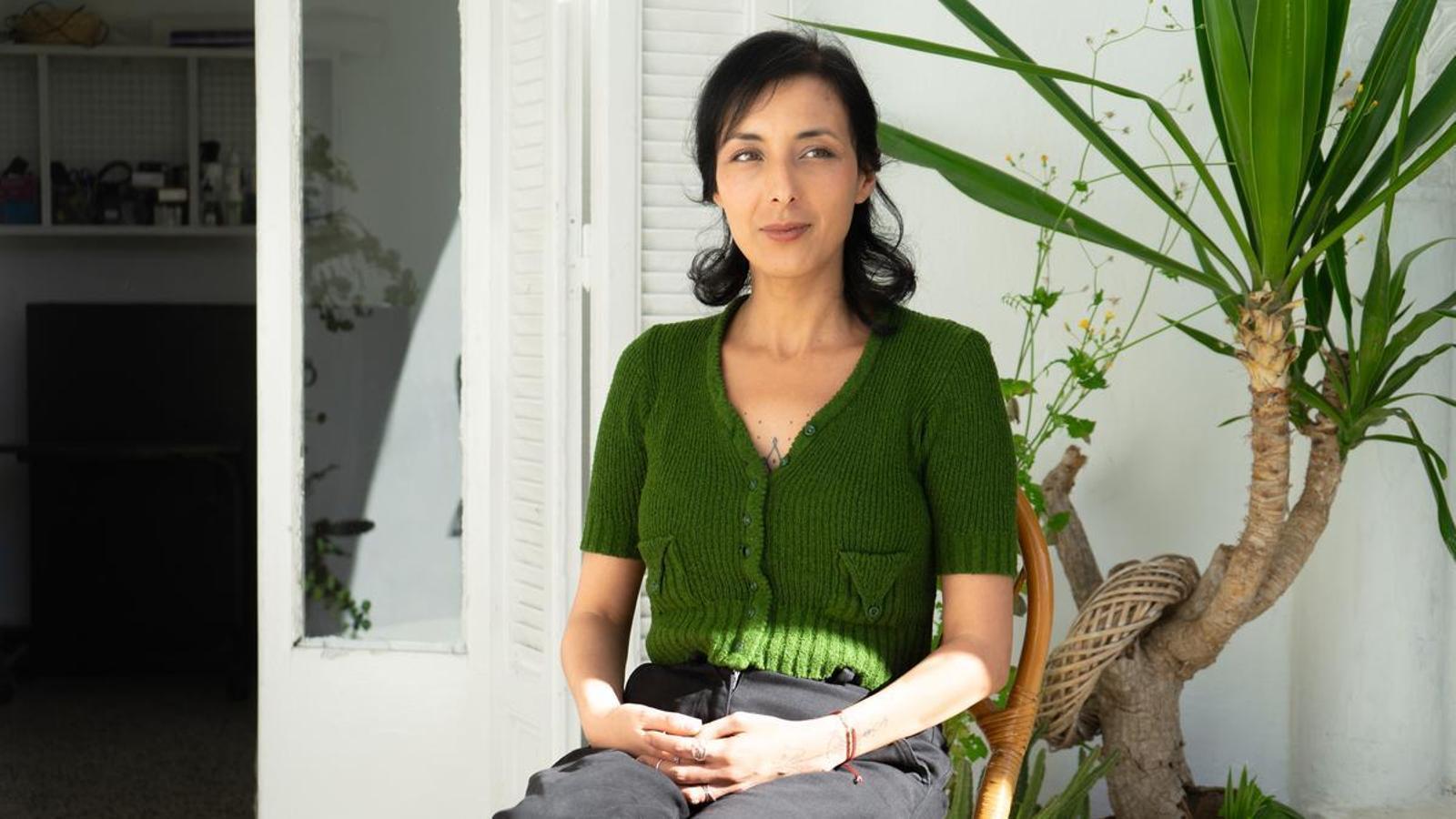
What looks like a small sewing workshop guarded by a dense garden hides the studio of Manel Mahdouani (Kairouan, 39 years old), the only woman in the country who still tattoos an extensive repertoire of Amazigh symbols. The disappearance of this heritage in Tunisia is a chronicle of a death foretold, but there are still those who resist abandoning this millennial custom.
Mahdouani grew up in an Amazigh family in Kairouan, 160 kilometers south of Tunis, the capital, where the only visible vestiges of this ethnic group are the clothes, the jewelry, and the preservation of healing methods with medicinal herbs that are still practiced in some homes. “It is now very difficult to find women with facial tattoos. Most are very old and are dying, and the tradition dies with them. Partly because there is no one specialized in this style. There are tattoo artists who do some designs purely for aesthetics, but without any prior research or sociological basis,” she explains.
It was not until 2015 that Mahdouani became interested in Amazigh tattoos and became a pioneer in the sector. The spark of modernization and democratization had just ignited after the revolutionary wave of 2011, the first success of the Arab Spring. The consequence was the fall of the atrocious dictatorship of Zine El Abidine Ben Ali after 25 years of ruling Tunisia with an iron fist. A regime that made Amazigh culture invisible in favor of a pan-Arabism that sought to unite the nations of the Greater Maghreb during the decolonizations of the 20th century.
A strategy based on blackmail
After decades of resistance against French colonialism, the Amazighs faced blackmail from Ben Ali. Around 1972, the dictator initiated a campaign of massive mobilization of rural populations to take total control of the communities in the south and southeast of the country. The vast majority lived in the isolated mountain areas and on the island of Djerba, from where they could defend themselves and protect themselves from French invasions. With the excuse of offering better living conditions—running water, electricity, schools, and transport—the regime wanted to appease any attempt at resistance to the prevailing centralism by installing new urban centers in lower and more accessible areas.
The professor at the National Heritage Institute of Tunis, Mansour Ghaki, one of the oracles of Amazigh memory, points out that it was a way of breaking the solidity of the social fabric. “The purpose of this policy of forced displacement was for the population to remain in the hands of the administration. A fragmented society is easier to integrate into new urban centers,” maintains Ghaki. According to the professor's own experience, who is originally from the Amazigh village of Tamezret, when bureaucrats or gendarmes arrived at the enclaves they encountered a hostile world. “At the end of the day, conflicts in the villages were resolved between the neighbors themselves, without the need for administrative intervention,” he explains. Today, only a few localities, such as Zraoua, Chenini, and Zmerten, resist the blackmail and are the last living vestiges of Amazigh culture.
It was not until the triumph of the revolution in 2011 that a path was opened towards political-religious plurality and cultural activism after years of censorship. During the years following the Arab Spring, new Amazigh associations emerged, and even Akal, a secular political party. But it was all a mirage. The timid political and social dimension that was achieved after the revolution receded again with the rise to power in 2019 of the ultra-conservative populist Kaïs Saïed, the president who keeps Parliament frozen and has returned the country to an autocratic system governed by strict religious moralism. Thus, the Amazigh have returned to political and social ostracism, as has the practice of tattooing. “For this government, tattooing isharam and goes against the morality preached by Islamic law,” asserts the tattoo artist.
Faced with the regime's inaction to recognize the Amazigh as a people, Mahdouani acknowledges that she feels a great responsibility to preserve an inherent part of their heritage. “It was an artistic choice, but it was also a way to investigate my origins. As I researched, the more I realized I needed to delve deeper into my quest. I not only had to strive to identify the symbols, but also to talk to the women and learn their stories because, unfortunately, they are not documented. The information that is in books or on the internet is very scarce,” she says.
The identity crisis is latent in Tunisia. Language is a very powerful weapon of social control and, from school onwards, the regime is in charge of burning the tribalization of this people into the collective consciousness and belittling it. “I learned the term Amazigh after the revolution, when there began to be awareness about the country's diversity. At school they teach us this heritage incorrectly. They tell us about the Berbers (barbarians) who inhabited it, a term that for us is pejorative,” she explains. But the reality, according to Mahdouani, is quite different: the Amazigh have never left. “What the regime wants is for society to think that it is eminently Arab, not Amazigh, not North African. For this reason, we Tunisians have a serious identity crisis. If you ask ten Tunisians, two will say they are North African, five that they are Arab and three others that they are Carthaginian. We are not a unified society,” she concludes.
The road has not been easy for Mahdouani, and she admits that she has been criticized. “They attack me because people are afraid of what they ignore. Especially because I am recovering animist symbols of our ancestors that now go against the official religion of the state,” she says.
There is a legal vacuum regarding tattoos, because there is no law that covers this activity but neither is there one that prohibits it. The supply of material is not easy either. “I often have to import it from European countries, mainly from Italy, Spain, and France,” she stresses. In fact, the only thing that reveals that tattoos are practiced in this space is a stretcher covered with disinfected plastic, a small cabinet with jars of ink, and an old book on the desk with all kinds of documentation on Amazigh tattoos. The rest of the room is occupied by elements such as sewing machines, fabrics, threads, and mannequins on which Amazigh symbology can endure without having to face stigmatization.
In recent years, the tattoo artist has traveled the country in search of tattooed Amazigh women, most of whom are elderly and are concentrated in the mountainous regions of the southeast and on the island of Djerba. “The functions of these tattoos had to do with initiation rituals, leaps into maturity, marriage, or fertility. The important thing is that people know how it was done before,” she emphasizes.
Yezza, 75, lives in Dkhilet Toujane, a town in the mountains straddling Matmata and Tataouine, better known for being the setting where the first movie of Star Wars was filmed. The main room where Yezza lives with her daughter is decorated only with an eighties Panasonic television, an old bar cabinet, two rugs, and a family photograph. In the garden, the olive tree is not missing. Although the aging of her skin has consumed much of the relief of the tattoos, she still wears a line with three dotted lines on her chin. “Life is not static, but a continuum of breaks to keep moving forward,” she says in Darija –the dialect of Arabic spoken in Tunisia– while pointing to the tattoo on the lower part of her mouth.
Each tattoo, despite retaining an aesthetic function, has a concrete meaning. Afterwards, she points to her wrists, where a couple of geometric figures can be intuited: "This one is to protect my body when I work, so I don't cut or injure myself when I sew or handle a knife. Even though I don't work much anymore...", she adds while laughing and pointing at the wrinkles on her hands with her finger. Yezza is one of the few dozen women, along with her sisters, Lamma and Halima –inhabitants of Toujane and Zmerten–, who still preserve tattoos in this region of the country. All three praise Mahdouani's work and support her, but they take it for granted that the tattoo and the language will disappear when they disappear.
The paradox of tourist exploitation
Unlike neighboring countries like Morocco and Algeria, where Amazighs represent between 50% and 20% of the population, respectively, seeing older women with painted bodies in Tunisia has become something of a miracle. Although there is no official data, associations like Azro, one of the most active in the country, estimate that there are around a million Amazighs living in the country—10% of the population. The Saïed regime does not actively persecute them, but it does marginalize them, to the point that the only way they have to assert themselves as a people is through a tourism sector hungry for exoticism.
The economy in the south of the country is based on agriculture and, to a lesser extent, on tourism from Europe, which wanders there anxious to acquire a piece of Amazigh handicrafts, taste their gastronomy, or get a photograph of the caves where this people lived centuries ago. The reality is that the Ministry of Tourism usually uses these elements of Amazigh heritage as a great exotic attraction. However, the economic benefits rarely impact the development of these southern communities.
The linguistic decline is accelerating
The language of these peoples, Tamazight, is not promoted in any way by the government, which conceives of Tunisia as eminently Arab. And even less so after the communities' awakening following the revolution, which they themselves dubbed tankra tamazight or "awakening of the language". "Bilingualism is endemic in Tunisia. We have always been a multicultural society, a crossroads of civilizations that has been assimilating into the dominant culture of the era," mentions Professor Ghaki. "From the learning of Punic script and the worship of the god Baal to the Arabization of the Tamazight language, passing through the imposition of Latin during the Roman presence in the territory," he adds.
To understand the critical situation the language is experiencing in Tunisia, one must look towards its western neighbors. In Algeria, it is estimated that there are between 10 and 12 million speakers (about 30% of the population), while in Morocco it is calculated that there are around 20 million, almost half of the population. Amazigh speakers in Tunisia do not exceed 100,000 (1% of the total).
No Maghreb government publishes official data on Tamazight, which depend on estimates from organizations such as the International Work Group for Indigenous Affairs (IWGIA). But Tunisia is the only one of these states in which Tamazight has no official status nor is it mentioned in the 2011 Constitution, a fact that has led UNESCO to declare it in “critical danger of extinction.” In fact, there are no laws, budgets, or public institutions destined for the protection of its linguistic heritage. There have only been timid advances, such as the recent elimination of the 1965 circular that prohibited the registration of babies with Amazigh names. Despite everything, administrative obstacles persist in practice.
According to Ghaki, the basic problem is found in the Arabic-speaking and French-speaking assimilation of the population from childhood. “Learning Tamazight does not usually go beyond six years of age. In public school, Arabic and French are studied by default. Families have already normalized this trend and look out for the good of their children, since these are the only languages with which they will be able to prosper academically and professionally,” he explains.
