"Now there are many more restrictions and prohibitions than before"
Companies like Circ Cric, El Perillós, La Tràgica and Sputniks remember the beginnings of the Catalan contemporary circus and make an x-ray of the state of the sector today
7 min
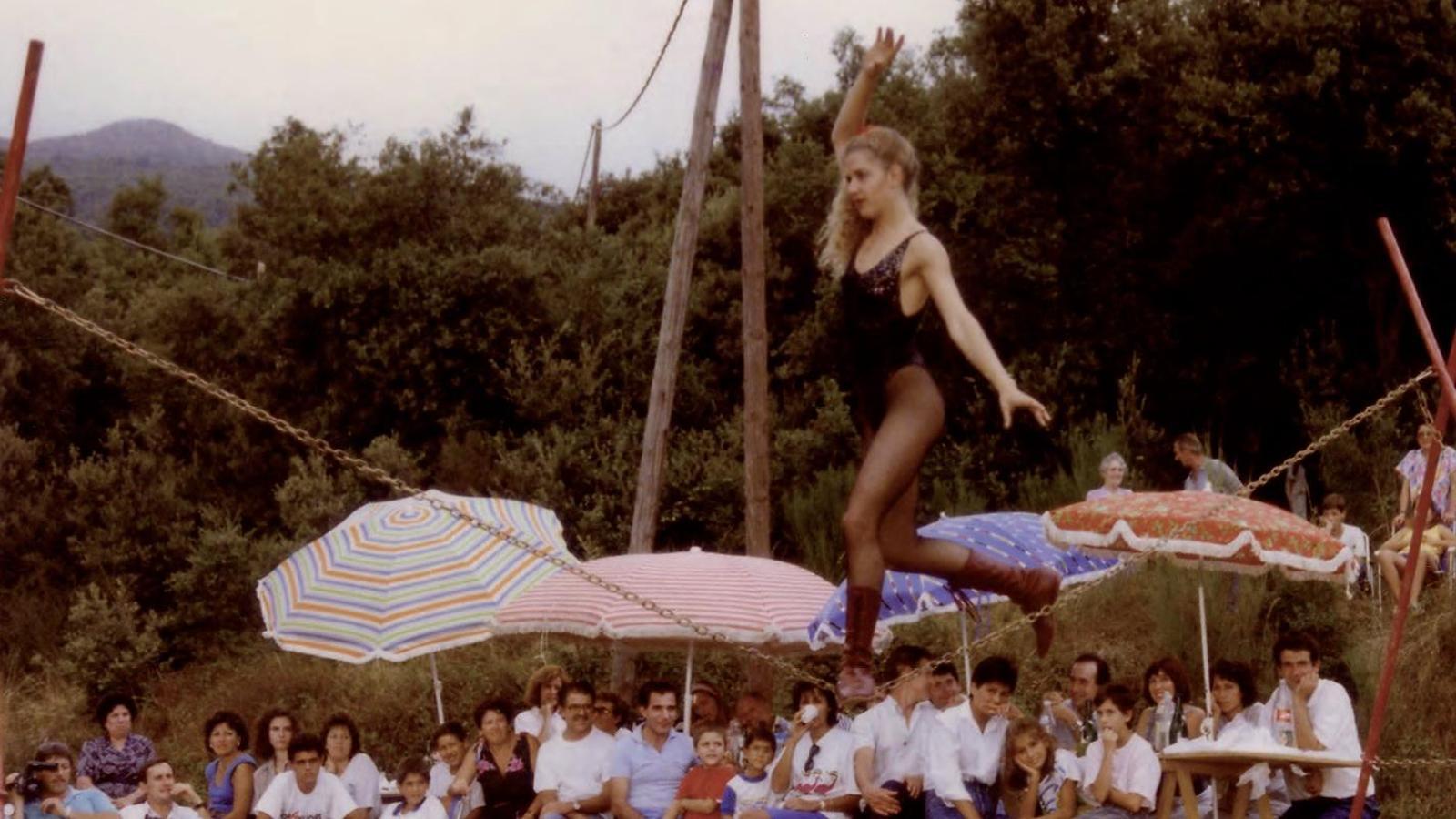
Bet Miralta during a performance of the show 'Circus, wonders and variety acts', by the company Escarlata Circus, in 1987.Raül Miralta / Arxiu de Circ
BarcelonaIn 1976, all the ingredients were on the table of the Catalan performing arts for a new contemporary Catalan circus to appear. The death of Franco gave wings to the young artists who, for some time, had been waiting for the opportunity to grasp freedom, go out into the street, and create. "We were born as a utopia," says Adelaida Frias, from Circ Perillós. When she looks back and thinks about those days, the artist recalls, above all, "a kind of joy, a need for overflowing imagination, a desire to move, of a changing era". With Comediants, Joan Brossa, Carles Santos, and Els Joglars as pioneers and benchmarks, at the end of the 70s there was an explosion of new companies such as Circ Sèmola, the Poltrona brothers, Picatrons, and La Tràgica. The latter marked, on October 6, 1976, the beginning of the Catalan contemporary circus with the premiere of the show Tripijoc joc trip, starring six auguste clowns and performed during the Sarrià Major Festival, in a tent at the Pati dels Caputxins.
"Society was a pressure cooker that had burst. There was a brutal energy, the circus took its space," explains Jordi Jané, one of the members of La Tràgica. The company had been created with a previous theater production under the baton of Lluís Pasqual, Fabià Puigserver, and Guillem-Jordi Graells. "We wanted to professionalize ourselves and decided that the next show would be about clowns, with the idea that they would face certain impositions of wealthy society and reflect on social life. The circus we had seen until then was decrepit, with all the negative clichés acquired," points out Jané. Tripijoc joc trip sought the formula to disassociate itself from it and create from singularity, moving away from tradition.
Tortell Poltrona balancing chairs on his chin during a Circ Cric performance in Sant Esteve de Palautordera.Josep Guindo / Arxiu de CircThe poster for the show 'Tripijoc joc trip'.Marcelo Grande / Arxiu de Circ
The Poltrona brothers –the company led by Tortell Poltrona and Claret Papiol that preceded the Circ Cric– followed the same mission. “The clowns we had here only told cheap jokes. We went to Paris and there we saw much more innovative clowns, who inspired us,” recalls Montserrat Trias, one of the souls of the Circ Cric. “We wanted to invent our own circus, to do it our own way. We were young and inexperienced, we didn't have Olympic skills. We had live music, we parodied the trapeze artist. If there was something we didn't know how to do, we turned it around,” the artist adds. In 1978, the Cric put on its first show at the Odéon in Canet de Mar. Three years later, they obtained a 750-seat tent and began their itinerant adventure until 1983, when they had to dissolve due to economic issues. They would return in 2002 and continue to the present day.
The conquest of the street
At the end of the 70s, the circus was emerging without a fixed exhibition space in Barcelona—the last one, the Teatre Circ Olympia, was demolished in 1948—, so artists conquered the street. “It is a very agile space, where there is an audience of all kinds. You find the show, you see it, you seduce them, and if they don't like it, they leave,” highlights Frias. The lack of legislation for spaces and artistic practice made it easy for an acrobat to climb up and test their skill in any corner without worrying about permits or sanctions. The Circ Perillós was founded in 1982 with Frias, Jordi Borrell, and Oriol Boixader at the helm. “One of our priorities was performing at height. We had a nine-meter arch and a set design with nests and ropes. That arch, which was very solid, was welded by Jordi [Borrell] with a blacksmith friend. It was not approved. This could not be done now, and the arch in question would be worth much more money,” the artist underscores.
A moment from the show 'El veí del balcó' performed in Barcelona this October.Cristina CaldererCirc Pistolet in a scene from the show 'Incert', at the Terrassa Cultural Center in 2014.Josep Guindo / Arxiu de Circ
Their show El veí del balcó –which they have now revived with new artists as part of the Interrupcions cycle, linked to the creation of a circus archive– rightfully reclaimed the use of the street as a stage. “Now there are many more restrictions and prohibitions than before. The street is, practically speaking, only for political rallies. There is no freedom of expression in the artistic and creative sense, it is a sadness,” laments Frias. Shortly after El veí del balcó, the Circ Perillós disbanded and its members dedicated themselves to other artistic disciplines. It was the 90s and the Catalan circus was beginning to expand: in 1996 the Winter Circus of the Ateneu Popular 9 Barris was born and, a year later, the first Trapezi Fair in Reus was held. Despite these leaps forward, the sector suffered from shortcomings —some of which still persist to this day.
Exponential growth
Over the last five decades, the circus has gained recognition and, above all, training spaces. In 1969, only El Timbal existed, the private performing arts school founded by Anton Font. “We used to go to traditional circuses to see what they did with the trapeze, we would copy it and evolve it. We taught acrobatics to each other in a totally kamikaze way. And sometimes we would fall, of course,” explains Frias. At the end of the 90s, however, things changed. In 1999, the Rogelio Rivel School was inaugurated, which since then has offered professional circus training and intermediate and higher-level courses. Joan Ramon Graell, artistic director of La Central del Circ, was part of the school's first graduating class.
“At that time, in the circus world, more or less we all knew each other. People trained in a room between the bar and the theater of the Ateneu Popular 9 Barris. Now the sector has grown a lot, it is almost unreachable. There are many more spaces, but there is still neither a higher school nor a large exhibition facility,” emphasizes Graell. One of the essential spaces for the Catalan circus is La Central del Circ, which was created in 2008 and inaugurated its headquarters in 2011. The building, located right next to the Forum, functions as a creation factory, hosts artist residencies, and every day about 150 acrobats train there.
Photograph of a scene from the show 'La gran parada', by Cirquet Confetti. 1990-1994Unknown Author / Circus ArchiveClown Pepa Plana performing at the Centre Cultural de Terrassa in 2015.Josep Guindo / Circus Archive
The number of people looking to dedicate themselves to the circus has grown exponentially in 50 years. In recent years, this artistic discipline has also gained weight within institutions with initiatives such as the Integral Circus Plan, which was presented in 2008, promoted jointly between the Ministry of Culture and the Association of Circus Professionals of Catalonia. Eleven years later, the Circus Promotion Plan was born, which had a budget of more than one million euros and initiatives such as the now-defunct National Circus Production. Even so, artists continue to share the feeling that the circus is a diminished art form. “There are many more people interested, but the circus is still not at the same level as the other arts. In Parliament, the word circus is used more as an insult than as a cultural benchmark. A discourse prevails in culture in which everything must be accessible, multicultural, and sustainable. The circus already is, but we remain relegated to the bottom of the cultural hierarchy ladder,” laments Graell.
Explosion of the Catalan circus
Precarity has forced artists to abandon the idea of a company. Nowadays, the vast majority perform in small groups or directly as individuals to reduce costs and have more possibilities of finding exhibition spaces where they can work. Names like Animal Religion, Baró d'Evel, Joan Català, the company “Eia” and Txema Muñoz, among many others, make up a wide range of circus artists who do whatever they can to practice their vocation in Catalonia, but also abroad. “We are in a moment of boom for Catalan circus, where the quality and the rhythm of creation are very high. There is an exhibition circuit, but it is not enough for the demand that exists,” says Lara Renard, a member of the company Sputniks Cia, which has just premiered the show Tros at the Escena Poblenou festival.
From their company, they work to create collectively and stay together production after production, even though it is not easy for them. “We are very militant, I would like to retire with Sputniks, but the lack of financial support for creation and the fees that are paid make it unsustainable to live solely from a company. We all work with other groups, the schedules are complicated. Years ago, Els Comediants dedicated themselves only to this. Now it is very difficult,” says Renard, who adds that the creation times for circus shows are between two and three years, but that their lifespan when performing them is becoming shorter and shorter. A pending issue that would resolve part of these problems is, according to the artist, the existence of a permanent space for circus exhibition. “Doing indoor circus in Catalonia is frankly complicated; theaters are put off because they are afraid of the reception it will have,” points out Renard. As an example, she highlights the link between the La Guixera school and El Canal in Salt, which in recent years has increased the presence of circus in its programming.
A moment from the show 'Tros' by Sputniks.Ave Amigó / Gala ProduccionsPhotograph of the show 'Genuinos imperfectos', by Cia. Circo Imperfecto in 2003.Mingo Vallès / Arxiu de Circ
“There are small circuses that are starting, but one must be brave. If you dedicate yourself to the performing arts, you cannot look for a job with fixed hours that provides you with money. We are like saltimbanquis, we generate our own work and we must have aspirations parallel to society, with a way of life far from convention, which does not imply what is socially imposed on us,” explains Montserrat Trias. Circ Cric was reborn in 2002 with the help of the Generalitat and the first tour they did lasted seven months. “It is one of the most beautiful times I remember. We were a troupe of 40 people touring Catalonia, the Basque Country, Spain. We even took a teacher that the ministry had assigned to us for the children,” says Trias. After five decades of doing whatever it takes to carry on with her passion, the artist is very clear about it: “We could fold if we wanted to, but we like it, it is our vocation. We are not looking to make money, we are looking to reach people and defend an ethic and a philosophy through the performing arts. When we see the people in the tent, moved and having a good time, all of that is priceless. In the end, we clowns want that, to laugh together. And a day without laughter is a day lost”.
An archive to preserve the memory of the circus
Two years ago, the Catalan circus launched a project to preserve its memory. The initiative, which is part of the Generalitat's Circus Promotion Plan, consists of creating a digital platform with the companies' material, so that it is accessible to artists, historians, and citizens. “The circus saw it as necessary to work on its memory collectively,” notes the coordinator of the Circus Archive, Vicent Llorca. The project, which has already achieved 65 donors, initially focused “on the artists who had materials that were most at risk of being lost.” They collected photographs, show dossiers, videos, leaflets, press articles, documents, and posters, and have digitized them and incorporated them into the platform, which can be consulted for free. “We have 8,000 references from 737 companies and more than 2,500 people,” highlights Llorca.
But the Circus Archive did not want to be just a simple documentation repository. The project's promoters interviewed several artists to create six narratives about circus pioneers, exile, the margins, dissidence, and the circus of today. In addition, they linked the Archive to current artistic proposals with the goal of turning it into a living tool. Thus, Interrupcions was born, a cycle with four street shows that have been performed in Barcelona throughout October. The Circus Archive project will culminate at the end of the year. “Now the sector has a resource to bear witness to the Catalan circus,” says Llorca.