Zoe Bonafonte: "Without my therapist I don't know how I would have navigated through the success of 'El 47'"
Actress. This Friday she premieres 'The Unholy'
-
CAT -
CAST
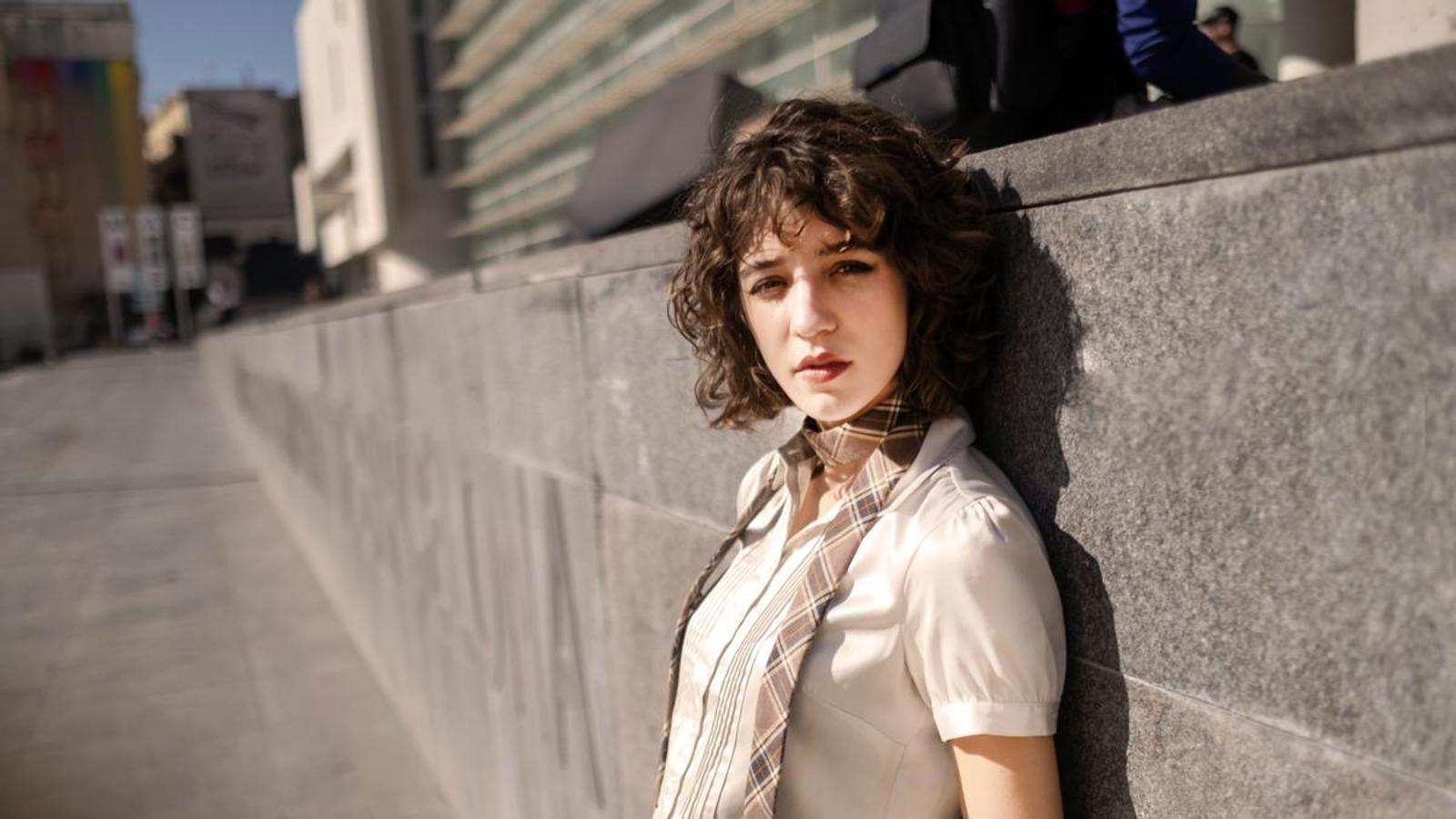
BarcelonaTwo years ago she got on El 47 and since then she has not stopped circulating through cinema. Her debut journey was also that of consecration. Her vocation came from afar and the projection now seems infinite. She premieres Ruega por nosotras, the film by Daniel Monzón that denounces a new shame of Francoism: the Patronato de Protección de la Mujer, an institution where women considered conflictive or rebellious were locked up and mistreated. Solid social cinema with the luminous face of this 22-year-old empathetic, analytical, and combative woman.
Your love for cinema is enormous and precocious.
— I remember my childhood, always related to the arts. I do not come from a family of artists, but my mother has always encouraged this part. And I liked cinema a lot, a lot, a lot, a lot, and I was very technical when watching it, since I understood why one movie was better than the other.
That is to say, you developed a criterion very early on.
— Since I was very little. I paid a lot of attention to the cinematography, what type of shot they used to explain something. I easily understood the audiovisual language and I liked it a lot. And I was actually considering training and dedicating myself to cinema, but from that side, more of a directing or screenwriting point, which I do not rule out.
It is in the United States where you decide on acting, right?
— Yes. At 15 years old I was given a scholarship and there I discovered acting as a way of seeing life... Passion, because in the United States there is a lot of focus, that is to say, they spend a lot of hours practicing to be a basketball player or a musical actress. It is there where I see that acting has future potential. I return and, at 16 years old, I tell my mother that I need to go to Madrid because I have to be an actress. Even though I already knew that only 7% of actors make a living from this; 93% are unemployed.
How were those first years alone in Madrid?
— They were hard, I won't lie. I didn't have a network of friends, or family, or anything. It was a very lonely period. And I am a very self-demanding person. I have always been a good student, but doing the performing arts baccalaureate while working, made my grades, which had always been excellent, fall. But my mother took the pressure off me, she would threaten me and say, “I'm taking you back to Barcelona if you don't stop trying to get good grades!”

And how are you approaching your goal?
— Using my analytical capacity. I am good at finding patterns. I analyzed the agencies, which actors they represented, who was working and who was not. And what material those who worked the most presented. I made a dossier, some emails and sent it to the representatives that I liked the most in the whole State, and within my top-3 was the agency that has represented me ever since. I could not be more grateful to them, because normally a rep of the caliber of my reps does not take on someone without experience unless they see some potential in them. And my rep always says it, that suddenly a 16-year-old girl arrived at the office with a great desire to be an actress.
Are you that analytical when approaching characters?
— Yes, but I have also had to learn to let go, because with too much analysis you run the risk of losing spontaneity. I do this at home, but when it's time to shoot it disappears. And intuition comes in. But above all, it is a matter of empathy. I believe that empathy is the icing on the cake.
Empathy for the character you are playing?
— Regarding people, regarding life. It is like that. You start from there and begin to empathize with the person you want to portray. Then you add technique, talent, perseverance... Many things. But if you are already an empathetic person, you have a lot gained as an actor.
And also when filming, because after all it is a team effort.
— Absolutely. You are an ant inside a very large system. If someone is holding an umbrella for you for a moment, it's so you don't burn and so that in tomorrow's scene you don't have a red face, it's not because you are Cleopatra, you know? In other words, bring yourself back down to earth.
You star in Ruega por nosotras, a chilling story based on true events. In 1974, a girl considered a rebel is admitted to the so-called Patronato de Protección de la Mujer so that some nuns can take charge of “straightening her out”. There, she and her companions are subjected to all kinds of vexations. How do you approach Ana?
— My character is a blend of many testimonies, a portrait of many people, so that the women who went through there can also feel identified and so that it is not a biopic of four or five. My sources of support have been learning about them through books, interviews, and podcasts. At that time I was not able to speak with them directly, but now I am in contact with Consuelo García del Cid, the author of the book that gives the film its title. I get along with her very well, I admire her a lot. She is the pioneer in bringing the Patronato to light.

A Francoist institution that was in force until 1985.
— Until 1986, as they say now. It is outrageous. But when it comes to playing these women, I am very clear that they are the protagonists of this story. We are just the flesh and the face placed in front of the camera. Yes, we are literally a medium of empathy. When I read or listened to the testimonies, I swear... my soul was breaking. Because the movie is the movie, but suddenly you remember that this actually happened.

Do you understand your character's final decision?
— Yes. I believe she makes a decision very much in her favor and in favor of the story, after all. Perhaps we could say that, even from the hardest and most horrific place, there are ways to get out of it. It is a story of survival, and she makes a decision to survive.
The film also talks about the network, about friendship, about chosen family. That saves lives, right?
— Yes. And this was also where we actresses had to hold on: to the fact that they were young and could be friends. Having this as the axis of the film. The here and now. Because their cases will be analyzed in the future, not now. For the moment, Ana does not know that she is part of a system and that there are many more like her.
Of course, he doesn't know what will happen...
— She doesn't know where she is. She is furious, because her parents have put her there. She is locked up and she is very afraid. And she cannot have empathy from the outside for what is happening to her, because she is living it. Her case will be analyzed in the future, not now. And, since in cinema you don't shoot chronologically, I had to be very clear at all times about where she was, where she was coming from, what was the next thing that happened, for coherence, so as not to get ahead of myself. I had to go about building the character's arc very progressively and this was a giant challenge. It is a film with 179 scenes and I am in 177, I think.
Is this the hardest shoot you have done so far?
— Yes, both emotionally and physically. It was nine weeks, five of which were from Monday to Saturday, ten hours a day. The crew did rotate, but I couldn't, because I was everywhere. It was very tiring. By the second or third week, I lost my voice because the voice is... an emotional transmitter. They detected nodules and told me I had to have surgery. It wasn't possible, so I started speech therapy without stopping filming. I communicated with the director using a whiteboard and only spoke during the scenes.
How is the film being received?
— People who knew nothing about the Patronato say “wow... what a tough movie, this is horrible”. That is why I have the hope that this film can serve so that all these women come out of the closet, feel proud. Because they do not want to call themselves victims, they call themselves survivors, because the victims are those who took their own lives in there. The women who have lived through it say: “I see everything that happened, because it is all there, but it doesn't make me feel what it used to make me feel”. Seeing and talking about this pain helps to mitigate the trauma. That is it. In other words, the movie makes sense. I hope it serves so that people know what happened, but above all so that these women can have the microphone and take advantage of the fact that cinema is interested in their story.
Essential always, and even more so at a time when Francoism is being trivialized...
— Yes, and I am quite... I don't know, disappointed. Because it's like... "Damn, really?" With the whole rise of the far-right and people my age romanticizing the dictatorship. And many women, I say... "but, wait a moment, are you aware of it?" I mean, I can half understand it from a person who wouldn't lose any rights back then and if you have no empathy for others. But... from a woman? It's just like... "Girl, watch the movie!"
Your generation is now at the center of the debate due to the housing crisis, which has led to the encampments in Sol or Plaça Catalunya. Do you think this is being done well?
— I cannot speak on behalf of my generation because I don't feel I am anyone to do so. And because I don't have time for active militancy. It's been over three years since I've had a vacation. But I do believe that there are many people doing things. I was in Sol helping out one afternoon, and the level of organization is impressive. And I know it's the same in Plaça Catalunya. There were signs that said “Si te vienes a drogar o a beber, te vas pa tu casa”. This is a peaceful mobilization, where the rules are respected. People are working, teleworking, and studying. The day I showed up there, they were singing Gallo rojo, gallo negro [the anti-Franco anthem she performed in the final scene of El 47] and a girl said to me: “Esta es por ti”. And I said: “No, no, por mí no es”. It was... very moving. I am super in favor of demonstrating, of breaking this label of “glass generation,” that does nothing. Things are being done, definitely. People are doing many things. It gives me hope, truly. Yes, I am very proud of it.

You have specialized in playing brave, strong, and combative women. Is it a way of exercising activism?
— When I decided to become an actress, my dream was to make social cinema films. Because before I am an actress, I am a person and I have values. And two years after starting, El 47 came to me: Marcel Barrena gave me the gift of a lifetime! And from then on, I started to be considered for these types of roles. That does not mean that I get less involved in projects that are not social, because I love acting, and I love being able to play all kinds of characters. But it is true that when a gem like Ruega por nosotras comes to me, I say: “This is why I am an actress, you know?” The film is important, but not as important as the story we are telling. That is something that both Daniel Monzón, the director, and I are very aware of.
How do you stay centered in this whirlwind of filming and promotions?
— With therapy. People sometimes tell me that I've swallowed an old lady; they tell me that because they think I have, like, oh, emotional intelligence and whatnot, and I say, “I've been to therapy for a very... very long time, I mean, what do you expect, you know?” I can't imagine having gone through what I went through with all the success of El 47 without being accompanied by my therapist. And what's more, she's a woman who works with actors, which helps, because there are many things I don't have to explain to her. And I continue to go, among other things, so as not to link my personal worth to my work and to be aware that I have nothing guaranteed, that there is a lot of glitter.
After so much intensity, don't you feel like something lighter? A musical?
— I would love to. I have only had one opportunity to audition for a musical movie. And they didn't pick me. I would have loved to, to be honest. But it's also good, you know, that not everything goes perfectly, because, otherwise, you end up living in a sort of unreal bubble, right? I would really like to do a musical at some point, but nowadays I don't know if I have those skills developed enough yet.
We close the circle. We started by talking about a very cinephile girl. Do you have time to go to the cinema, now?
— Watching movies in the cinema is something I do not want to sacrifice. Because I love it and it is part of my job. Inevitably, I notice the performances and they also help me as an actress. It is very important to go to the cinema, for everyone, but especially if you dedicate yourself to this.
