Oleksandra Matvitxuk: "Europe helps us not to lose the war, but it is afraid of helping us to win it"
Jurist, human rights defender and president of the Center for Civil Liberties
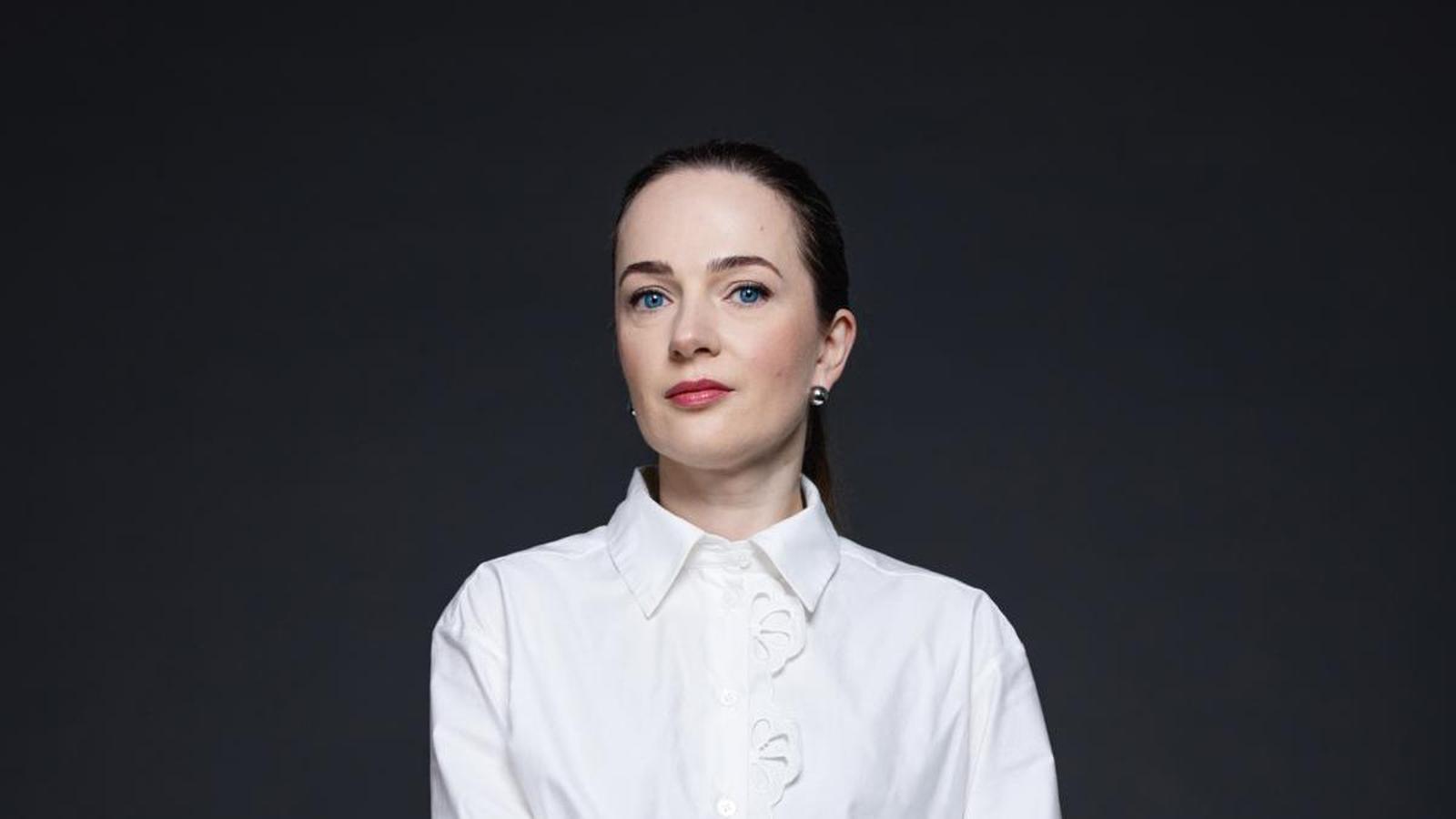

-
CAT -
CAST
BarcelonaI begin by talking about faith with Oleksandra Matviichuk (Boiarka, 1983). In wars, religion is often found navigating a paradox. On one hand, people living through war strengthen their bond with the gods because, while bombs are falling, they need hope, consolation, mercy. On the other hand, they often ask themselves a question: if God exists, how can He allow this horror? Matviichuk is a believer, and she says that she too has pondered this dilemma. But she has an answer: one must not confuse wishful thinking with faith. “Wishful thinking is thinking that one does not need to fight against evil, that God has the capacity to decide and solve all problems. Faith, on the other hand, gives you the courage and the responsibility to act within this horrific, dangerous reality.” Faith, hope, says Matviichuk, has been key in the nearly five years of Ukrainian resistance against the full-scale Russian invasion. But Kyiv is currently facing, probably, the most difficult moment since the beginning of the war: betrayed and unprotected by Donald Trump's United States, the intensification of Kremlin bombings against major cities aggravates all the woes of the Ukrainians and anticipates a severe, perhaps decisive, winter. Matviichuk, like the majority of her fellow citizens, maintains faith in the future, that is, in victory. The alternative, she says, goes against survival. Her voice is especially relevant: in 2022, the foundation she chairs, the Center for Civil Liberties, received the Nobel Peace Prize for its work documenting Russian war crimes in Ukraine since 2014, because this war began then in the Donbas and Crimea, amidst European innocence. It is 2026, and Matviichuk and her team continue working from the ground. The Nobel Peace laureate will travel this week to Barcelona to receive the ARA International Award. In this profound interview, she provides a human, but also political, X-ray of the darkness of war, and leaves three messages of urgent reading: Ukrainians will not capitulate because they cannot afford to; there is not and will never be peace without justice, and Europe must prepare itself for the worst forecasts regarding the imperialist intentions of Vladimir Putin.
While I was preparing this interview, Russia bombed a school in the Ukrainian region of Zaporizhzhia and killed more than 50 people.
— It is horrifying. Horrifying. And this horror has become part of our daily life. When I receive this type of news, I try to pause for a few seconds, thinking, visualizing what has happened. This helps me to be aware of the horror and not to allow this horror to be normalized. Because this is not normal. And, unfortunately, I have the impression that the international community has become accustomed to it. And our work as human rights lawyers is also about this: while the world turns people into numbers, we give them back their names. People are not numbers: every life, every death, must matter.
You document Russian war crimes. You were telling me that in your organization's database you have documented more than 100,000 episodes.
— And, unfortunately, there are many that are against children. This is, for me, the most horrible, darkest part. Let me tell you the story of a 10-year-old boy named Andri who is from Brovary, a city near Kyiv. When the Russians started the full-scale war, his parents probably did what almost all parents would do: they took their son, some documents, a few belongings, and tried to get away from the danger by car. But, unfortunately, on the road they encountered a column of Russian tanks, and an armored vehicle deliberately rammed their vehicle and drove over it. Andri explained to us that, after that, it seemed to him that his father was already dead, but that his mother was alive, because they were sitting together in the back seat and she was talking to him. A moment later, someone grabbed the boy and threw him onto the road and, a second later, the Russians fired at the car's fuel tank. And this 10-year-old boy told us that his mother burned alive inside the car, before his eyes. Why did the Russians do this? Because they felt they could. Probably, for simple amusement.

I have heard many Ukrainians say that they will never be able to forgive Russia. Or the Russians.
— Not long ago, a Ukrainian psychologist organized a discussion group and asked Ukrainians from whom they expected apologies from the Russian side. From Putin? From the Russian generals? From the Russian Parliament? From the Russian intellectuals? From the Russians themselves? And the result was very interesting: everyone answered that from no one. This means that we, Ukrainians, expect something different. We expect justice. Justice also has a restorative effect, and in the future, it can rebuild the broken ties between people. And yes, it is clear that it is not just Putin's war, because, unfortunately, the majority of Russians have supported it and, therefore, they will have a historical responsibility for this shameful page of their history. And this support from the population is not explained only because it is an authoritarian country, where they can persecute you for expressing a position against the war, but also because it is an imperialist country. Russia is an empire, and an empire has a center, but it has no borders. An empire always tries to expand. And this is the way of thinking of the majority of Russians, who literally believe that they have the legitimate right, in the 21st century, to invade another country, kill people there, dominate their identity, steal their children, and raise them as Russians.
But there is also a minority of Russians who have spoken out against this war.
— Yes, and I want to highlight them. Many have had to leave the country to do so. We have many such colleagues, incredibly brave people who have shown that, even in these circumstances, you always have a choice. That is to say, you cannot choose the country where you are born, nor the era in which you are born, but you can always choose between being an honest citizen or doing nothing. Once, I asked my Russian human rights defender colleagues how I could help them, how I could be useful to them. Because they have done a lot for us, we work together daily to help Ukrainian citizens living in territories occupied by the Russians, and doing this work poses a constant danger to them. Well, they told me: “If you want to help us, please, succeed.” And I think that is brilliant. They told me that only Ukraine’s success will give a chance for a democratic future to Russia itself.
Is the final goal of your career to bring Vladimir Putin before a court?
— Look, I work with people directly affected by this war. People who have been through hell and who need to rebuild not only their shattered lives, their shattered homes, their shattered families, their shattered vision of the future, but also their broken faith in the possibility that justice will arrive, even if it is late. That is why our goal is to ensure that, regardless of how and when the war ends, all the people who have committed these crimes, as well as the Russian political leadership and the high military command, must be held accountable. But this is not my only professional goal. During all this time, I have been able to witness firsthand that this international UN system, based on the United Nations Charter and international law, has collapsed. It cannot protect people, and I think it is for an obvious reason: the system has never been reformed. Therefore, another of my goals is to get involved in the civilizational battle for the new world order. And the true battle is to decide what the new world order will be like: whether it will be a world in which the rule of law can be trusted and people have human rights or if it will be a world governed by the will of the strongest. If this second option ends up winning, we are heading towards an even more dangerous scenario, in which wars and human rights abuses will occur more and more often in more and more parts of the world... because the international wiring is faulty and there are sparks everywhere.
If you could ask Putin a question, what would it be?
— I don't have any questions for Putin right now, but I hope to have that opportunity when he is in The Hague and I have an official legal position from which to ask him a question. Then I will ask him.
What is Putin's ultimate goal in Ukraine?
— The same as it had at the beginning of the invasion. This war has a genocidal character: Putin still openly says that the Ukrainian nation does not exist, that the Ukrainian language does not exist, that the Ukrainian culture does not exist. I have been documenting for twelve years how these words turn into horrible practices in the occupied territories, where the Russians physically exterminate active people from the local communities: mayors, journalists, environmentalists, writers, priests, musicians, teachers, any active person in the community. How they forbid the Ukrainian language and culture, how they destroy and plunder the Ukrainian cultural heritage and how they take Ukrainian children to Russia to try to re-educate them as Russians. Therefore, for me it is clear that, if we Ukrainians stop resisting and Russia occupies the whole country, we will cease to exist, we will disappear as a nation. But this is only one layer of this complex situation. Putin did not start a full-scale war just to occupy another part of Ukrainian territory. In fact, it is very naive to think that he has lost hundreds of thousands of soldiers to occupy Avdiivka, Bakhmut or another village in the Donbas that most Russians would not even know how to locate on the map. Putin is not crazy. He is very pragmatic.
What does it mean?
— Putin started the full-scale war to occupy and destroy all of Ukraine and advance further. He sees Ukraine as a bridge to Europe. His logic is historical, and he dreams of his legacy. He wants to restore the Russian Empire and Russian dominance in Europe by force. This means that people in other European countries are safe only because we Ukrainians continue to resist and do not let the Russian army advance further. And there are still many European politicians who want to believe that Putin will stop in Ukraine. I call this phenomenon a lack of imagination. Let me remind you that five years ago, when Putin launched the full-scale war, no European leader believed it would happen. They openly said that Putin would never do it, that it was irrational, that it made no sense because it would isolate Russia, harm the economy, and set back the development of the entire country by decades. But that logic is rational. Putin's is historical.
This week, peace talks sponsored by Trump's United States have resumed.
— You know what? Ironically, in 2025, the year of Trump's return to the White House and the supposed year in which Trump was to put an end to the war, the number of dead and wounded Ukrainian civilians increased by 31% compared to the previous year. And this 2026, just during the first six months, the number of dead and wounded civilians has already increased by another 37%. Look, these supposed Trump peace negotiations are designed in a way that they have completely lost the human dimension. American negotiators talk about natural minerals, about Russia's territorial claims, about Putin's vision of Ukraine... About so many things, but they do not talk about people. They do not talk, for example, about the 20,000 children illegally deported to Russia, separated from their families, sent to Russian re-education camps, where they have been told: “You are not Ukrainian, you are Russian children; your families, your parents, will reject you, they have abandoned you, and Russian families will adopt you and raise you as Russians”. Nor do they talk about the thousands of illegally detained Ukrainian civilians, men and women, subjected every day to terrible torture and sexual abuse. These people are literally dying in Russian prisons. I myself have interviewed hundreds of them, and they have told me that they beat them, that they raped them, that they locked them in wooden boxes, that they cut off their fingers, that they tore out their nails, that they applied electric shocks to their genitals. Therefore, when the American negotiators talk about occupied territories, I get the impression that they are talking about empty spaces. But these spaces are not empty. Millions of Ukrainians live there, in a grey zone, without any possibility of protecting their lives, their freedoms, their loved ones.
They are similar, but they are two different questions: how do you think this war will end and how should this war end?
— I will answer him in only one way. Capitulation is not an option for us. I know for a fact that the people of Ukraine dream of peace, we all dream of peace, because war is horrible, war is probably the most horrible thing that can happen to a person. But I also know for a fact that peace does not come when the country that has been invaded stops resisting. That is not peace. That is occupation. And occupation is also horrible. Occupation does not reduce human suffering: it simply makes it invisible. Therefore, it is no surprise that the people of Ukraine who dream of peace do not want this peace at any price. If we capitulate, we will never achieve peace, understood as the freedom to live without fear of violence and to have a long-term perspective.
What is the way, then?
— Thinking about how we can pressure Putin, in a realistic way, so that he stops this bloody war. And the approach is to make the cost he allocates to this war higher than the cost of peace. Because, unfortunately, the war is still profitable for him: it serves as an excuse for all of Russia's internal problems, and it helps him to centralize and consolidate his power. And I would tell you, furthermore, that the war has even become profitable for the Russian population.
For the people?
— From the outside, when people talk about Russia, often only Moscow and Saint Petersburg are known, but the majority of Russians live in depressed regions and in incredible poverty. And, for these people, joining the army is the only existing social elevator, because they start earning money that they could not even dream of before. In fact, if one of these people dies in the war in Ukraine, their family would receive money that that person could not earn even by working until the end of their days. Our Russian human rights defender colleagues call this type of economy necronomy, which means economy of death. The Kremlin sells death. Literally, it is not a metaphor. If we want to stop this bloody war and make the cost for Putin higher than the cost of peace, we must break the capacity of the necronomy to finance this war. Because if Russians started receiving coffins from the Ukrainian front, but without compensation money, that would change everything.

Official figures state that at least 50,000 Ukrainian soldiers have died since the start of the invasion. Other calculations multiply the number of military deaths. What does this mean for a country?
— It means that this war has knocked on almost every door. In recent polls, approximately 70% of Ukrainians have said that they had lost someone from their closest circle in this war. And we all have friends, colleagues, or relatives who have joined the Ukrainian army and who until yesterday were civilians: hairdressers, journalists, musicians, teachers, steelworkers, drivers... Very, very peaceful professions. But they decided to take up arms to defend their home. Our army is an army of yesterday's civilians, like my friend Katerina Zaremba. She serves voluntarily as a medic on the front line, and before she was a brilliant scientist, writer, and mother of four children, one of whom is only three years old. Two years ago, Katya got her first tattoo on her forearm, and she had it written: “The brave are always lucky”. And a few months later, she went off to rescue the wounded on the battlefield. And she told me: “As a responsible mother, I have to fight for a peaceful and democratic future for my four children”. And this is just my personal example of what it means to live in a large-scale war when your army is an army of former civilians: it means living in constant fear for the people you love.
One of the images that struck me most from the war in Ukraine was that of a woman, a mother, who was convinced that her son, a soldier mobilized to the front, would return home on Christmas Eve. She missed him so much that, that night, she set the table for herself and for him. And she waited for him all night, convinced that he would come to surprise her, because it was Christmas. The son never returned home.
— I know many stories of this type, because we work with relatives of missing persons. There is the case, for example, of a man who in 2015 entered a Ukrainian territory that at that time was already under Russian occupation because he wanted to take his mother out of there. The Russian soldiers located him and arrested him. His wife, suspecting that he had been kidnapped, did an incredible thing: she entered these occupied territories to find her husband. Her love was so strong that she managed to meet with high-ranking officials of the occupation forces and reconstructed the entire story of what had happened to him before they arrested him illegally. But she never managed to find any information about the whereabouts of her husband. This happened in 2015, and even now in 2026 we have absolutely no information about this man. In such cases, when there has been no communication for so many years with a person detained by the Russians, it is most likely that he is dead. But she, the wife, is convinced that he is alive and that he will return home. And this has often caused me an ethical dilemma: when I look at her and see her faith, her courage, her love to keep searching for him and maintaining the idea that he is not dead, I ask myself: “Who am I to doubt, who am I to make her doubt?”
Are we Europeans aware of the depth of the Ukrainians' pain?
— No, you are not aware of it. But the thing is, you cannot be. And it is not your fault, because there is a huge difference between reading the news, seeing photographs, watching videos, and living through a situation like this. There is a huge difference. Literally, you cannot understand it in its full dimension without having been through a similar experience.
Is Europe doing enough for Ukraine?
— We are grateful to European governments for their support, but none of us are doing enough while this bloody war continues. It is common sense. And the problem with European governments is that they help us just enough not to lose the war, but they are afraid to help us enough to win it. And this is not an abstract statement: these differences are very practical and we can measure them by the types of weapons, the speed of decisions, and the decisiveness of the sanctions. European politics is often lost in eternal debates while in Ukraine people are being bombed in school shelters. There are many things that the governments of Europe can do, such as creating a special tribunal for the crime of aggression, the confiscation of Russian state assets, the detention of the Russian shadow fleet, the closing of the back doors that Russia uses to evade sanctions... In the missiles and drones that kill Ukrainian civilians, we still find components fromWestern companies. And European governments know this, but the key is whether or not they will have the courage and sense of historical responsibility to do the right things at the right time. These times put us all to the test regarding authentic leadership, authentic courage, and authentic responsibility.
Speaking of leadership... Volodymyr Zelenskyy, their president.
— When the full-scale war began, I refused to be evacuated and, with part of my team, we continued working on the ground while the Russians were trying to encircle my city. These were very dramatic times. At that time, all international partners were convinced that Ukraine had no capacity to resist, that Kyiv would fall in just three or four days. And I remember that, during the first few weeks, we celebrated the arrival of each morning as a victory, because we had managed to survive one more night. And, for me, as a citizen of my country who was in Kyiv while the Russians were trying to encircle it, it was extremely important, on a human level, that my president decided to stay in Kyiv, share that risk with us, and tell our partners: “I do not need an evacuation. I need weapons to defend our country”. Therefore, I have no doubt that President Zelensky is a brave person and that he is trying to defend our country with great sincerity.
But I have read statements of yours in which you are quite critical of him.
— Well, that's the thing about being a democracy. And being one even in the middle of a war, in the middle of a transition. But yes, we human rights lawyers have many criticisms of Zelensky's work and that of his government. We cannot afford the luxury of postponing any task of this democratic reform until the postwar period, basically because we have no idea if we are at the end of the war, in the middle, or just at the beginning. In fact, to survive the Russian invasion, we must not only defend the country but also transform it, deepening the democratic transition that actually began just twelve years ago, after the Revolution of Dignity. I believe that this, despite the darkness of the war, must also be a priority for our government, because the future of our country depends on it.
How did you feel when you were awarded the Nobel Peace Prize?
— It is a bit of a funny story. I received a call when I was heading to catch a train in Warsaw and it was my colleagues, telling me that we had received the Nobel Peace Prize. I answered them: “A very well-crafted joke, thank you”. And I continued walking towards the station. But the phone went crazy and I started to receive messages and calls. Then I understood that, effectively, it was not a joke. And my first thought was: “My God, now I will miss the train”. But well, speaking seriously, it is a strange feeling. We have received the Nobel Peace Prize in the midst of a bloody, cruel war against people. It is surreal to receive such an award in this context. And for that reason, my team and I feel an enormous responsibility and, above all, we understand this recognition as an opportunity to be heard and denounce this war. Because, you know what? For decades nobody listened to us when we warned that countries that, like Russia, violate the human rights of their citizens also represent a threat to global security and peace. And with Russia we have a clear example: for years, we all turned a blind eye. Especially European governments, who continued shaking Putin’s hand, building gas pipelines and doing business as usual with Moscow... as if nothing was happening. And that was essential for Putin to start believing he was untouchable. And here we are: in the middle of a great war in Europe.
There is a person who desires this award very much. How would you feel if one day they awarded it to Donald Trump?
— Given all their background, I would say that they would have had to do something so extraordinary for peace and freedom that the Nobel committee would have decided to award them this prize. I am not sure that right now this is very realistic, but why not? I wish them success.
What is Trump looking for in Ukraine?
— I think it became very clear in the United States national security strategy, which was made public a few weeks after Trump returned to the White House. From this document, the vision of today's America is understood very clearly: that the world should not be governed according to the rule of law, but according to the will of the strongest. And that the strongest will divide the world into spheres of influence. And Europe, for Washington, is the Russian sphere of influence.
A few weeks ago, a voice from the Ukrainian government told me that Kyiv cannot survive without the United States.
— I think I disagree. In a way we are doing it, we are surviving. We have not received any support from the United States during these two years of Trump's return to the White House, because the president has stopped all military aid. I mean, we buy weapons now, therefore, it is simply a business, it is not support. And the only thing we still receive is intelligence information. But, as we have seen, even with that there have been problems. But, look, I am sorry to tell you that this is both a Ukrainian and a European problem. Trump has shown that Europe no longer has security guarantees from its American ally, and this directly means that Europe has prioritized its own strategic autonomy. The decades in which security was taken for granted are over, and it is better to understand that soon and urgently develop capabilities to protect itself. And this also has another reading: Ukraine is not only a beneficiary of European support, Ukraine contributes and can contribute even more, and decisively, to European collective security.
An argument that is defended from Kyiv is that Ukraine's accession to the European Union would be very strategic in this regard. Should Ukraine's future be in the EU?
— I will give you a concrete example. Last year our Parliament passed a law that limited the independence of anti-corruption bodies and, immediately, people took to the streets. Not only in Kyiv, but also in Kharkiv, Sumy, Dnipro and other cities and municipalities. It is not easy for people living in war, under constant bombing by Russian drones and missiles, to think about such a complex issue as the independence of anti-corruption bodies. But people understood that this did not fit with our integration vector, that it would harm our goal of returning to the civilized European dimension, of entering the EU one day. And they took to the streets and told Parliament: “You have made a mistake. You must go back to work and vote to reverse it all”. And the people succeeded. That is why I can clearly say that the Ukrainian people are very sincere in our struggle to build a country where everyone's rights are protected, the government is held accountable, the judiciary is independent, and the police do not beat up students who are demonstrating peacefully. Because we have paid the highest price just to have the chance to build such a country, which is what this hellish war is.
