Take care of them: an immersive experience at the Barcelona Zoo
The Barcelona Zoo continues to advance in its transformation within the Ciutadella del Coneixement project and invites young and old to care for the planet's biodiversity
17/07/2026 - 22:14 h
-
CAT -
CAST
Take care of themisBarcelona Zoo's new immersive experience, which invites young and old to protect biodiversity. Located next to the access from Ciutadella Park, this new proposal welcomes visitors who, in a fun and interactive way, can discover how to get involved in preserving species and ecosystems. Barcelona Zoo continues to advance in its transformation project to become a new benchmark space for the preservation of the planet's biodiversity, as a key part of the Citadel of Knowledge project and with Cuida'ls it aims to involve young and old so they connect with nature through experiences and play. The future Citadel of Knowledge will make Ciutadella Park and its surroundings a leading node in Europe for knowledge, dissemination, research, and innovation. Alba and the otter
Cuida'ls is a 230 m² installation distributed in three spaces: a first immersive room to understand what biodiversity is and two rooms with interactive elements to take action and learn to preserve the natural environment. In the immersive room, the avatars of a caregiver, Alba, and her companion, the otter, receive visitors and accompany them on a journey through time to discover the origins of life, the richness of different ecosystems, and the numerous threats that endanger biodiversity. From poaching to pollution, fires, or overexploitation of resources. At the end of the immersive projection, Alba and the otter invite visitors to move to the second room and learn, through digital and interactive content, about real cases of illegal animal trade and the networked work carried out by entities, organizations, and security forces, such as the Nature Protection Service (Seprona) and the Mossos d'Esquadra, to prevent this illegal trafficking of wild species. Zoo, reception center
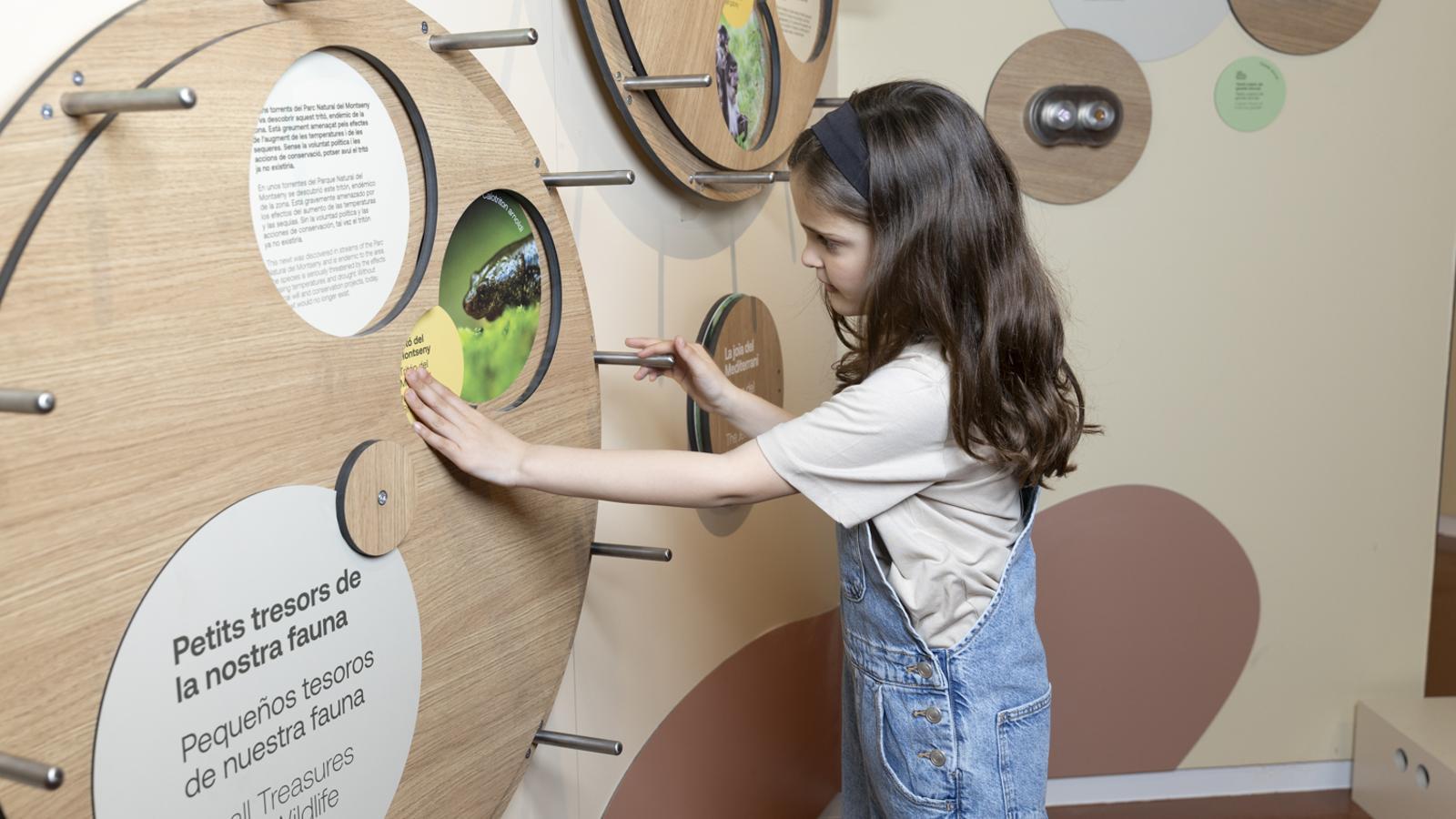
The Barcelona Zoo is a center adhering to the Convention on International Trade in Endangered Species of Wild Fauna and Flora (CITES), the international agreement whose purpose is to prevent illegal trafficking of species, and it displays replicas of real objects confiscated from visitors, in the second room of the facility. The zoo acts as a rescue and shelter center for animals intervened by administrations and thanks to this agreement it has already become a new home for numerous confiscated animals. Through interactive elements, visitors can also discover the conservation status of some species, based on the classification by the International Union for Conservation of Nature (IUCN), the international organization dedicated to the preservation of biodiversity. The activity shows how the Barcelona Zoo and the Barcelona Zoo Foundation contribute to preserving certain threatened native species with numerous conservation projects inside and outside different natural habitats, such as, for example, the conservation project of the Montseny newt, the TUROCAT project for the reintroduction of the European polecat, or initiatives to recover populations of Iberian minnows, Pyrenean brook newts and the Mediterranean tortoise, among others. Finally, in a third space designed to move directly to action and also equipped with digital and interactive elements, visitors can learn about the Barcelona Companion Animal Reception Center (CAACB) and find out how to collaborate or contribute to the care of the animals it hosts. In this last room, young and old can formalize their commitment to the preservation of biodiversity and draw an animal that will be projected as an avatar on the large outdoor screen in the "Cuida'ls" space, simulating their reintroduction. For all ages and educational centers
This space has been designed taking into account the different ages of the public visiting the Barcelona Zoo, with special emphasis on children and young people. There are contents designed so that the little ones can familiarize themselves with basic concepts such as biodiversity and the main risks we face; and others more elaborate so that young people can delve into these same topics. Since its opening, Cuida’ls also has a program of complementary activities to the visit and educational proposals aimed at schools and institutes and linked to curricular content.
