How to watch the eclipse in Catalonia
Catalonia will experience an exceptional astronomical phenomenon that will need to be observed safely and in the best locations. In the south of the territory the observation will be total, but the occultation will also be very high throughout the territory.
-
CAT -
CAST
On August 12, the Moon will completely cover the Sun and, for just over a minute, day will turn into night. Catalonia will experience an exceptional astronomical phenomenon, which has not been observed in its entirety for over a century. The enormous scientific and historical interest of this eclipse has made it an unmissable event for both experts and astronomy enthusiasts, and the Government, together with the municipalities, has identified the best observation points.
The total eclipse will be visible from the south of the territory and partially in the north. However, in the rest of the country, the occlusion will be very high and will also allow us to contemplate a unique event.
The totality strip of a solar eclipse is usually very narrow and, therefore, it is essential to know precisely which points in the territory will enjoy this phase of totality. To facilitate this information and offer reliable and up-to-date data, the Institute of Space Studies of Catalonia (IEEC), in collaboration with the Generalitat de Catalunya through the Department of Research and Universities, has prepared a map of interactive visibility.
The map simulates the sky during the solar eclipse and allows you to see the position of the planets and the brightest stars at the moment of the event, thus identifying the main visible celestial objects. In this way, the observation of the eclipse can be accompanied by a more complete view of the firmament, thanks to this additional and reference information available to all interested people.The south, a privileged location
The southern regions will enjoy a privileged location to contemplate the solar eclipse and, for this reason, the Government has made a selection of the best locations, a total of 20, which meet the criteria of safety and capacity to become recommended observation points.They are spacious areas, with safe access and mobility, good visibility conditions, and which ensure the protection of the natural environment and the logistical viability and minimum services for large public gatherings.The points are located in the towns of Alcanar, Altafulla, Amposta, Camarles, Cambrils, Constantí, Gandesa, l'Aldea, l'Ametlla de Mar, les Borges Blanques, Lleida, Montbrió del Camp, Móra la Nova, Reus, Santa Bàrbara, Tarragona, Torredembarra and Valls and can be consulted on the web.
Through the municipality search engine on the web, you can also consult a table of the ephemerides that are organized with the exact times of the different moments of the eclipse: start of the eclipse, start of totality, moment of maximum, end of totality, end of the eclipse (sunset), duration of totality and the Sun's altitude at the moment of maximum.Safety, first of all
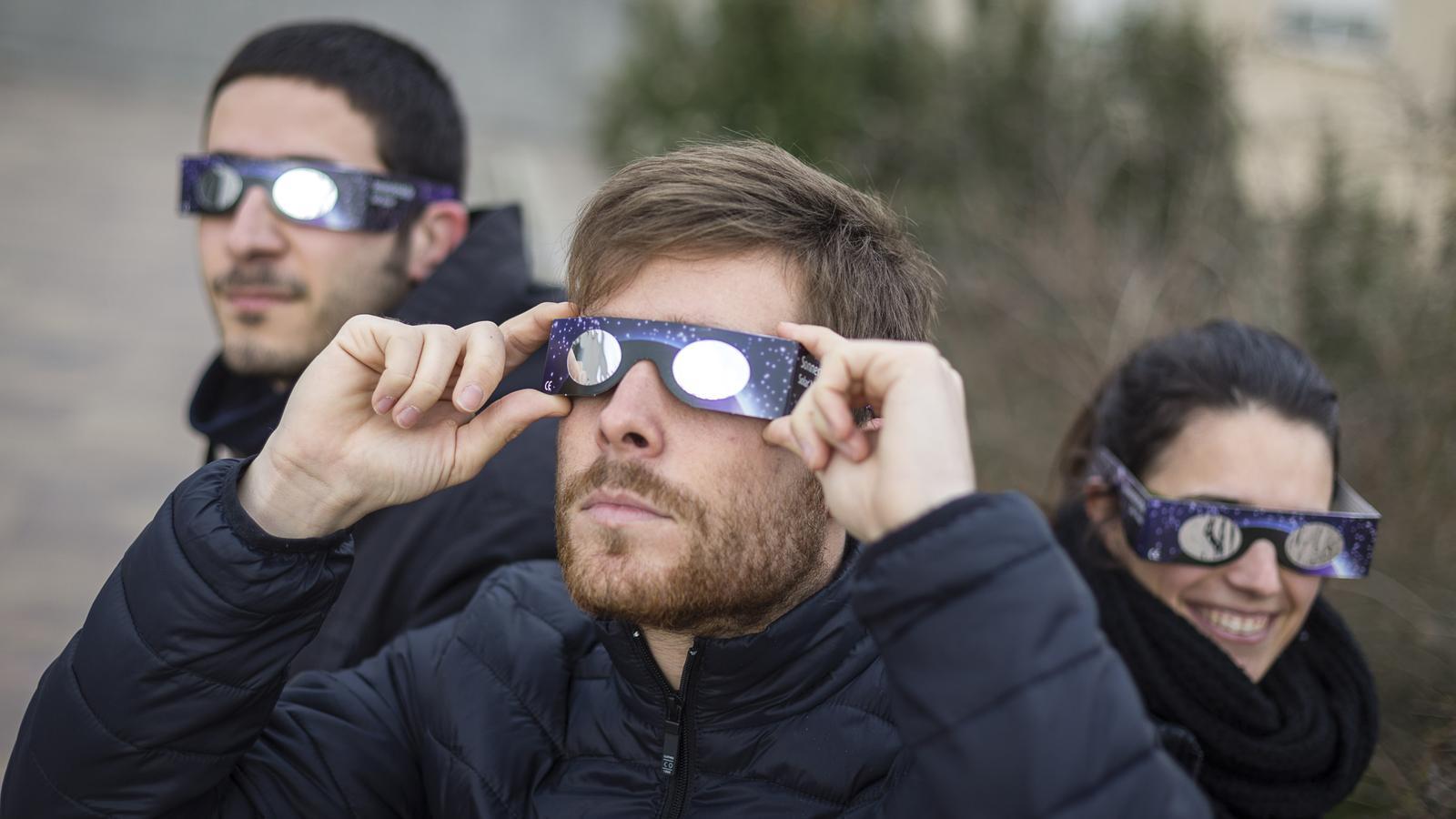
Despite its spectacularity, a total solar eclipse is a phenomenon that must be observed with the utmost caution. Looking directly at the Sun without adequate protection can cause serious and irreversible eye damage, and this must be taken into account before looking at the sky. Therefore, it is essential to always use safe and approved observation methods, even in areas where the observation is only partial, as is the case in Barcelona and Girona.
The best-known method is solar filter glasses, which must be certified according to the ISO 12312-2 standard. But indirect observation methods can also be used, such as telescopes equipped with adequate solar filters or the simple pinholemethod, a small hole in a cardboard box or cardstock, which projects the image of the Sun onto a surface, allowing the eclipse to be followed without any risk to eyesight.
During the totality phase, and only in those moments, we must observe the eclipse with the naked eye, as the use of protective glasses would prevent us from seeing the solar corona or the stars and planets. As soon as we see the first light of the Sun reappearing behind the Moon, we must put on the glasses again.Sunglasses, fogged-up analog photography films, X-rays, CDs, or qany method of which we are not certain that it is 100% safe. Nor should we look at the Sun through any optical instrument (camera or binoculars, for example) if it does not have the appropriate filter, which must always be placed in front of the lens.
