The key moments of the migratory crisis
The chronology of Spain's most tragic mass entry, one week later
-
CAT -
CAST

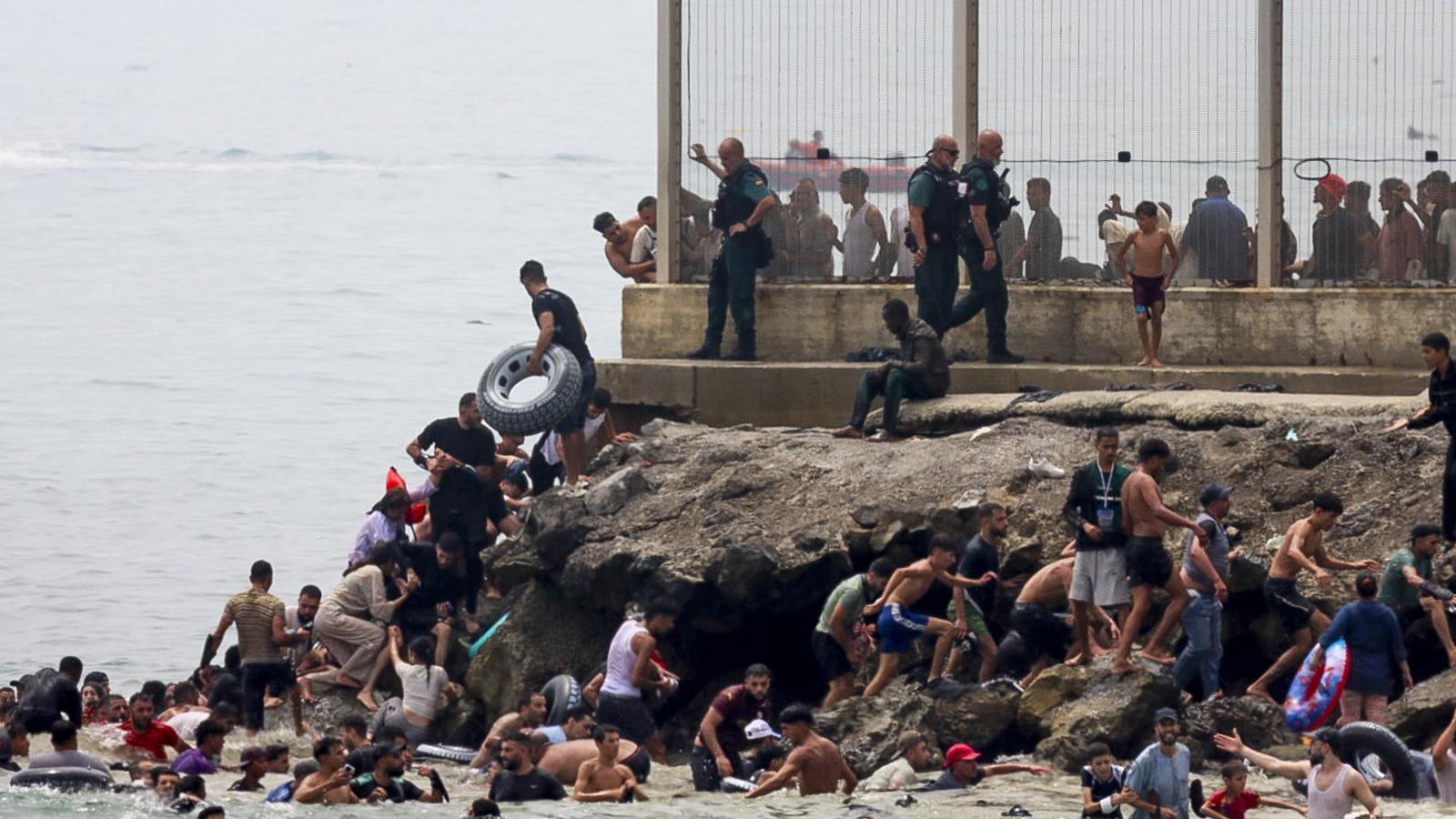
Last Thursday, at midday, alarms sounded in Ceuta: there was an uncontrolled and massive entry of people from Morocco, swimming to cross the pier that separates the country from the autonomous city and walking on land. Most are men and youths, many also minors, and they arrive wet, with practically nothing on them. Many shout cries of victory, celebrating. Others, however, arrive injured. Initially, there was talk of hundreds of arrivals. Shortly after, however, there were already "thousands".
The same Thursday afternoon, the Spanish Ministry of Defense announces that nearly a hundred army personnel are being mobilized in El Tarajal to "maintain security" in Ceuta. Meanwhile, security forces find nine bodies of people who have died of asphyxiation while trying to reach the coast of Ceuta. By nightfall, the death toll rises to 18.
At night, the Prime Minister of Italy, Giorgia Meloni, says she is studying closing the Schengen area with Spain due to the migratory crisis and calls to "defend the borders" and stop "human traffickers". From Madrid, despite accusations from Vox and the PP, the Spanish government states that it is "false" that the impetus for entry is the extraordinary regularization of migrants, and points out that "mafias and criminal organizations" have instrumentalized the entry, taking advantage of the vulnerability and need of some Moroccan citizens.
On Friday morning, Spanish President Pedro Sánchez, travels to Ceuta accompanied by the Minister of the Interior, Fernando Grande-Marlaska, where he denounces the "violation of Spain's territorial integrity". During the night, hundreds of people have managed to cross the highly tense border, and the first estimates are appearing: according to the Ministry of the Interior, more than 50,000 people have entered between July 30 and 31. In contrast, the president of Ceuta, Juan Jesús Vivas (PP), estimates the irregular migrants at 60,000.
The Civil Guard's devices continue to recover bodies in waters near the border throughout Friday. By the end of the day, authorities put the death toll at 57 over the two days, and the number is expected to rise. In fact, on Saturday, 67 are accounted for.
In parallel, hundreds of people begin their return to Morocco via the border pier, led by soldiers, upon seeing the situation on the other side of the border. "There is nothing to eat or anywhere to sleep, it's better to leave," explained some young Moroccans. By the end of the day, approximately 48,300 migrants have returned to Morocco.
It is the first day of August, and Denmark, Germany, and 21 other European Union countries are joining Italy's call, demanding in a letter to the President of the Commission, Ursula von der Leyen, and the President of the Council, António Costa, a "coordinated response" with immediate actions to control the EU's external borders and prevent "new uncontrolled crossings" through a reinforcement of Frontex services.
Von der Leyen confirms that no irregular migrant has arrived from Ceuta to the Spanish peninsula and that, although the almost total return of migrants is "good news," she assures that it is necessary to "reinforce [the system] even further." Despite Europe's demands, Sánchez and Grande-Marlaska boast of having "reversed" the crisis in less than 48 hours, and they describe the attitude of some European states as "selfish and unsupportive."
The trickle of fatal victims does not stop and the Ceuta crisis becomes one of the most tragic in recent decades. Morocco confirms a total of eleven deaths on its side of the border. In Spain, the toll according to the government of Ceuta is 88 dead, while Moncloa confirms 75. However, around 100 victims are estimated, as there are still more than thirty reports from relatives of missing persons. Grande-Marlaska also provides a new toll and says that 72,000 people entered Ceuta between July 30 and 31. According to the minister, the return exodus is now "almost total", as 70,000 of these people are already on African soil.
But Spain remains in Europe's sights, and both the opposition and European member states are demanding explanations. In a meeting with his European counterparts, Grande-Marlaska defends Spanish immigration policy, calling it "preventive" and "committed to the control of European borders".
Meanwhile, the National Court is trying to clarify and question the facts of the massive entry and magistrate María Tardón requests a report from the National Police to determine if it was directed by "any criminal group". Although on the same day, the Moroccan government denies having acted "under pressure or blackmail", on Wednesday, the Tetouan Prosecutor's Office is prosecuting 25 people linked to crimes related to the organization of the irregular passage of migrants from Morocco to Ceuta. Furthermore, Tardón also asks the force to clarify whether they received any prior alert notice of the entry of migrants.
The president of Ceuta, Juan Jesús Vivas, reports that there are about 6,000 migrants wandering through the city, most of them minors, and denounces a "notable lack of resources" to manage the crisis, as their reception centers are at 2,600% of their capacity". This figure is more than double what the government estimates: the delegate in Ceuta, Miguel Ángel Pérez, states that there are 528. On the same day, the Spanish government announces that it will allocate 25 million euros to the urgent care of unaccompanied children and adolescents. For the moment, the possibility of distributing these minors throughout the different autonomous communities is being debated in the face of the frontal rejection of the far-right.
The city is trying to progressively recover normality. A Ceuta, however, notably marked by the crisis lived in recent days. A tense calm can be felt. In the city center, bars, restaurants and shops are functioning with a certain normality, but every few meters there is a Civil Guard 4x4 vehicle patrolling or members of the army walking. "The summer season has been damaged," complain some restaurateurs, who lowered their shutters for a few days for fear of the situation.
