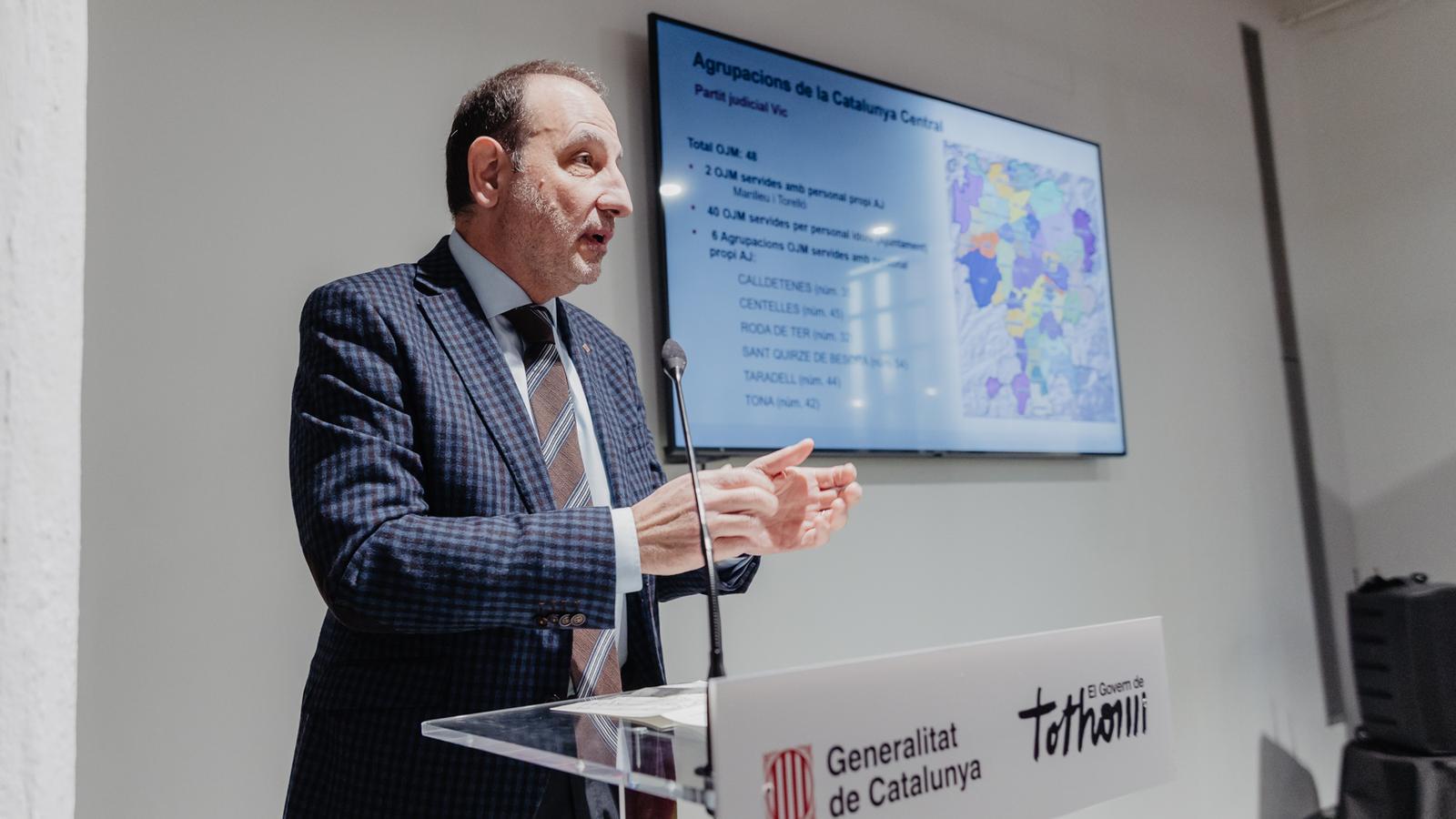
It is the first specific plan on peace justice in Catalonia and its implementation allows for the deployment of new justice offices in municipalities provided for in Organic Law 1/2025 on measures regarding the efficiency of the public justice service. The plan also foresees expanding groups of peace courts to improve this service in more municipalities and strengthening citizen attention, especially in those towns that do not have a judicial office. The objective is to streamline the management of procedures and facilitate access to justice from proximity.
Law 1/2025 promotes the modernization of the figure of the justice of the peace, an institution with a long tradition in Catalonia and competence of the Generalitat, in accordance with article 108 of the Statute of Autonomy. Through the justice offices, which support the work of the justices of the peace, the reform brings justice even closer to citizens and offers a more agile, efficient, and accessible service.
The Plan foresees providing service to 3.2 million people, a figure that represents 40.4% of the population of 92.3% of the territory (898 municipalities out of the 947 in Catalonia). Furthermore, the Plan foresees the transformation of peace courts into modern municipal justice offices through a series of improvements in areas such as organization, technology, spaces, and staff training. Those municipalities where there is no Court of First Instance benefit from this.
According to the Minister of Justice and Democratic Quality, Ramon Espadaler, “grouping the OJM is a benefit for everyone: on the one hand, the grouping allows us to provide them with staff from the justice administration, which means that the justices of the peace have better technical assistance and it is a gain for the judges; but it is also a gain for the citizens who can offer better services to their fellow citizens and for the citizens to whom we provide a better and closer service”.
The groupings, which must serve a population of over 7,000 inhabitants without the municipalities being from the same region, but yes from the same judicial district, are, in the minister's words, "a great opportunity for the local world to equip itself with better technology, spaces, and personnel so that the public justice service is closer, and we will help them in this".
Organization, training, dissemination, and spaces
Currently, there are 77 groups with a total of 460 justice offices in the municipality grouped; 90 justice offices in the municipality equipped with staff from the administration of justice (AJ) and, 348 that are not grouped and are not equipped nor receive support from AJ staff, but from staff hired by the town councils. One of the plan's objectives is to guarantee AJ staff support in all these offices to provide a more specialized and uniform service. For this reason, new groupings of justice offices in the municipality are being promoted, in dialogue with the town councils, the county councils and with the peace judges.
The Plan also foresees training actions for staff and dissemination to citizens. For example, training is being provided on adequate means of dispute resolution (AMDR), specific training for peace judges, specific dissemination and information channels have been created for peace judges, as well as the dissemination of the figure and their competencies among citizens, among other actions.
The Department of Justice and Democratic Quality has carried out an audit to map the spaces and facilities currently occupied by Justice Offices in Municipalities, their new needs and the study of the necessary adaptations. The map of Peace and Proximity Justice in Catalonia is extensive and can be consulted through this Microsoft Power BI. Finally, the electronic file is being deployed in the municipalities' Justice Offices and a plan has been made for the provision of necessary equipment and ICT tools, such as, for example, videoconferencing systems.
New competencies
The new organic law on Efficiency of the Public Service of Justice, which came into force last year, grants new functions to the former Courts of Peace, such as collaboration with the adequate means of conflict resolution (MASC) units; the performance of procedural actions by videoconference; the management of citizen requests; the reception of applications for free legal assistance and their forwarding to the competent bar associations, or the provision of other services through agreements with different administrations.
These new functions have been incorporated into those carried out to date: performance of procedural communication acts –letters rogatory– to residents of the municipalities where they provide the service and their function as a collaborating office of the Civil Registry.
The Justice of the Peace in Catalonia
History and roots
The Justice of the Peace courts are single-judge judicial bodies established in those municipalities where there is no court of first instance and instruction (courts of instance, in accordance with Organic Law 1/2025) and they provide a public service to improve neighborhood relations.In addition to the civil procedure law and the Statute of Autonomy, there are other regulations that govern the Justice of the Peace courts: the Organic Law of the Judicial Power and Law 38/1988, of December 28, on Judicial Demarcation and Structure, which determines aspects of the internal organization and personnel of the Justice of the Peace courts. Now, the new Organic Law 1/2025 of January 2, on measures regarding the efficiency of the public justice service, is reconverting the Justice of the Peace courts into modern justice offices in municipalities, to facilitate citizen access to the Administration of Justice and to have services throughout the territory.