Foreigners are almost half of the Catalan population in some age groups
The demarcation of Barcelona surpasses for the first time six million inhabitants, while Spain heads towards 50 million

-
CAT -
CAST
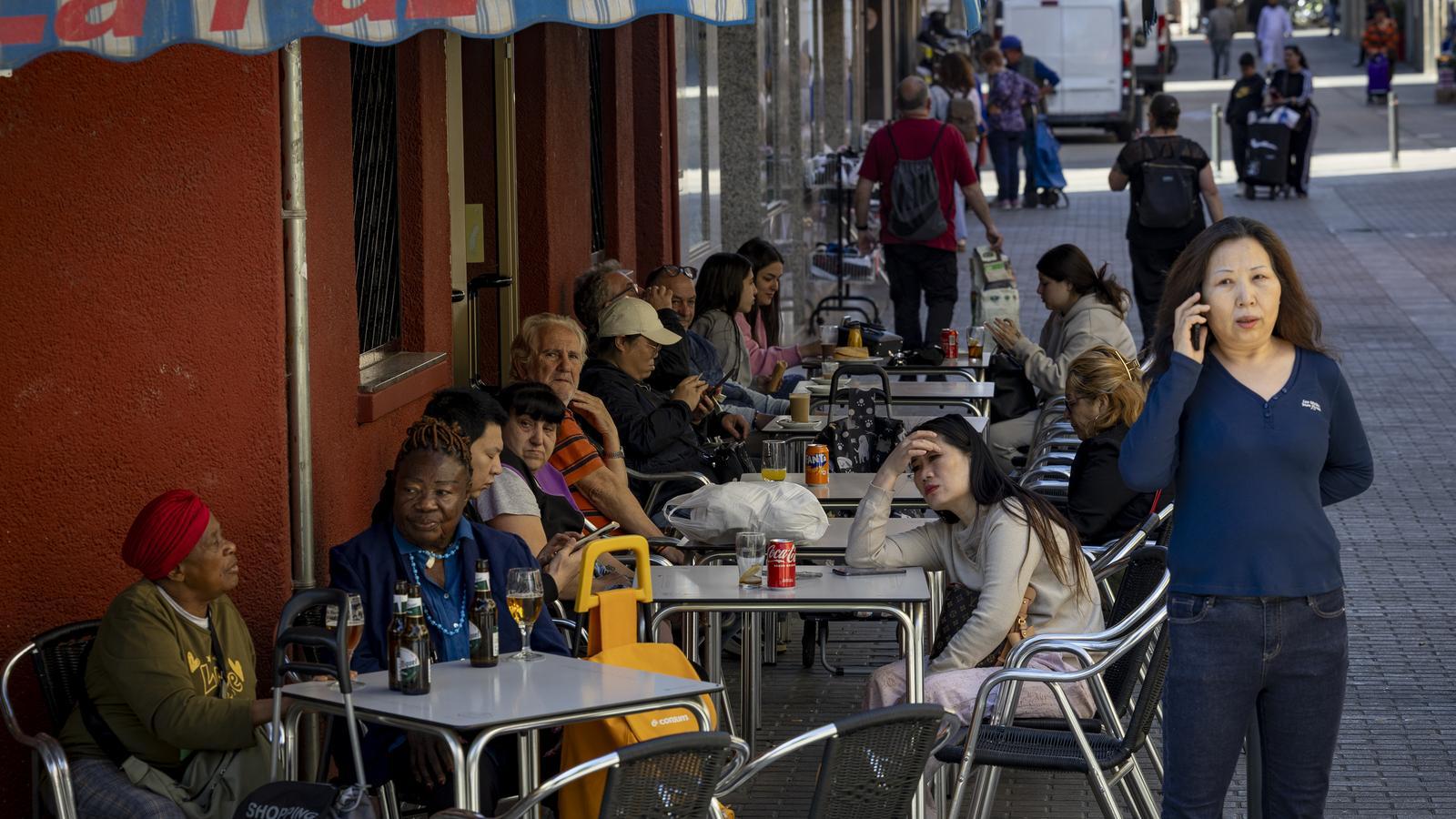
Barcelona8,233,788. These are the inhabitants of Catalonia as of this Thursday. Up to 72,150 more people than a year ago and 32,000 more than six months ago, according to the latest report prepared by the National Statistics Institute (INE). The annual growth of Catalan territory is around 1%, although the country's population would have a negative trend if it were not for the arrival of foreign people, a usual dynamic for years. Right now, there are 90,000 more foreign residents than a year ago. In total, there are 2.15 million people born outside the State, which accounts for 26.2% of the population. That is, one in every four inhabitants of Catalonia.
In the last decade, Catalonia has gained more than 780,000 inhabitants and now has 10.5% more population than in 2016. Pau Miret, a researcher at the Center for Demographic Studies of the UAB, explains that for approximately three years, birth rates in Catalonia have been below mortality rates. This implies that the current population growth is exclusively due to immigration.
INE data shows that the weight of the foreign population is even more pronounced in certain age groups. This is especially true in younger age brackets, as between the ages of 25 and 44, foreigners exceed 40% of the population. Specifically, among Catalans between 30 and 40 years old, the percentage of foreigners is close to 50%; almost one in two people are of this origin.
In this regard, Miret explains that migrations are deeply linked to the search for job opportunities, often related to sectors such as tourism, hospitality, or construction. These jobs, he adds, are usually precarious, with low wages and difficult hours that the native population often does not accept, creating a strong demand for foreign workers. Therefore, the profile of the foreigner who typically arrives in Catalonia is that of a young but adult man of working age.
Growth engine
What is clear is how many people arrive and register in the country, but Miret points out that it is more difficult to know how many Catalans have gone abroad to work, since they are only removed from the list if they register in another state. Catalonia is, in fact, one of the engines of growth for Spain. Miret links this to the search for job opportunities and also adds territories like the Balearic Islands and the Valencian Country to the same equation: "It is an absolutely economic migration, it is related to jobs that they do not find in their country and that are in demand here. Fundamentally, they find them in the tourism sector, which is what has held up the most after the crisis," comments the expert.
In fact, Miret speaks of a "migratory boom" for more than ten years, especially intense in the last three, the largest Spain has experienced. How long will it last? The researcher replies that not until there is a new economic recession that causes the labor supply to decrease and, therefore, also the number of foreigners who will come looking for opportunities.
Global growth
All Catalan demarcations have gained population. Barcelona's surpasses for the first time the figure of 6 million inhabitants, with 47,396 more residents than on July 1, 2025. The second demarcation in population volume is still Tarragona, with nearly 900,000 inhabitants, and it is, moreover, the one that has grown the most in percentage terms, 1.6% (14,112 more residents). Girona now has 840,086 (0.5% more) and Lleida registers 467,938, 1.3% more than a year ago.
Regarding the whole of the State, it already stands at 49.8 million inhabitants. Spain, therefore, is heading to reach 50 million residents. The population growth is also due to the increase in people born abroad, as the number of people born in the State is decreasing.
According to the INE, the main foreign nationalities during the second quarter of 2026 in the State were Colombian (with 34,000 arrivals), Venezuelan (23,300), and Moroccan (21,100). They are followed by Peruvian (16,800), Brazilian (8,300), Italian (7,600), Honduran (7,200), Pakistani (6,700), and Ukrainian (6,600). Regarding the leadership of Latin American nationalities, Miret explains that Spanish legislation favors the arrival and naturalization of people from these countries, which has caused this group to currently surpass North African immigration in volume. "A person who comes from Latin America needs two years, a person who comes from Africa needs 10 to be able to start the procedures," he assures.

Furthermore, in the second quarter of 2026, the population has grown in all autonomous communities. The Valencian Country (+0.43%) leads the ranking, followed by the Balearic Islands (+0.36%), the Principality of Asturias (+0.29%), and Murcia (+0.29%). Aragon (+0.28%), Castilla-La Mancha (+0.28%), and Catalonia (+0.27%) are also above the average population increase.
Furthermore, Spain is also growing in the European context. According to Eurostat data from 2025, the organization of the 27 grew by 0.16% while Spain grew by practically 1%. "Currently, in all countries, growth comes fundamentally from the migratory phenomenon," concludes Miret. According to data from 2024, also from Eurostat, Spain received 23% of the total immigrants who arrived in the EU, placing it in first position.
