Starting Monday, the Diagonal will have another bus crossing it. This is the X1 express line (Torre Melina - Glòries), which currently connects Francesc Macià and Glòries. Now, this line extends its route to reach the university area of the Diagonal, with a stop also at Maria Cristina. According to TMB, this change will improve urban connectivity, reinforcing intermodality and expanding public transport coverage. Since its launch, the demand for the line has not stopped increasing: if 1.2 million validations were recorded in 2024 (a figure representing a 31.65% increase compared to the previous year), nearly 1.13 million were counted in 2025.
The measures to ease the chaos of buses on the Diagonal fall short
The return to work and university highlights the need for new initiatives to minimize crowding in queues and on the road
19/09/2026 - 08:01 h

-
CAT -
CAST
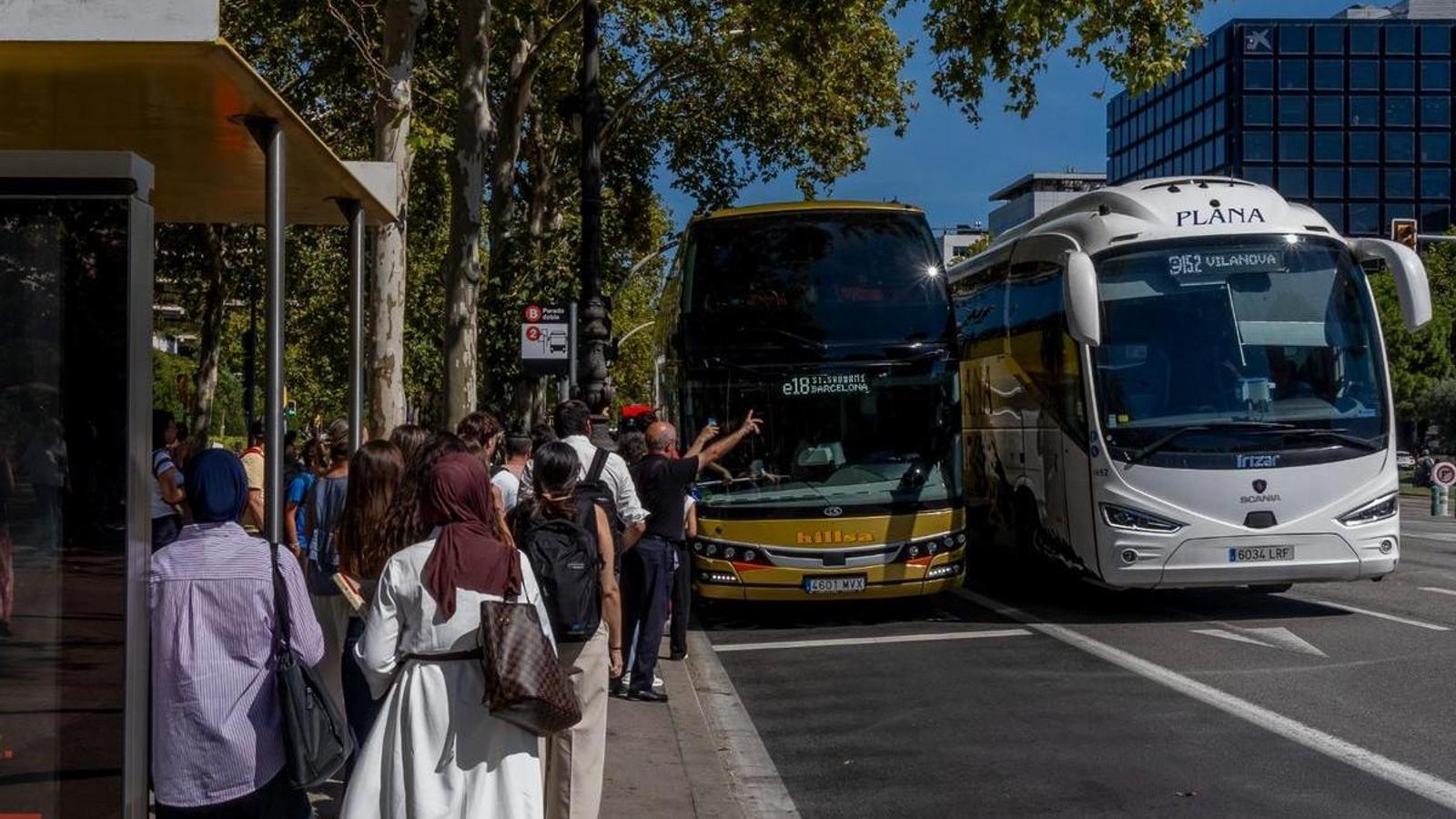
BarcelonaSeptember is back and, with it, the return to work, to university, and also commuting and traffic. And users of interurban buses – especially those entering and leaving through Barcelona's Diagonal – are already noticing it. In July, Barcelona City Council and the Department of Territory carried out a first attempt to organize the 1,800 buses that stop daily on this avenue by splitting the stops, which went from 13 to 23. But this easing has fallen short with the arrival of autumn.
This week, the queues of users waiting for the bus at the Maria Cristina stop were already far exceeding 400 people on the sidewalk during rush hour. The chaos of finding the correct line and the lack of knowledge among many passengers about the new bus stop plan were once again causing massive scurrying from one stop to another and the indignation of passengers after waiting for many minutes under an intense sun.
While a regular user spontaneously organizes the lines, Marta, who works in banking, explains the mess to ARA: "Every day I have to leave work early because the queues become miles long and if you don't arrive early, you don't get on the bus." Like her, Ares and Ernest, students, have been queuing for more than half an hour. "If you aren't a regular, it's very hard to understand how they work and which bus you have to take. Sometimes the lines of people end up merging and it's a show," these university students explain.
On the road, although the operators state that the situation "has improved a little" with the splitting of the stops, the situation is also complicated: buses in double rows, vehicles stopped far from the stop point, and others directly with the engine turned off waiting to fulfill the regulatory minutes to be able to leave again. Even several drivers have to perform maneuvers and reverse to fit into the stops and avoid saturating (even more) the traffic of this great Barcelona artery.

The operators value the administration's intention positively, but point out that the measures are insufficient. "It is evident, for example, that there is a need for a space where drivers can regulate [stop to comply with regulatory rest times and breaks], and this is still a pending issue, especially on the Diagonal", admits the president of the bus association Fecav, José María Chavarría, who acknowledges that there has been good coordination with the City Council and the Department of Territory, but stresses that "not everything is 100% ready".
Demand has doubled in just 5 years: it has gone from 50 million trips in 2021 to the almost 100 million expected this year. Every day, 1,800 buses stop on the Diagonal and, at peak hours, about 200 are concentrated there at once. "We have gone from 6,000 to 7,000 trips in less than two years, but with the same infrastructure. We are acting and improvising –in a positive way–, but a more solid foundation is needed, because we are building a giant with feet of clay", warns Chavarría.
Immediate solutions
Mobility experts from the Public Transport Promotion (PTP) association lament the treatment of users. "It seems as if the bus is a second-class transport," assesses Jordi Porta, spokesperson, who adds: "More comfortable waiting areas for users and drivers are needed, as well as excellent, real-time information." The PTP also views this first "phase 0" positively, but agrees that it is necessary to go further.
In the first instance, they demand that all these scattered stops be treated as real interchanges and that they be signposted from the metro to the pole of each stop. They also urge the completion of the double lane for buses – a fact that would allow them to overtake each other – and ask for the same to be done for all buses entering the city. "They have only made changes to the lanes leaving Barcelona and it is also very necessary for the ones entering, we do not understand why they haven't done it," questions Porta.
From the City Council and the Department of Territory, they remind that the measures taken so far are only "the initial phase" of a plan that must go much further and they value the changes "very positively." However, they do not specify with which measures or with what calendar they will continue.
From small changes to a great station
Once this first phase of reorganization is overcome, the PTP requests that, in the medium term, the possibility of bringing together the two inbound bus lanes, which currently run one through the center and the other along the side, in the central trunk of the Diagonal, next to the tram, be evaluated. They argue that this would save interference with cars turning right and would improve intermodality. "You could change from bus to tram without crossing streets or tracks. You could even build stairs in the central part to access the metro," suggests Porta. At points like Maria Cristina, they explain, a central platform for buses and trams could be created that would allow the bus capacity to be quadrupled. "Investment is needed, and it must be studied well, but we have already sent a conceptual proposal that we believe is viable," he says.
If this central platform were to go ahead –which could be built in three years, according to the PTP–, the sector would have some breathing room until the construction of the future underground bus station, the great dream of both operators and users. "The station could take between 15 and 20 years, we cannot hold out until then like this. That is why we think the double central inbound lane would be a boost," assesses Porta. "A great pact is needed, one that goes beyond different governments. Building strategic stations at Diagonal - Francesc Macià and also at the Meridiana and the Gran Via, south and north; and that requires having a plan," concludes Chavarría.
The X1 line reaches the university area
