The rescue in Urda approaches the end with some identifications of "enormous complexity"
Until now it has been possible to determine the identity of twelve of the 69 confirmed fatalities and five missing persons have been located alive

-
CAT -
CAST
BarcelonaThe rescue tasks for the Urda accident are facing their final stage. This Friday, the government of Castilla-La Mancha detailed that the work "is very advanced," but President Emiliano García-Page was clear: "We do not rule out that there may be more deaths," he admitted from Toledo. Although the toll of fatalities remains at 69 people, the number of reports for disappearances related to the accident that have not been resolved is 67. In fact, the Manchego president explained that work continues at the ground zero of the accident and lamented that there are about thirty bags "with partial remains" and that identifying them implies "enormous complexity."
Regarding those hospitalized for the accident, García-Page explained that the evolution of the situation is "notably positive": in Castilla-La Mancha, of the 110 injured who had initially been admitted to the hospital due to the accident, this Friday there are 39 left, 17 of whom remain in the ICU. Therefore, 71 injured have already been discharged and, according to the Manchego president, those admitted show a "reasonably positive" evolution. There has also been some positive news regarding the missing: among the 72 disappearances that had been reported, five people have been located alive. Among them are two people who are admitted to the hospital and a third who did not even board the train on the day of the accident.

In parallel, at the Forensic Institutes of Toledo and Ciudad Real, more than 60 professionals continue to work on the autopsies and identifications of the fatalities. According to the latest report from the Integrated Data Center (CID), all autopsies for the 69 recovered bodies have been completed, but the identification process is moving at a slower pace: so far, 27 identifications have been notified to the victims' families, 18 men and 9 women.
In this regard, it should be noted that, as experts explain, an autopsy usually lasts about two hours, and during this time the necessary information to identify the person is also extracted. Typically, the simplest way to determine a victim's identity is through fingerprints. In fact, for the moment, the twelve people identified have been identified using this technique by the Criminalistics Service of the Civil Guard.
Other ways to determine the victims' identities include their personal belongings—although, given the shock, it is likely they were no longer carrying them—DNA testing—there are several points where various citizens are providing samples to find their relatives—or by performing a dental identification.

Dogs and cranes on the ground
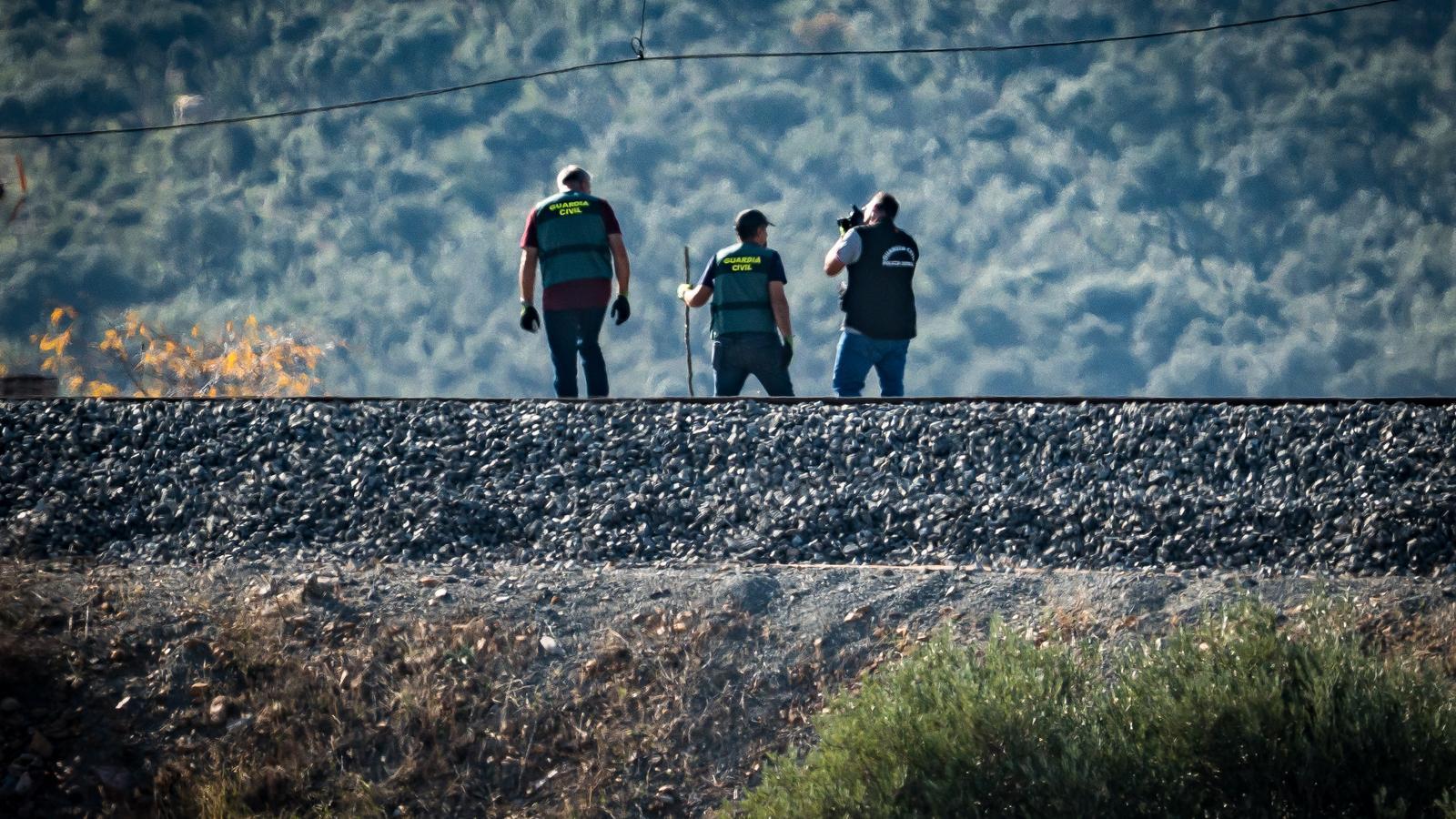
Meanwhile, at ground zero of the accident, tasks continue to inspect every corner of the terrain in search of victims and, also, evidence for the investigation of the incident. "The goal is to make sure that no one is left," insisted Civil Guard spokesperson Teresa Albacete this Friday, who explained that the canine unit had already traversed the terrain on Thursday, but that they would return to "comb the area." They are doing so with four canine handlers and four dogs in order to find biological remains or new missing persons.
Several cranes are also being used to move the damaged carriages. Regarding this part of the rescue tasks, García-Page explained that "fortunately," when emergency services overturned one of the damaged carriages, they did not find any fatalities underneath. Given the advanced state of the rescues, the emergency status has been downgraded to level 1, and this, as the Manchego leader detailed, means that "many resources" that have already completed their work will be demobilized. Therefore, only the units in charge of judicial and surveillance tasks will remain on the ground.
